
Enterprise SEO for AI-Search Era: Effective Strategies
Explore enterprise SEO strategies, operating models, and managed search functions in the evolving AI-search landscape for large organizations.
Introduction to Enterprise SEO in the AI-Search Era
SEO for enterprise has evolved from a specialized technical discipline into a cross-functional operating model that touches strategy, content, conversion, and analytics. Where five years ago an SEO team might have focused on keyword rankings and backlinks, today's enterprise search function must manage AI citation visibility, structured data pipelines, content architecture at scale, and integration with business intelligence systems. The job description for a modern SEO lead often spans eight distinct operating disciplines, from technical search and entity intelligence to conversion paths and AI tooling.
This shift reflects a fundamental change in how search engines work. AI-driven platforms like ChatGPT, Perplexity, and Google's Search Generative Experience do not simply rank pages — they synthesize answers from multiple sources, cite entities, and surface content based on semantic relevance and machine-readable signals. For large organizations managing thousands of pages, multiple brands, or complex product catalogs, this means SEO for enterprise strategy must now account for how AI models parse, understand, and reference their content.
The stakes are higher because the definition of success has changed. Organic visibility is no longer considered successful merely because rankings improve; the objective is qualified consultations, signed contracts, and measurable pipeline contribution. Best practices for deploying AI web apps apply equally to search infrastructure — technical debt, indexability failures, and content fragmentation all prevent AI systems from surfacing your brand when prospects search for solutions you provide.
Many enterprises are discovering that their existing SEO operating model cannot scale to meet AI-search demands. Companies post roles asking one person to own a search stack, content system, technical roadmap, AI visibility program, conversion layer, and executive reporting cadence. That breadth signals a structural problem: the work has outgrown the traditional in-house SEO team, but leadership has not yet recognized that some capabilities belong with software, some with managed services, and only a subset with a full-time employee.
This guide walks through what enterprise SEO means in the AI-search era, why it matters now more than ever, how to implement strategies that align technical execution with business outcomes, and where organizations commonly fail. The goal is not to provide a checklist of tactics, but to show you how to think about search as a managed function that integrates with your broader go-to-market system.
SEO for enterprise demands integrated strategies spanning technical search, AI citation visibility, and content operations in the AI-search era.
SEO for enterprise demands integrated strategies spanning technical search, AI citation visibility, and content operations in the AI-search era.
What is Enterprise SEO?
SEO for enterprise is the practice of optimizing large-scale websites — typically 10,000+ pages across multiple domains, subdomains, or international markets — to improve organic search visibility, AI citation presence, and business outcomes. Unlike small-site SEO, which a single practitioner can manage manually, enterprise SEO requires automated systems, cross-functional governance, and technical infrastructure that coordinates marketing, IT, legal, and product teams.
At enterprise scale, SEO is not a project but a managed function. Organizations must maintain formal workflows for content publication, structured approval chains for technical changes, and automated quality controls that smaller operations handle manually. The technical stack differs too: enterprise platforms require custom integrations, API-driven content management, and monitoring systems that catch errors before they propagate across thousands of URLs.
Why SEO for Enterprise Matters in the AI-Search Era
Large organizations face a compounding problem: the search landscape is shifting toward AI-generated overviews and conversational interfaces at the same moment that internal SEO responsibilities are fragmenting across teams. What used to be a technical SEO function now spans content operations, structured data, AI citation visibility, conversion optimization, and executive reporting. The stakes are higher because the margin for error is smaller — a single indexability issue or a misaligned content architecture can suppress visibility across thousands of pages.
The Expanded Scope of Enterprise Search Functions
Modern search roles increasingly combine eight operating disciplines: SEO strategy and technical search; AEO / GEO / AI citation visibility; keyword, entity, and intent intelligence; content architecture and managed production; structured data and machine-readable content; conversion paths and CRO; reporting, share of voice, and pipeline measurement; and AI tooling and agents. Companies are posting SEO/GEO roles that ask one person to own a search stack, content system, technical roadmap, AI visibility program, conversion layer, and executive reporting cadence. That scope reflects the real operational burden, but it also signals that SEO for enterprise is no longer a specialist function — it is a cross-functional capability that touches product, engineering, content, and analytics.
AI Integration and the Quality Signal Shift
AI is integrated into Search and affects how search functions and the quality of clicks from search results pages with AI Overviews. Google has observed that clicks from AI Overview results tend to be higher quality, meaning users are more likely to spend meaningful time on the destination page. This changes the success metric: raw traffic volume matters less than whether the traffic converts into qualified actions. For enterprises, this means SEO is not considered successful merely because rankings improve — the objective is qualified consultations, signed contracts, or measurable pipeline contribution.
In the evolving AI-search landscape, SEO for enterprise strategies must adapt to ensure that technical issues like indexability are addressed to maintain organic visibility. A 403 exclusion in Search Console or a self-canonical conflict can block an entire product line from AI-generated citations, and the resolution path often requires coordination across engineering, CDN configuration, and content operations. The complexity is structural, not tactical.
Modern search roles increasingly combine SEO, AI-search visibility, content operations, technical implementation, conversion, analytics, and automation.
Why Enterprise Scale Amplifies Risk and Opportunity
At enterprise scale, small inefficiencies compound. A poorly structured taxonomy can create thousands of near-duplicate pages. A missing structured data layer can suppress rich results across an entire category. A misaligned content approval workflow can delay publication by weeks, eroding relevance. Conversely, a well-architected content system with machine-readable markup and clean internal linking can lift visibility across the entire domain when AI systems parse and cite it.
The organizations that treat SEO as a managed function — with defined ownership, repeatable processes, and integrated tooling — are better positioned to compete in an environment where AI systems reward clarity, structure, and authority. The ones that treat it as a tactical marketing channel will struggle to coordinate the cross-functional work required to stay visible. For more on deploying AI-driven systems that support enterprise operations, see Best Practices for Deploying AI Web Apps.
How to Implement SEO for Enterprise Strategies
Building an enterprise SEO function is not a plug-and-play operation. Large organizations face distributed ownership, legacy technical debt, and competing priorities across product, engineering, and marketing teams. The implementation path depends on your current search footprint, execution capacity, and whether you need an internal hire, a managed partner, or a hybrid structure.
Assess Your Current Search Footprint and Execution Burden
Before you hire anyone or sign a contract, catalog what you already own. Map every domain, subdomain, and subdirectory that touches your brand. Identify which teams control DNS, CMS access, and deployment pipelines. Document your technical stack: content management systems, CDN configurations, JavaScript frameworks, and any middleware that sits between your content and Googlebot.
Companies should assess their existing search footprint and execution burden to determine whether they need an internal hire, a managed partner, or a hybrid structure for SEO. If your organization has dozens of microsites, multiple CMSs, and no central authority over robots.txt or canonicalization, you are not ready to execute strategy — you are ready to audit and consolidate.
Define the Operating Disciplines You Need
Modern search roles increasingly combine SEO strategy and technical search, AI citation visibility (AEO / GEO), keyword and intent intelligence, content architecture and managed production, structured data and machine-readable content, conversion paths and CRO, reporting and share of voice measurement, and AI tooling or agent integration. Not every organization needs all eight disciplines at once, but you should know which ones matter for your business model.
If you sell through a complex B2B funnel with long consideration cycles, your priority is intent intelligence and conversion path optimization. If you operate a high-volume transactional site, technical search and structured data become load-bearing. If your brand competes in AI Overviews or citation-driven results, GEO and entity optimization move to the top of the list.
Step 1
Map disciplines to business outcomes
List the search outcomes you need: organic traffic growth, AI citation visibility, conversion rate improvement, or competitive share of voice. Then map each outcome to the disciplines that drive it. This becomes your hiring brief or your managed-service scope.
Decide Between Internal, Managed, or Hybrid Execution
Deciding to hire a company or person to do search engine optimization for your website is a big decision that can potentially improve your site's visibility and save you time. The choice depends on execution velocity, technical complexity, and how much control you need over day-to-day operations.
An internal hire makes sense when you have ongoing technical debt, need tight integration with engineering sprints, or want someone embedded in product roadmaps. A managed partner works when you need specialized expertise (international SEO, programmatic content, AI-search optimization) that does not justify a full-time role. A hybrid structure — an internal strategist paired with a managed execution team — often delivers the best of both: strategic alignment with operational scale.
| Model | Best For | Trade-Off |
|---|---|---|
| Internal hire | Ongoing technical debt, product integration | Slower to scale, single point of failure |
| Managed partner | Specialized expertise, variable workload | Less day-to-day control, vendor dependency |
| Hybrid (internal + managed) | Strategic alignment with execution scale | Coordination overhead, clear role boundaries required |
Establish Crawl and Indexation Governance
To manage how your site is crawled by Google, use robots.txt directives and ensure that your preview control is correct and visible to Googlebot. Large organizations often have multiple teams deploying robots.txt rules, meta robots tags, and canonical directives without a central review process. The result: accidental noindex tags on revenue-driving pages, orphaned sitemaps, and crawl budget wasted on staging environments.
Set up a governance model where every robots.txt change, every noindex directive, and every canonical update goes through a review queue. Use Search Console to monitor crawl stats, index coverage, and any unexpected drops in indexed URLs. If you see a sudden decline in indexed pages, you likely have a technical conflict — a new deployment that introduced a noindex tag, a CDN rule that blocks Googlebot, or a CMS update that broke your XML sitemaps.
Align SEO with AI-Search Visibility Requirements
Google's AI Overviews and AI Mode do not require special optimization beyond standard search essentials. To be eligible to be shown as a supporting link in AI Overviews or AI Mode, a page must be indexed and eligible to be shown in Google Search with a snippet. That means your existing SEO foundation — crawlability, indexability, structured content, and clear entity signals — directly determines your AI-search visibility.
If your pages are not showing snippets in traditional search results, they will not appear in AI-generated answers. Focus on the fundamentals: ensure Googlebot can access your content, your pages return clean HTML with semantic markup, and your schema.org structured data accurately represents entities, relationships, and intent. For more on deploying AI-driven systems that integrate with search functions, see best practices for deploying AI web apps.
AI-search eligibility is not a new optimization layer — it is a test of whether your existing SEO foundation is machine-readable and semantically coherent.
Build Reporting That Tracks Business Outcomes, Not Vanity Metrics
Enterprise SEO reporting should connect search performance to revenue, pipeline, or customer acquisition cost. Track organic traffic by intent segment (informational, commercial, transactional), measure conversion rates by landing page template, and calculate the incremental value of ranking improvements in high-value keyword clusters.
If you only report on rankings and traffic, you cannot defend budget when leadership asks whether SEO is worth the investment. Build dashboards that show how organic search contributes to customer lifetime value, how AI-search citations influence brand consideration, and how share of voice in your category correlates with deal velocity. Use attribution models that account for multi-touch journeys, and segment your data by business unit, product line, or geographic market.
Best Practices for SEO for Enterprise
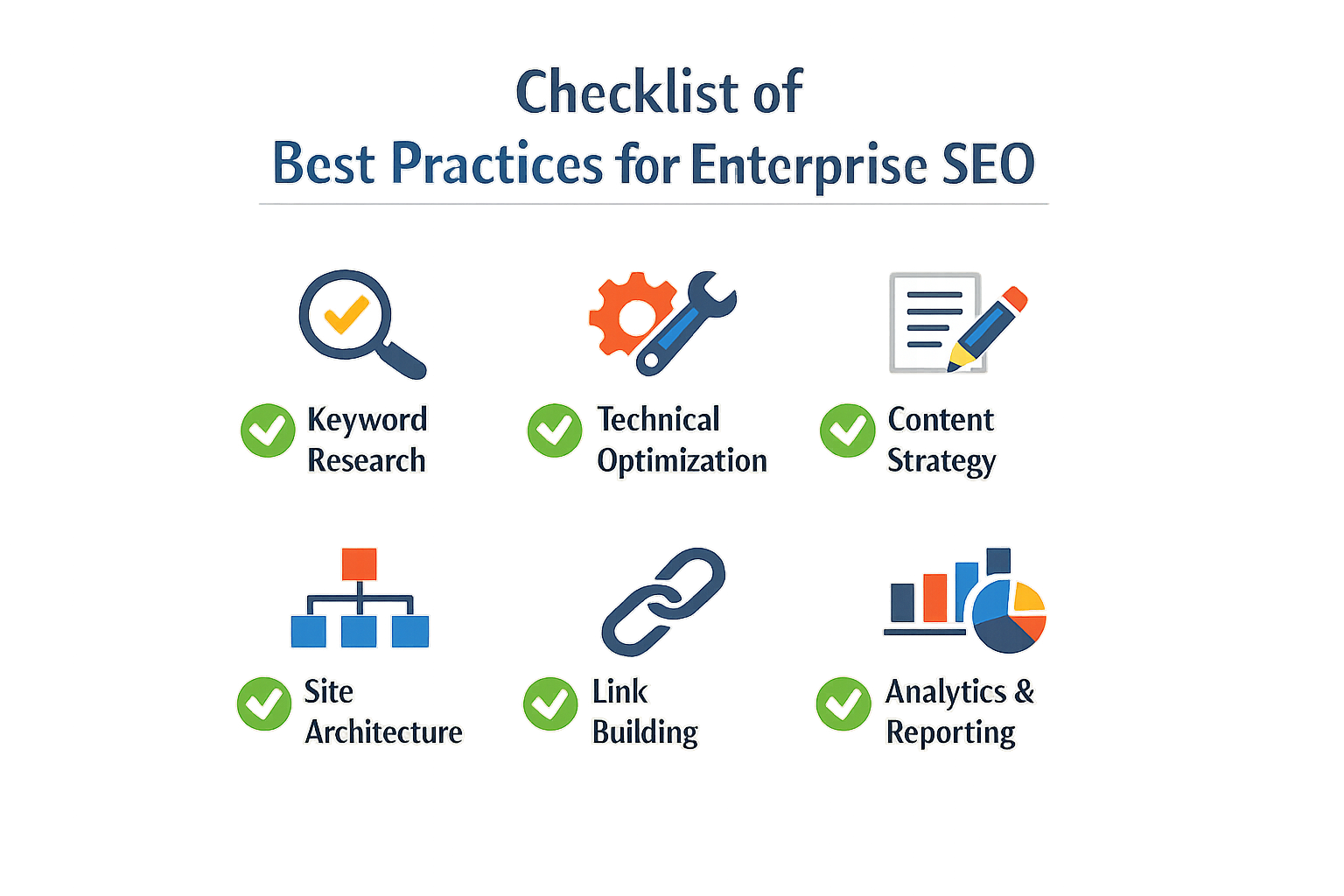
Enterprise SEO success depends on execution discipline across hundreds or thousands of pages. The practices that work at scale are not the same ones that work for a twenty-page marketing site — large organizations need repeatable systems, technical rigor, and clear ownership. The best practices below reflect what survives contact with real enterprise constraints: multiple stakeholders, legacy platforms, and the need to demonstrate measurable business outcomes.
Focus on Technical Foundations Before Content Expansion
Before publishing new content at scale, resolve indexability and crawl issues. Publication should be contingent on confirming that Search Console shows no 403 exclusions and that product and case-study routes are self-canonical and indexable. Pushing content onto a site with unresolved technical debt wastes effort — search engines cannot surface pages they cannot crawl or index reliably.
Structured data deployment follows the same principle: completeness beats coverage. It is more important to supply fewer but complete and accurate recommended properties rather than trying to provide every possible recommended property. A fully populated Product schema on ten pages outperforms partially populated schema on a hundred pages.
Establish Clear Ownership and Accountability
Enterprise SEO fails when no one owns outcomes. Assign a dedicated team or individual responsible for organic search performance, with authority to coordinate across engineering, content, and product. This owner should have read access to Search Console, analytics, and deployment logs, and should be the single point of contact for SEO-related decisions.
When hiring external SEO support, vet carefully. Deciding to hire a company or person to do search engine optimization for your website is a big decision that can potentially improve your site's visibility and save you time. Ask for business references, review past client outcomes, and grant only read access to Search Console during the evaluation phase.
Prioritize Quality Over Volume in Content and Metadata
Large sites often default to automation for metadata and internal linking, but automation without quality control creates noise. Write unique, descriptive title tags and meta descriptions for high-value pages manually. For long-tail pages, use templates that pull from structured fields — but audit a sample regularly to catch edge cases where the template fails.
Internal linking should follow a hub-and-spoke model: pillar pages link to related subtopics, and subtopics link back to the pillar. Avoid link schemes that exist only to manipulate rankings. Instead, link when the connection genuinely helps a reader understand context or find the next logical step. For organizations looking to integrate best practices across technical and content operations, Best Practices for Deploying AI Web Apps offers a complementary perspective on managing complex deployments.
Monitor, Measure, and Iterate
Set up automated monitoring for core metrics: organic traffic by template type, indexation coverage, crawl errors, and Core Web Vitals. Review these weekly, not monthly — enterprise sites change frequently, and small regressions compound quickly. Use Search Console's URL Inspection tool to validate that high-priority pages render correctly and match the live version.
Test changes on a subset of pages before rolling them out site-wide. If you change a template that affects ten thousand pages, deploy it to one hundred first and measure the impact over two weeks. This reduces risk and makes it easier to isolate the cause of any performance shift.
The best enterprise SEO practice is the one you can execute consistently across every relevant page without manual intervention.
Common Mistakes in SEO for Enterprise
Enterprise organizations often stumble over the same obstacles when scaling SEO programs. These pitfalls typically stem from treating SEO as a technical checklist rather than a continuous operating function, or from organizational silos that fragment what should be a unified search strategy.
Understanding where other large organizations fail helps you design processes that avoid the same traps. The mistakes below appear repeatedly across industries and company sizes.
Hiring Without Proper Vetting
Deciding to hire a company or person to do search engine optimization for your website is a big decision that can potentially improve your site's visibility and save you time, but you can also risk damage to your site and reputation. Many enterprises skip rigorous reference checks or fail to ask candidates for concrete examples of past work. A qualified SEO should be genuinely interested in your business and ask questions about what makes it unique, rather than pitching a one-size-fits-all package.
Ask for business references from past clients. Verify that those clients felt the SEO provided useful service, was easy to work with, and produced positive results. If an SEO offers to do an audit, carefully consider what's involved and only grant read access to Search Console at the initial stage.
Siloed Teams and Fragmented Ownership
When product, engineering, content, and marketing teams operate independently, SEO requirements fall through the cracks. A product team may ship a site redesign that breaks URL structures because no one flagged the SEO impact during sprint planning. Content teams publish without metadata because no shared workflow enforces it.
The fix is cross-functional governance: a standing SEO council that reviews roadmaps, a shared taxonomy and metadata schema, and documented handoff points where SEO review is mandatory. Without these structures, you end up with localized fixes that never scale.
Treating SEO as a One-Time Project
SEO is not a launch checklist. Enterprises that audit once, implement fixes, and then move on see rankings decay as competitors iterate and search engines evolve. Algorithms change, user behavior shifts, and content ages. A static approach guarantees obsolescence.
Successful programs treat SEO for enterprise as continuous operations: regular audits, ongoing content refresh cycles, performance monitoring with defined SLAs, and quarterly strategy reviews. Build these rhythms into your operating model from the start.
Ignoring Technical Debt at Scale
A single misconfigured canonical tag can remove thousands of pages from the index overnight when your CMS templates propagate it across domains.
Small technical errors compound at enterprise scale. Enterprises often defer technical SEO work because it requires engineering resources and delivers no immediate feature value. But crawl inefficiencies, duplicate content from staging environments leaking into production, or broken structured data markup erode visibility across entire site sections.
Prioritize technical health alongside feature development. Allocate dedicated engineering capacity to SEO infrastructure, and instrument monitoring so you catch regressions before they cost you traffic.
Over-Optimizing for Legacy Metrics
Many organizations still chase keyword rankings and raw organic session counts without tying them to business outcomes. You can rank for hundreds of terms that generate zero qualified leads. Focusing exclusively on traffic volume leads to content strategies that attract the wrong audience.
Align SEO KPIs with revenue metrics: conversion rates from organic traffic, customer acquisition cost, lifetime value of organic cohorts, and pipeline contribution. When SEO teams report in the same language as finance and sales, they earn budget and executive attention.
Neglecting Cross-Channel Integration
SEO does not exist in isolation. Enterprises that run SEO, paid search, social, and email as separate programs miss opportunities for reinforcement. Paid search data reveals high-intent queries that should inform organic content priorities. Email nurture sequences can drive engagement signals that strengthen page authority.
For insights on deploying integrated digital strategies, see Best Practices for Deploying AI Web Apps.
Build shared reporting dashboards, run joint planning sessions, and create workflows where channel teams exchange insights regularly. The goal is a unified search presence, not a collection of independent tactics.
Frequently asked questions
What makes SEO for enterprise different from traditional SEO?
SEO for enterprise operates at a scale and complexity that changes the fundamentals. Where a small site might manage a few hundred pages, enterprise sites coordinate tens of thousands of URLs across multiple domains, subdomains, and international markets. The difference shows up in governance: enterprises need formal workflows for content publication, structured approval chains for technical changes, and cross-functional coordination between marketing, IT, legal, and product teams. The technical stack is different too — enterprise platforms require custom integrations, API-driven content management, and automated quality controls that smaller operations handle manually.
How do you measure ROI for SEO for enterprise initiatives?
ROI measurement in SEO for enterprise starts with attributing organic traffic to specific business outcomes: lead generation, pipeline value, e-commerce revenue, or customer acquisition cost reduction. Enterprises typically track share of voice across strategic keyword clusters, monitoring how visibility shifts relative to competitors over quarterly periods. The measurement framework connects search performance to downstream conversion events through multi-touch attribution models, accounting for the reality that enterprise buyers rarely convert on first visit. Reporting structures separate brand from non-brand traffic, isolate the impact of technical improvements from content initiatives, and benchmark performance against the cost of equivalent paid-search coverage.
When should an enterprise hire an external SEO agency versus building an in-house team?
The decision hinges on capability gaps and operational capacity. Enterprises hire external help when they lack specialized expertise in areas like international SEO, technical migrations, or AI-search optimization — skills that are expensive to maintain full-time for intermittent needs. Agencies also make sense during high-stakes projects with fixed timelines: site redesigns, platform migrations, or market expansions where failure costs exceed agency fees. In-house teams own the ongoing operational work — content production, technical maintenance, cross-functional coordination, and institutional knowledge that cannot be outsourced without losing strategic control. Many enterprises run a hybrid model: in-house leadership setting strategy and managing execution, with agencies providing surge capacity and specialist skills.
What role does AI play in modern SEO for enterprise?
AI search engines like ChatGPT, Perplexity, and Google's AI Overviews change how enterprises approach visibility. Traditional SEO optimized for ten blue links; AI-search optimization (often called GEO or AEO) optimizes for citation in generated answers. Modern search roles increasingly combine SEO, AI-search visibility, content operations, technical implementation, conversion, analytics, and automation. Enterprises adapt by structuring content to answer questions directly, implementing schema markup that machines parse easily, and tracking whether their brand appears in AI-generated responses to strategic queries. The shift does not replace traditional SEO — organic listings still drive traffic — but it adds a parallel discipline focused on being the source AI systems cite.
How often should SEO for enterprise strategies be updated?
Strategic reviews happen quarterly; tactical adjustments happen continuously. Quarterly reviews assess whether keyword priorities still align with business goals, whether technical debt has accumulated to the point of requiring remediation, and whether competitive dynamics have shifted enough to warrant repositioning. Monthly operational reviews track performance against targets and surface emerging issues before they compound. Tactical work — content updates, technical fixes, schema additions — runs on an ongoing cycle managed through sprint planning or ticket queues. Major strategic pivots typically align with annual planning cycles, but enterprises that wait a full year to reassess their search strategy often find themselves reacting to changes competitors spotted months earlier.
What are the biggest challenges enterprises face with technical SEO at scale?
The central challenge is maintaining consistency across systems that were never designed to coordinate. Enterprises run multiple CMSs, each with different URL structures, metadata conventions, and publishing workflows. A single technical change — migrating to HTTPS, implementing hreflang tags, or updating structured data — requires coordination across IT, development, marketing, and sometimes legal teams, each operating on different timelines and priorities. At scale, small errors multiply: a misconfigured robots.txt rule can block thousands of pages, a broken canonical tag can create massive duplicate content issues, and a poorly planned redirect chain can degrade crawl efficiency across entire site sections. Enterprises that succeed build automated monitoring to catch errors before they propagate and establish governance frameworks that prevent unauthorized changes from reaching production.
How do you handle SEO for multiple brands or business units within one enterprise?
Multi-brand enterprises choose between centralized and federated operating models. Centralized models pool SEO resources into a shared services team that supports all brands, ensuring consistent standards and efficient use of specialist skills. Federated models embed SEO practitioners within each business unit, allowing closer alignment with brand-specific goals but risking duplication of effort and inconsistent execution. Hybrid models are common: a central team owns platform-level technical SEO, sets governance standards, and provides specialized capabilities (international SEO, migrations, AI-search strategy), while embedded practitioners handle brand-specific content and local optimization. The key is defining clear ownership: who approves technical changes that affect multiple brands, who resolves conflicts when two business units target the same keywords, and who allocates shared resources when priorities compete. For more on deploying AI-driven capabilities across complex organizational structures, see Best Practices for Deploying AI Web Apps.
Conclusion: The Future of SEO for Enterprise in an AI-Driven World
SEO for enterprise is no longer a single discipline owned by a single team. It is a managed search function that spans technical implementation, content operations, AI visibility, structured data, conversion optimization, and executive reporting. Organizations that treat it as a checklist will fall behind those that build it as an integrated capability.
The AI-search era does not replace the fundamentals — it raises the bar. Pages must still be indexed, crawlable, and eligible to appear in search with a snippet to qualify for AI Overviews or AI Mode. But the work now extends into entity modeling, answer-box optimization, machine-readable content, and the orchestration of content at scale. Companies are posting roles that ask one person to own a search stack, content system, technical roadmap, AI visibility program, conversion layer, and executive reporting cadence — a scope that reflects the real complexity of the function.
The Operating Model Matters
The question is not whether to invest in SEO for enterprise, but how to structure the capability. Centralized models give you consistency and shared infrastructure. Federated models give you speed and local accountability. Hybrid models balance both, but require clear governance and tooling to prevent drift. The model you choose should reflect your organization's structure, risk tolerance, and ability to enforce standards across business units.
AI integration in search affects not just visibility, but the quality of engagement. Clicks from search results pages with AI Overviews tend to be higher intent, meaning the traffic that arrives is more likely to convert. That makes the stakes higher for technical errors, content gaps, and structural inconsistencies that prevent pages from qualifying.
What Comes Next
The enterprise SEO function will continue to absorb adjacent capabilities — content intelligence, schema automation, AI agent optimization, and real-time reporting. The teams that succeed will be those that stop treating SEO as a project and start operating it as a managed service with defined SLAs, clear ownership, and continuous improvement cycles. For organizations ready to take that step, best practices for deploying AI web apps can inform how technical and content systems integrate at scale.
The future belongs to organizations that build search visibility into their operating model, not those that bolt it on after launch.
Related reading
Programmatic SEO Examples: Templated Pages and Content Abuse
Content Audit: Content Refresh - How to Decide What to Keep, Update
Sources(12)
- Google Search Central documentation
- Google Search Central — Local business (LocalBusiness) structured data
- Google Business Profile guidelines
- Google Search Central documentation
- Google Search Central documentation
- Google Search Central documentation
- Google Search Central documentation
- google-search-essentials (source_extract)
- Introductions – The Writing Center
- google-search-central (source_extract)
- google-search-central (source_extract)
- google-search-central (source_extract)
Written by
Xenophon Giannis
Published October 18, 2026 · 23 min read
Xenophon Giannis is the founder and CEO of Xenco Labs, where he designs, builds, deploys and operates production AI software solo — on his own multi-node cluster, with his own LLM gateway and automation infrastructure. Twenty-five years in enterprise technology came first: a decade at AboveNet, hired as its first sales rep after bankruptcy and promoted until he ran the entire Western Pacific region, then sales leadership at Black Lotus and Nexusguard in DDoS mitigation. He writes about what he actually ships, and what actually breaks in production.
You Might Also Like
More from the Xenco Labs blog

Lead Generation for IT Companies: Enterprise Strategies
Learn effective lead generation for IT companies and infrastructure strategies, turning search demand into a strong sales pipeline.
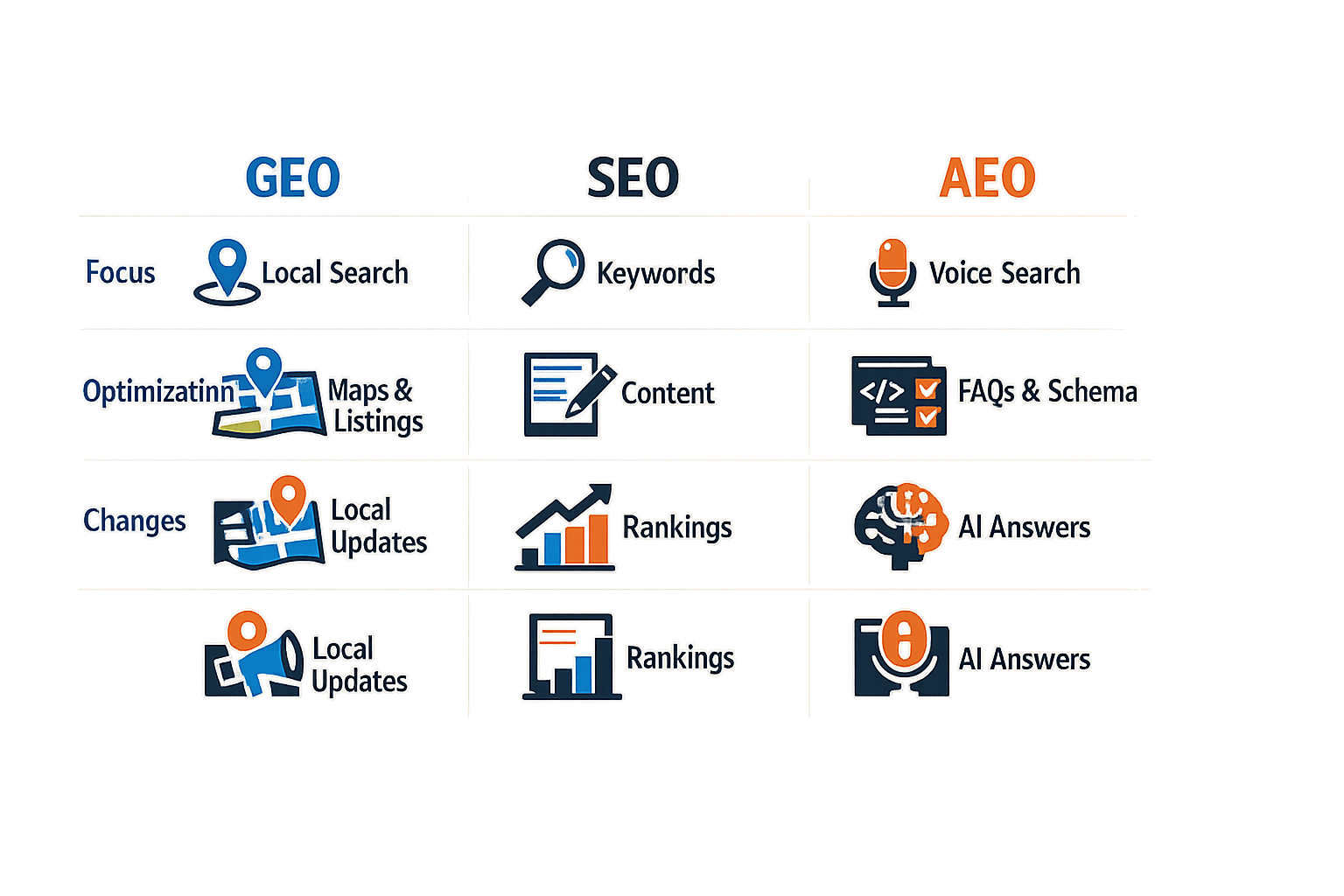
Geo vs SEO: AEO vs SEO: Key Changes for Search Teams (+ GEO Explained)
Explore the differences between AEO vs SEO and GEO, and understand what changes for search teams and what remains the same in modern search optimization. Learn about geo

SEO Manager Job Description: In-House vs Agency
Explore in-house SEO vs agency options through the SEO Manager job description, covering key responsibilities and when each approach fits your organization.
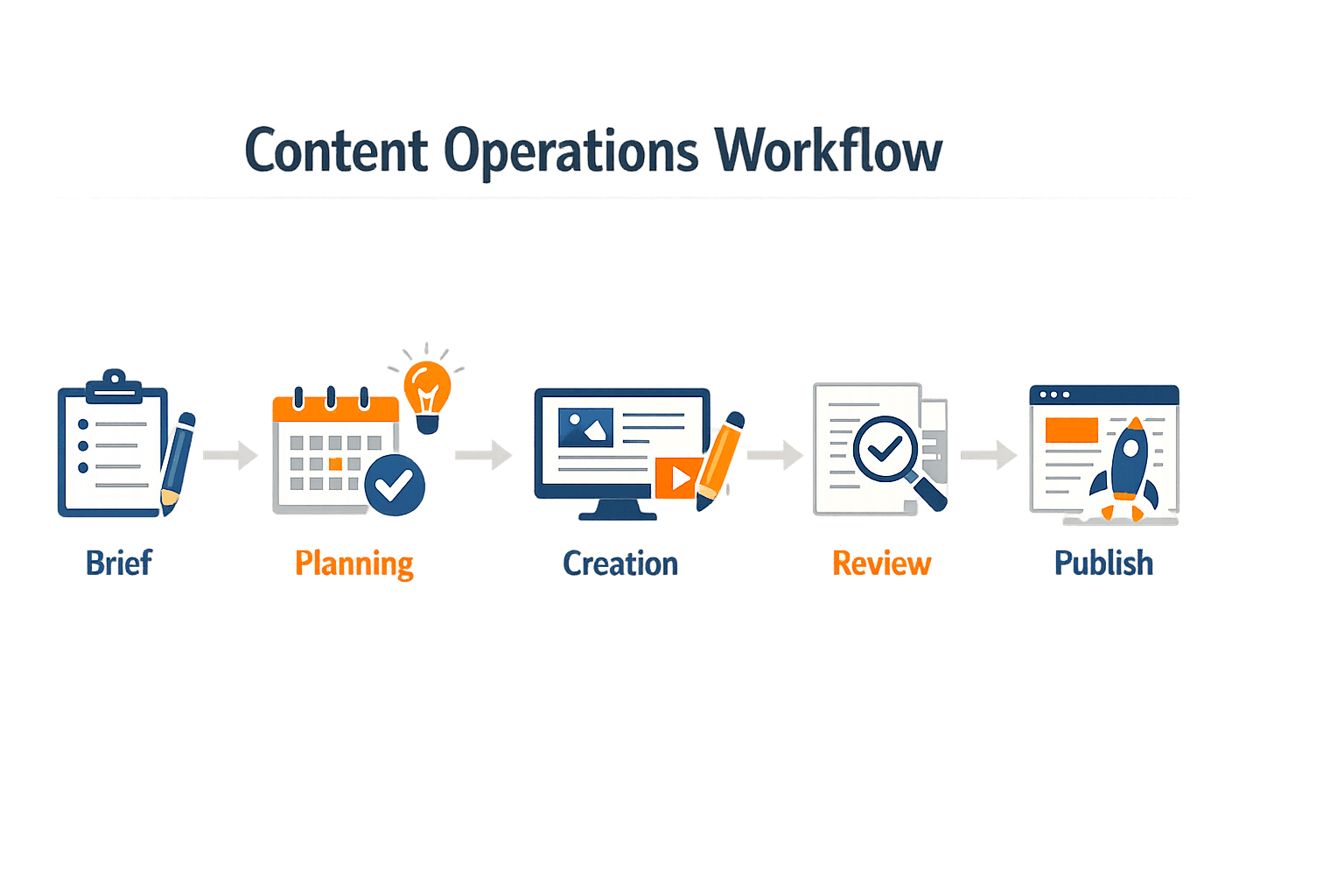
SEO Content Brief to Published Page: Content Operations Workflow
Explore the content operations workflow from seo content brief to published page, ensuring efficiency and quality at every stage.