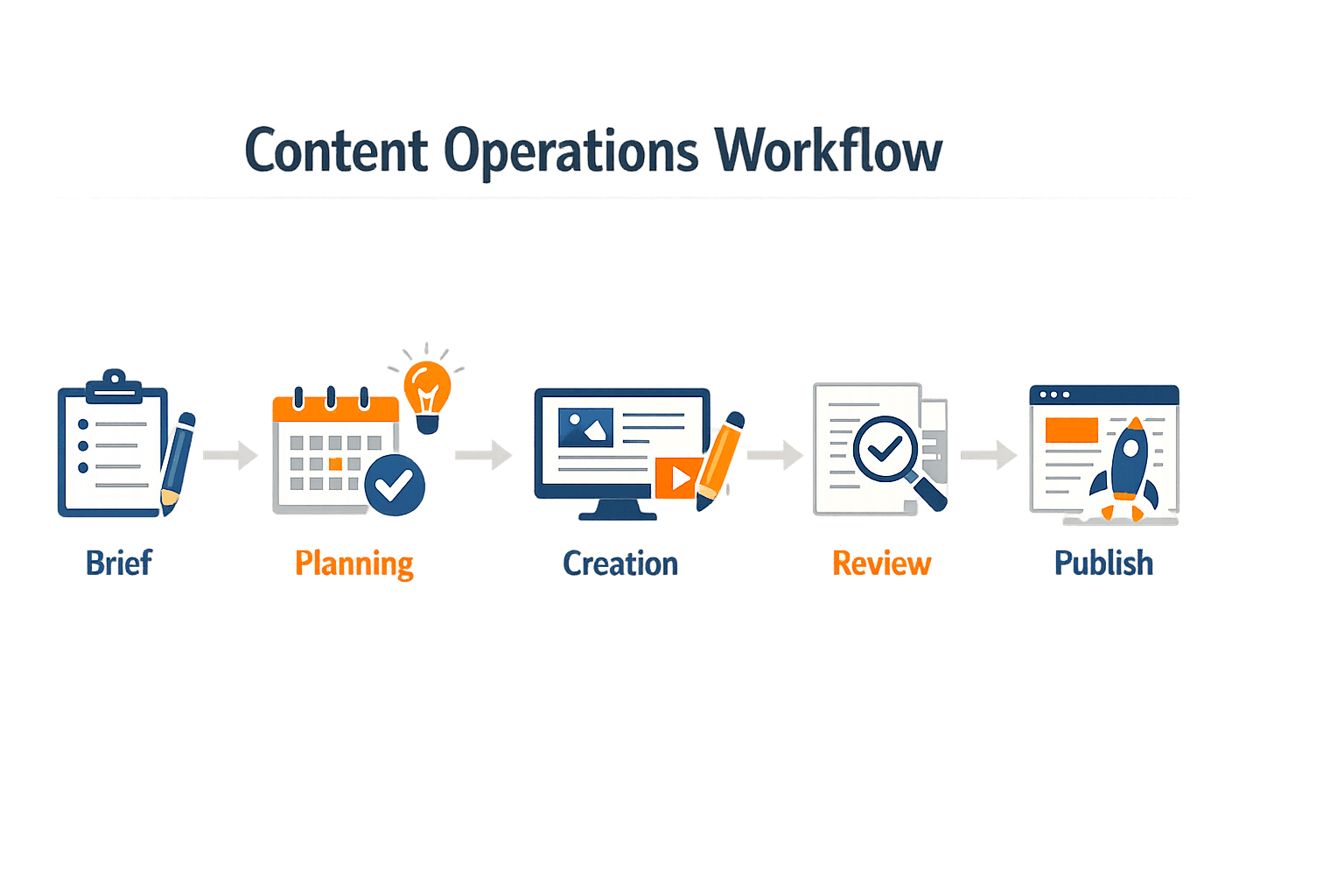
SEO Content Brief to Published Page: Content Operations Workflow
Explore the content operations workflow from seo content brief to published page, ensuring efficiency and quality at every stage.
Introduction
Content operations is the system that takes an SEO content brief from initial concept to a live, validated page on your site. At Xenco Labs, our work with local service businesses and technology companies has shown us that content operations is not just about creating content — it's about building a seamless workflow that ensures every piece meets strategic goals and quality standards. Without a defined process, content production becomes a series of one-off efforts: briefs sit in limbo, drafts miss the mark, and published pages fail to deliver the results the business needs.
The workflow from brief to publication involves distinct stages: brief creation that defines scope and SEO requirements, drafting that adheres to the brief's specifications, review cycles that catch errors and alignment issues, and publication steps that include technical validation and post-launch checks. Each stage requires clear ownership, documented standards, and handoff protocols. When one stage breaks down — a vague brief, an unreviewed draft, or a publish step that skips validation — the entire pipeline stalls or delivers substandard work.
Google's guidance on creating helpful content reinforces the operational need for process discipline. Content should demonstrate first-hand expertise, serve an existing or intended audience, and provide substantial value beyond what already exists. Meeting these criteria consistently requires an operational framework, not ad hoc execution. A well-constructed SEO content brief acts as the contract between strategy and execution, specifying audience, keyword targets, structural requirements, and quality benchmarks.
The sections that follow break down the common failure points in content operations, then walk through the solution steps and optimization tactics that turn a fragile process into a reliable system. Our focus is on making the workflow from SEO content brief to published page repeatable, measurable, and capable of supporting both quality and volume.
Problem Statement
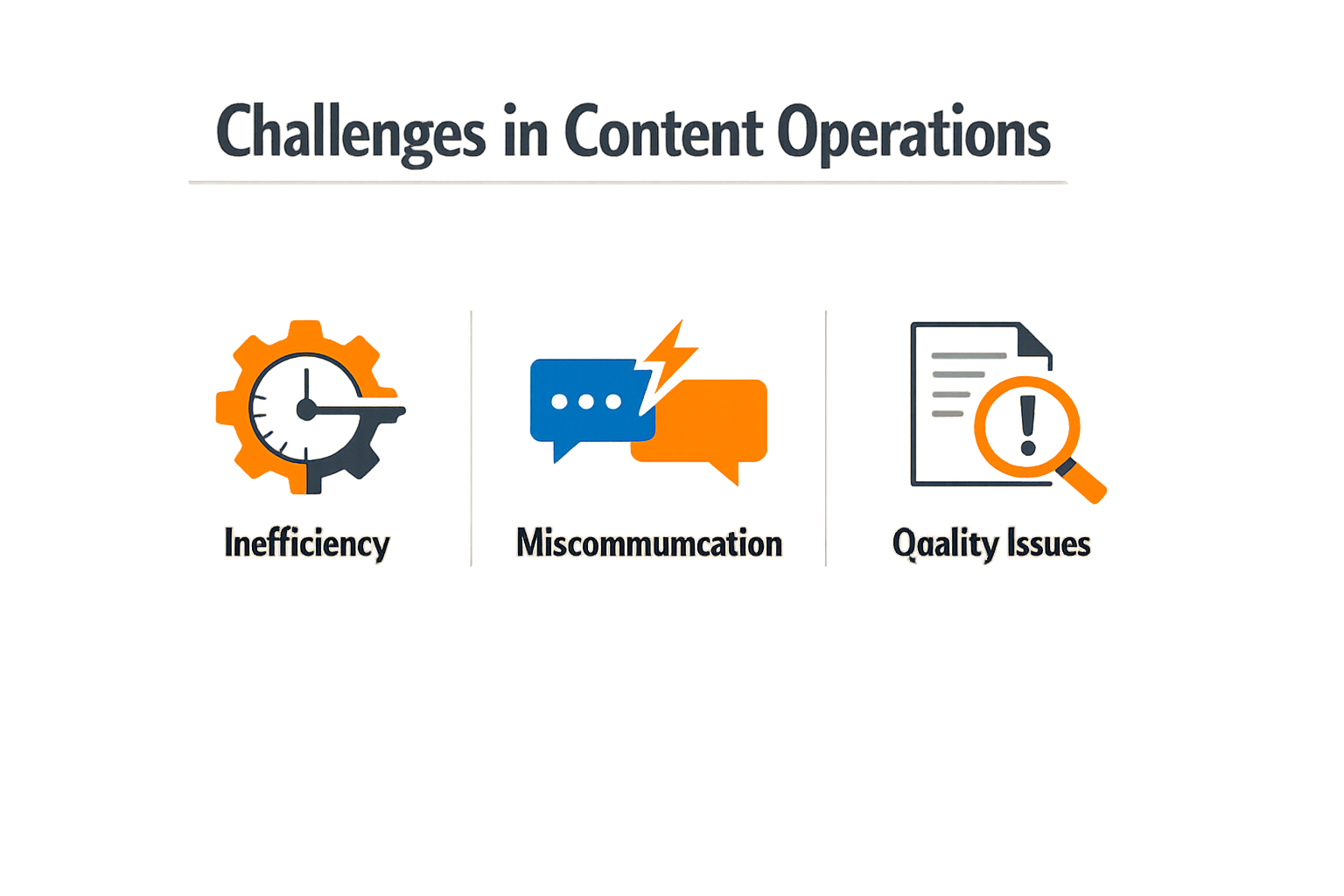
Content operations fails when the seo content brief never reaches the writer intact, when the published page contradicts the brief's strategic intent, or when nobody can answer whether a piece actually moved the business forward. These are not edge cases — they are the norm when content workflows rely on email threads, shared drives, and the assumption that everyone knows what "SEO-optimized" means.
The inefficiency compounds at every handoff. A strategist writes a brief specifying target keywords, competitor gaps, and conversion goals. The brief lands in a project management tool where a writer interprets "people-first content" as permission to ignore the keyword entirely. An editor reviews for grammar but not strategic alignment. A publisher schedules the piece without confirming indexability or internal link placement. Weeks later, the page ranks for nothing, converts nobody, and the strategist has no audit trail to diagnose what broke.
The Quality Control Gap
Quality control in content operations is not about catching typos — it is about validating that each artifact in the workflow supports the business objective stated in the brief. When mass production or outsourcing enters the picture, individual pages lose the attention required to meet their goals. A writer handling twelve briefs simultaneously cannot internalize the nuance of each target audience or the strategic reason behind a specific keyword phrase.
Miscommunication between teams creates a second failure mode. A strategist expects the published page to include a call-to-action above the final third of the article, as outlined in the brief. The writer places it in the footer because that is where CTAs "usually go." The editor does not catch the discrepancy because the brief was never part of the review checklist. The result is a structurally sound article that underperforms its conversion potential by design.
Workflow Fragmentation and Ranking Penalties
Fragmented workflows also obscure the relationship between content decisions and search performance. When a page fails to rank, the team cannot determine whether the issue was keyword targeting, technical indexability, insufficient backlinks, or poor content quality — because no single system tracked those variables from brief to publication. SEO reporting becomes reactive rather than diagnostic, and the cycle repeats.
Search engines prioritize content created to benefit people, not content created to manipulate rankings. Yet without a structured workflow that enforces alignment between the brief's intent and the published output, teams default to producing pages that check superficial SEO boxes while missing the strategic substance that earns rankings and conversions. The brief becomes a formality rather than a binding contract, and the published page becomes a guess rather than a validated asset.
Solution Steps for Effective Content Operations
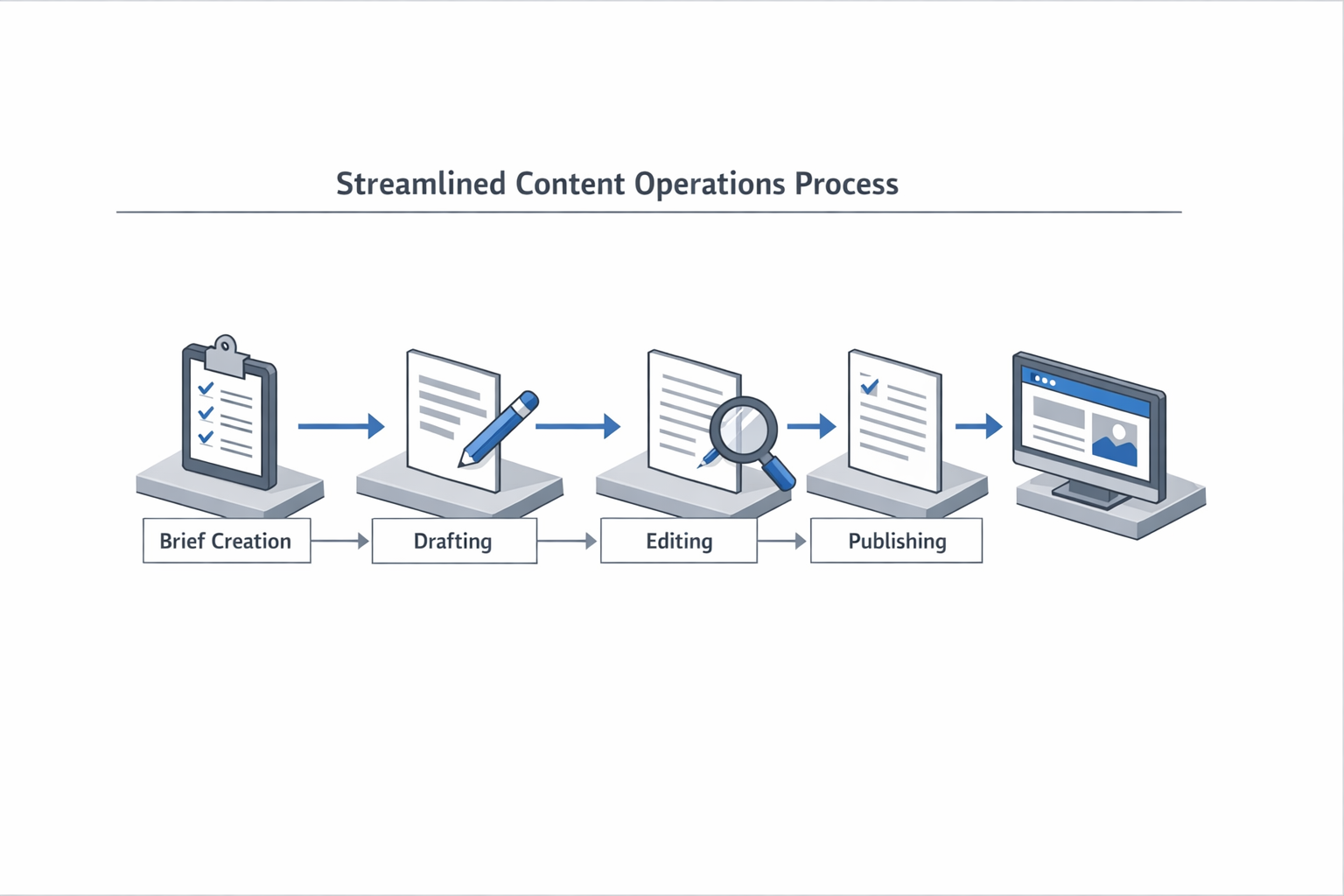
Building a reliable content operations workflow requires clear steps that move a piece from an seo content brief to a live, indexed page. The following framework addresses the inefficiencies and quality gaps outlined earlier by establishing checkpoints at each stage.
Step 1: Create a Structured SEO Content Brief
Every piece begins with a brief that defines scope, target keyword, audience intent, and success criteria. A structured brief includes the focus keyword, secondary terms, required headings, internal link targets, tone, and word count range. This document serves as the contract between strategist and writer — if the brief is vague, the output will be too.
Step 1
Define success criteria upfront
Before writing begins, specify what success looks like: qualified traffic, conversion actions, or consultation bookings. Organic SEO is not successful merely because rankings improve; the objective is measurable business outcomes like signed implementations or qualified build consultations.
Include a section in the brief for required internal links and external sources. Writers should know which pages to link to and which authoritative sources are approved before they draft the first paragraph.
Step 2: Draft with the Brief as the Single Source of Truth
Writers produce the first draft by following the brief exactly. Deviations — adding unsupported claims, skipping required links, or ignoring tone guidance — create rework cycles. The draft should match the brief's structure, include all specified elements, and stay within the target word count.
At this stage, the draft is a working document. It does not need to be perfect, but it must be complete according to the brief's requirements.
Step 3: Review and Edit for Quality and Compliance
An editor reviews the draft against the brief and applies a quality checklist: factual accuracy, source attribution, readability, keyword placement, and link structure. The editor also confirms that the piece aligns with broader content strategy — for example, ensuring that high-intent articles place calls-to-action above the final third of the content, not only at the footer.
Every article should point to one of four specific conversion targets, including product pages or case studies — not a generic contact form.
If the piece requires revisions, the editor returns it to the writer with specific, actionable notes. Vague feedback like "needs more detail" creates another round of guesswork; clear feedback like "add a paragraph on X with a link to Y" closes the loop in one cycle.
Step 4: Optimize for Technical SEO Before Publishing
Before the piece goes live, a technical review confirms that the page is set up for indexability and performance. This includes checking canonical tags, meta descriptions, image alt text, internal link paths, and mobile rendering. Publication is gated on resolving any Search Console exclusions and confirming self-canonical indexability.
Step 4
Run a pre-publish technical audit
Verify that the URL structure matches the site's taxonomy, all images have descriptive alt text, and the page loads without render-blocking issues. If Search Console shows 403 exclusions or indexing errors, resolve them before the publish date.
This step prevents the common mistake of publishing first and troubleshooting later. A page that is not indexable on day one wastes the initial crawl window and delays any ranking benefit.
Step 5: Publish, Monitor, and Iterate
Once the page is live, monitor its performance in Search Console, Google Analytics, and any rank-tracking tools. Track impressions, click-through rate, average position, and conversion actions tied to the success criteria defined in the brief. If the page underperforms, revisit the brief and the content to identify gaps — missing keywords, weak CTAs, or poor internal linking.
| Metric | What It Tells You | Action If Low |
|---|---|---|
| Impressions | Visibility in search results | Add secondary keywords, improve title tag |
| Click-through rate | Relevance of title and meta description | Rewrite meta description, test new title |
| Average position | Competitive strength | Build more internal links, update content depth |
| Conversions | Business impact | Adjust CTA placement, clarify value proposition |
Content operations does not end at publication. The workflow includes a feedback loop where performance data informs the next brief, creating a cycle of continuous improvement. For teams managing multiple content streams, this step is where small business automation tools can track metrics and flag underperforming pages without manual review.
Tips and Tricks for Optimizing Content Operations
Once you have a workflow in place, the next challenge is making it run smoothly under real-world conditions. Small optimizations compound over time — a clearer brief template saves hours in revision cycles, and a consistent metadata schema prevents last-minute scrambles before publish. The tips below come from practical experience: they address the friction points that slow teams down and the quality gaps that slip through when processes are informal.
Focus on Quality Over Quantity in Metadata
When building an SEO content brief, resist the urge to fill every possible field. Google's own guidance makes this clear: it is more important to supply fewer but complete and accurate recommended properties rather than trying to provide every possible recommended property. A brief that specifies a tight focus keyword, a clear target audience, and two or three supporting subtopics will produce better content than one cluttered with tangential keywords and vague instructions. The same principle applies to structured data — include the main type of structured data that reflects the main focus of the page to help Google Search understand its purpose, rather than layering on every schema type hoping something sticks.
Avoid Boilerplate in Titles and Metadata
Repeated or boilerplate text in title elements can make it difficult for users to distinguish between pages, which is not helpful for user experience. This shows up most often in scaled content operations where teams use templates without customization. If your workflow generates fifty service pages and forty-nine of them share the same title pattern with only the city name swapped, you have a navigation problem and a ranking problem. The fix is straightforward: build variation into the brief itself. Specify unique value propositions or local context for each piece, and enforce a review step that flags duplicate patterns before publish.
Standardize Brief Templates to Reduce Revision Cycles
Every undefined field in a brief becomes a decision point during writing, and decision points slow velocity. A standardized SEO content brief template should answer: what is the user intent, what is the primary keyword, what subtopics must be covered, what internal links are required, and what success looks like (word count, readability target, required schema). When these are consistent across projects, writers spend less time interpreting instructions and more time executing. For teams managing small business automation, this standardization is the foundation that makes workflow automation possible — you cannot automate what you have not first made repeatable.
A brief that answers intent, keyword, structure, and success criteria in the same order every time turns writing into execution rather than interpretation.
Build a Pre-Publish Checklist That Catches the Usual Suspects
Most publishing errors are not creative failures — they are checklist failures. A pre-publish review should verify: focus keyword appears in title and at least one H2 or H3, required internal links are present and functional, external sources are cited with correct URLs, images have descriptive alt text, and metadata fields match the brief. This is not editorial judgment; it is quality assurance. Automate what you can (broken link checks, keyword presence), but keep a human in the loop for tone and factual accuracy. The goal is to catch the predictable mistakes so the team can focus on the unpredictable ones.
Use Structured Data to Signal Page Purpose Clearly
When a page could qualify for multiple content types — a service page that is also a local business listing, or a guide that includes a video — choose the structured data type that best represents the primary user intent. Google's structured data policies emphasize clarity: include the main type of structured data that reflects the main focus of the page. If the page is primarily a how-to guide, use HowTo schema even if there is a supporting video. If it is a local service page, prioritize LocalBusiness schema. Mixing schemas is fine when it adds genuine value, but the primary schema should never be ambiguous.
Conclusion
A structured content operations workflow transforms how organizations move from an SEO content brief to a published page that delivers measurable results. The workflow outlined in this article — from standardized brief creation through research, drafting, review, and publication — ensures that every piece of content serves a strategic purpose rather than simply filling a publishing calendar. When you treat content operations as a system rather than a series of isolated tasks, you gain consistency, quality control, and the ability to scale without sacrificing editorial standards.
At Xenco Labs, our work with local service businesses and technology companies has reinforced a simple truth: content operations is not just about creating content; it's about building a seamless workflow that takes a piece from a brief to a published, validated page. The difference between content that ranks and content that converts lies in the rigor of the process behind it. A well-constructed SEO content brief sets expectations, gates approval at critical checkpoints, and ensures that every stakeholder — from the writer to the technical SEO team — knows exactly what success looks like before the first draft is written.
The most effective content operations workflows share three characteristics: they are documented, they are repeatable, and they are designed to fail early. When a brief is incomplete or a research pack lacks sufficient sources, the system should surface that gap immediately rather than allowing a flawed piece to reach publication. This approach reduces rework, protects editorial quality, and ensures that the content you publish aligns with both user intent and business objectives.
As you refine your own content operations workflow, focus on the points of failure that currently exist in your process. If briefs are vague, standardize them. If research is inconsistent, gate publication on source quality. If review cycles drag, define clear approval criteria and timelines. The workflow from an SEO content brief to a published page is not a creative exercise — it is an operational discipline that rewards precision, documentation, and a willingness to say no when the inputs are not yet ready. For organizations serious about small business automation and scalable content strategies, this discipline is the foundation of everything that follows.
Sources(11)
- Google Search Central documentation
- Google Search Central documentation
- Google Search Central documentation
- Google Search Central documentation
- Managed Search & Content Intelligence
- Xenco Labs — Local Service Business OS SEO/AEO/content strategy (2026-10-08)
- Xenco Labs — Local Service Business OS narrated product pitch brief (2026-10-08)
- Google Search Central — AI features and your website
- Xenco Labs — Digital Growth Strategy
- managed-search-content (xl_local_os_editorial)
- google-search-essentials (source_extract)
Written by
Xenco Labs Editorial
Published October 20, 2026 · 13 min read
The Xenco Labs editorial team writes about building and shipping AI products to production.
You Might Also Like
More from the Xenco Labs blog

Lead Generation for IT Companies: Enterprise Strategies
Learn effective lead generation for IT companies and infrastructure strategies, turning search demand into a strong sales pipeline.
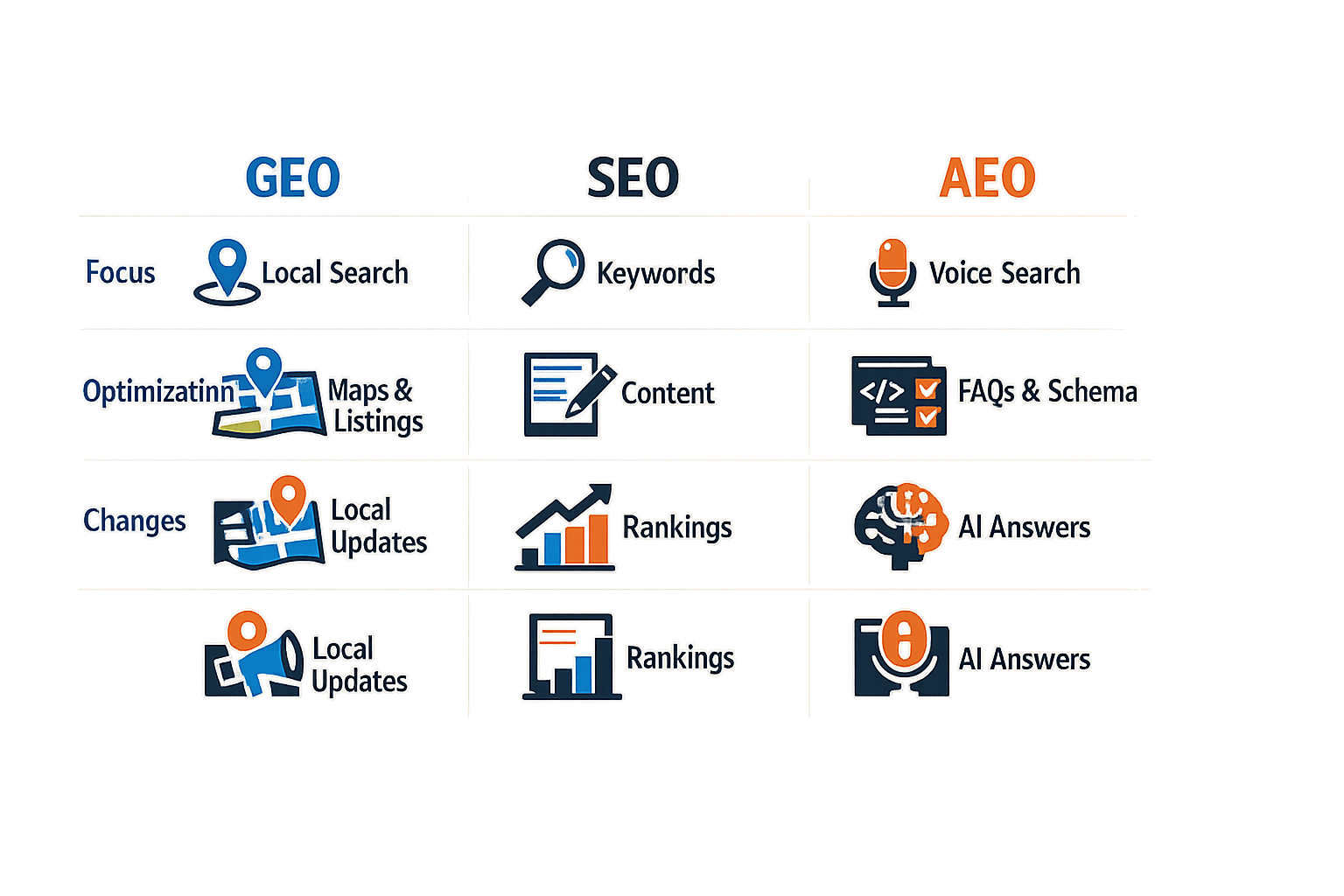
Geo vs SEO: AEO vs SEO: Key Changes for Search Teams (+ GEO Explained)
Explore the differences between AEO vs SEO and GEO, and understand what changes for search teams and what remains the same in modern search optimization. Learn about geo

SEO Manager Job Description: In-House vs Agency
Explore in-house SEO vs agency options through the SEO Manager job description, covering key responsibilities and when each approach fits your organization.

SEO Reporting KPIs for Executives: Essential Metrics to Review
Explore key SEO reporting KPIs for effective executive reviews, ensuring data-driven decisions and measurable business impact.