
Home Service Marketing: A Channel Plan for Owner-Operated Businesses
Discover practical home service marketing strategies. Build an effective channel plan for owner-operated service companies.
Explore effective home service marketing strategies to optimize your channel plan for owner-operated service businesses.
Introduction
Marketing for home service businesses is the structured process of connecting customer inquiries to completed jobs through channels that deliver qualified leads and systems that convert them efficiently. Most owner-operated service businesses treat marketing as a collection of tactics—a Google Business Profile here, a yard sign there, maybe some paid ads when things slow down. The result is a scattered effort that generates leads but leaves money on the table because no one answers fast enough, estimates take days to deliver, or the handoff between quote and calendar breaks down. Marketing for home service businesses works when it connects the channel that brings the lead to the operating loop that closes it and collects payment.
The challenge is not awareness. Homeowners search for window cleaners, pest control, and junk removal every day. The challenge is converting that intent into a booked appointment before the customer moves to the next name on the list. When a lead arrives by phone or web, the business that responds with a real answer—not voicemail, not a contact form that disappears into a queue—wins the job. Speed matters more than polish, and a rules-based estimate delivered in minutes beats a custom quote that takes three days.
We've seen this pattern across owner-operated field teams: the businesses that grow without hiring coordinators are the ones that automate the repeatable parts of the sales process and reserve their own judgment for the decisions that matter. A structured channel plan does not replace the owner's expertise; it ensures that expertise gets applied to pricing, scope, and customer commitments instead of phone tag and calendar Tetris. The operating loop—from lead arrival through estimate, booking, verification, contract, job execution, documentation, and invoicing—becomes the backbone of the marketing plan, not an afterthought.
This guide walks through the channel plan that works for service businesses where the owner or a small crew sells measurable field work. You will see how to identify the marketing challenges specific to local service operations, the steps to build a channel plan that converts at each handoff point, and the tactics that improve close rates without adding overhead. For a detailed framework on automating these handoffs, see Small Business Automation: Workflow Automation for Small Business.
Identifying the Challenges in Home Service Marketing
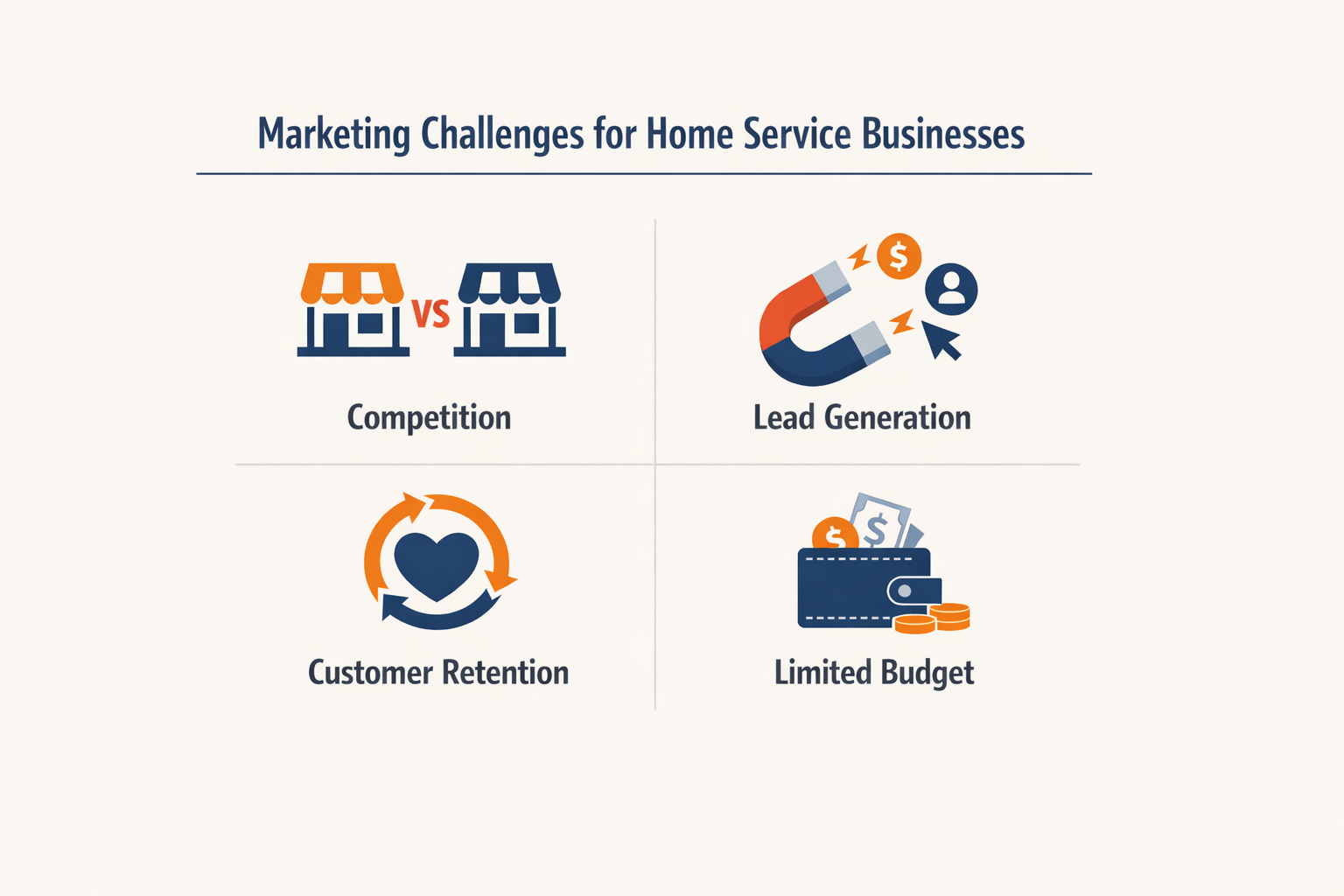
Owner-operated service businesses face marketing obstacles that enterprise playbooks do not address. You are simultaneously the estimator, the crew lead, and the person who answers the phone at 7 PM. Marketing competes with fieldwork for attention, and most tactical advice assumes you have staff to execute it.
The core tension is operational: every hour spent on marketing is an hour not billed to a customer. When the phone rings during a job, you choose between finishing the work in front of you or capturing the lead. When you finally sit down to update your website or run a campaign, the backlog of quotes and follow-ups has grown.
Time Fragmentation and Lead Response
Lead response time determines conversion rate, but owner-operators rarely control their schedule tightly enough to answer within minutes. A prospect who calls three companies will book with the first one who picks up and can quote a price. Voicemail loses to a live answer every time.
The same fragmentation affects follow-up. You generate an estimate, send it, and then move to the next job. Without a system that surfaces un-responded quotes or reminds you when a proposal has been open for three days, follow-up becomes random. The work you remember to chase is the work that happens to cross your mind, not the work with the highest close probability.
Channel Overload and Inconsistent Presence
Service businesses are told to maintain a Google Business Profile, run local ads, post on social media, send email campaigns, and keep a content-rich website. Each channel has different update cadences and format requirements. An owner working alone cannot sustain all of them at once.
The result is inconsistent presence: a Google profile updated six months ago, a Facebook page with sporadic posts, and a website with placeholder text that was never replaced. Prospects interpret inconsistency as unreliability. A stale online presence signals that the business might also be stale in how it handles work.
Inconsistent marketing presence is read as operational inconsistency—customers assume your follow-through on the job will match your follow-through online.
Pricing Transparency and Scope Creep
Many service businesses avoid publishing prices because every job is different. That caution is operationally sound, but it creates a marketing problem: prospects cannot self-qualify, so every inquiry requires a custom estimate. You spend time quoting work that was never in budget, or you underprice to win the lead and discover mid-job that the scope was larger than the quote assumed.
Without a rules-based estimating system, pricing becomes a negotiation every time. Some owners quote high to protect margin and lose price-sensitive work; others quote low to win volume and erode profitability. Neither approach scales, because both require the owner's judgment on every deal.
Attribution Blindness and Budget Waste
When a customer calls, you rarely know which marketing activity generated the lead. Did they find you through Google, a neighbor's referral, or a door hanger you distributed three months ago? Without attribution, you cannot confidently allocate budget. You might be paying for ads that generate zero calls, or you might be underinvesting in the channel that drives most of your work.
Attribution blindness also prevents optimization. If you do not know which service pages convert traffic into estimates, you cannot prioritize content updates. If you do not track which email campaigns produce repeat bookings, you cannot refine your messaging. Marketing becomes a series of one-off experiments with no feedback loop.
For a clearer view of the foundational steps that precede paid advertising, see the Local SEO Checklist: NAP Consistency for Service Businesses, which covers the structural work that makes attribution possible.
Automation Gaps and Manual Overhead
Most owner-operators patch together tools: a scheduling app, a separate invoicing system, a spreadsheet for leads, and a different platform for email. Each tool requires manual data entry, and nothing syncs automatically. A lead captured on the website must be copied into the CRM, then into the calendar, then into the invoicing system after the job is complete.
Every manual handoff introduces error and delay. A missed data entry means a lost follow-up. A scheduling conflict means a customer gets double-booked. The cumulative overhead of stitching together disconnected tools is a hidden cost that shows up as lost evenings and weekends spent on administrative cleanup.
How Do You Build a Marketing Channel Plan for Home Service Businesses?
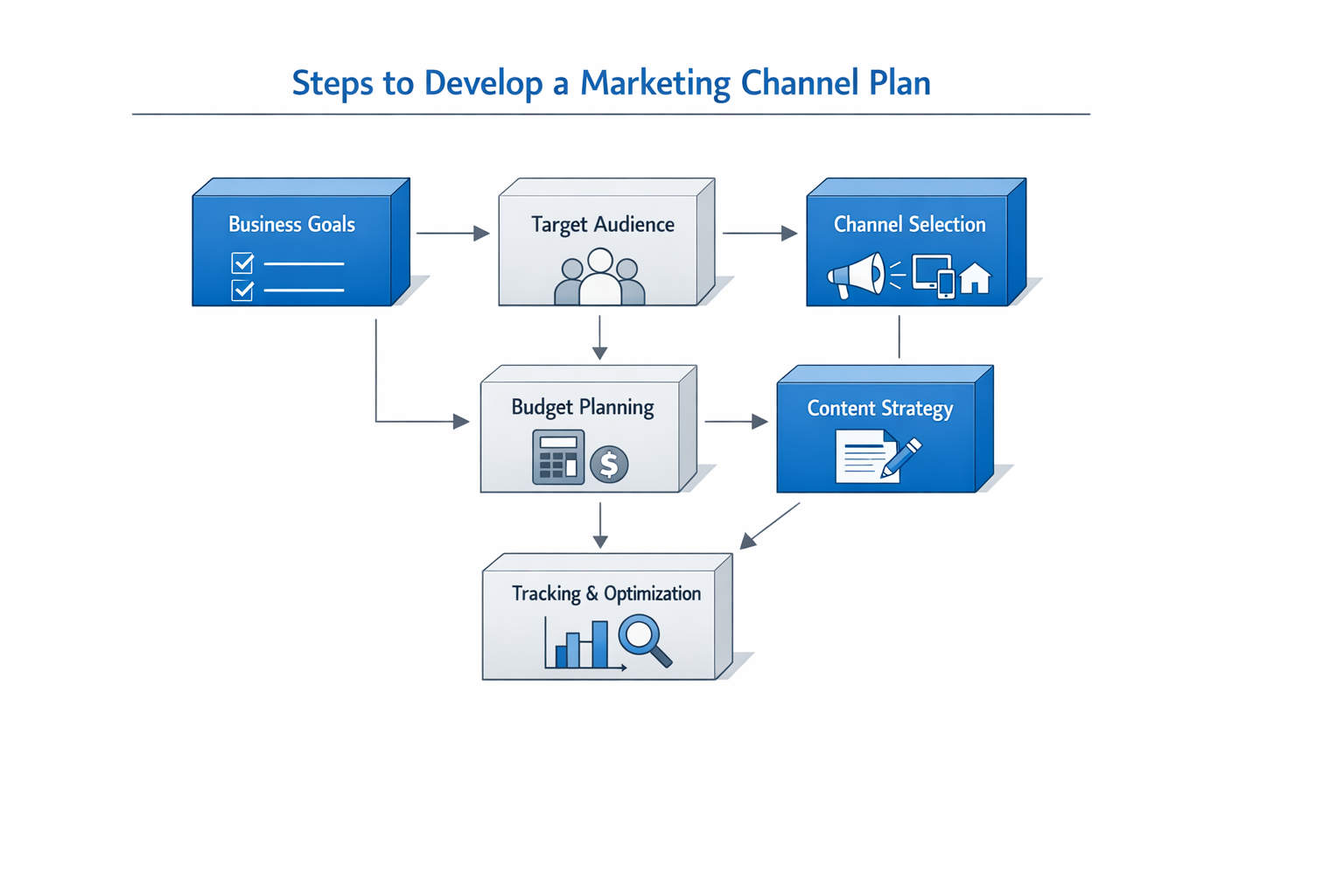
Building a marketing channel plan for an owner-operated service business requires mapping the customer journey from first contact to payment, then aligning marketing activities to each stage. The plan should prioritize channels that deliver measurable leads without requiring full-time management.
Step 1: Map Your Operating Loop
Start by documenting how work moves through your business. A typical operating loop includes lead arrival, estimate generation, appointment booking, verification of scope, contract signing, job execution, documentation, and invoicing. Each stage represents a point where marketing can either feed the next step or create friction that loses the customer.
Step 1
Document your current process
Write down every step from the moment a lead contacts you to the moment you receive payment. Note where customers drop off, where you spend the most time, and where miscommunication happens. This map becomes the foundation for choosing marketing channels that feed a process you can actually execute.
Most owner-operators discover that their biggest constraint is not lead volume but the time required to answer calls, write estimates, and confirm appointments. Marketing channels that generate unqualified leads or require immediate responses create operational debt rather than revenue.
Step 2: Prioritize Channels That Match Your Capacity
Once you understand your operating loop, evaluate marketing channels based on three criteria: lead quality, time required to manage the channel, and cost per qualified lead. Organic search through local SEO typically delivers higher-intent leads than paid social media, but it requires upfront investment in content and structured data.
| Channel | Lead Quality | Management Time | Best For |
|---|---|---|---|
| Organic search | High | Low (after setup) | Businesses with defined service areas |
| Google Business Profile | High | Low | Service area businesses |
| Paid search | Medium-High | Medium | Businesses with clear unit economics |
| Referral programs | High | Low | Established customer bases |
| Paid social | Low-Medium | High | Brand awareness, not direct response |
For most owner-operated businesses, the first three channels deliver the best return on time invested. Referral programs work when you have an existing customer base and a structured way to ask for introductions.
Step 3: Build the Infrastructure Before Spending
Marketing channels only convert when the operational infrastructure can handle the lead. Before increasing ad spend or launching campaigns, confirm that your business can answer calls during business hours, generate written estimates quickly, and schedule appointments against live availability.
Step 2
Set up lead-handling infrastructure
Implement a system that captures lead details, generates estimates from a real rate card, and allows customers to book appointments without phone tag. If a customer has to wait 48 hours for a callback or three days for an estimate, your marketing channel plan is irrelevant—the operational gap will lose the lead before the channel can be evaluated.
Step 4: Test One Channel at Controlled Volume
Rather than launching across multiple channels simultaneously, pick one channel that matches your capacity and run it at a volume you can manage. Track conversion rates at each stage of the operating loop: lead to estimate, estimate to booking, booking to completed job, completed job to payment.
If fewer than 30 percent of estimates convert to bookings, the problem is not the marketing channel—it is pricing, response time, or how the estimate is presented. If fewer than 80 percent of booked jobs convert to completed work, the issue is scheduling or scope verification. Marketing for home service businesses only works when the operating loop can close the leads the channel delivers.
Step 3
Measure conversion at every stage
For each lead source, track how many leads convert to estimates, how many estimates convert to bookings, and how many bookings convert to completed jobs. Calculate the cost per completed job, not just cost per lead. A channel that delivers cheap leads but low conversion rates costs more than a channel with expensive leads and high conversion.
Step 5: Scale the Channel or Add a Second One
Once a single channel consistently delivers qualified leads that convert at predictable rates, increase volume until you hit capacity constraints. Only then should you add a second channel. Adding channels before proving that your operating loop can handle the volume creates complexity without revenue.
The best marketing channel plan is the one your business can execute without hiring someone to manage the leads.
For owner-operated businesses, the goal is not to maximize lead volume—it is to generate enough qualified work to keep the schedule full without overwhelming the systems that move leads to revenue. A channel plan that requires constant attention or produces leads faster than you can service them is a plan that works against the business rather than for it.
What Are the Best Practices for Marketing Home Service Businesses?
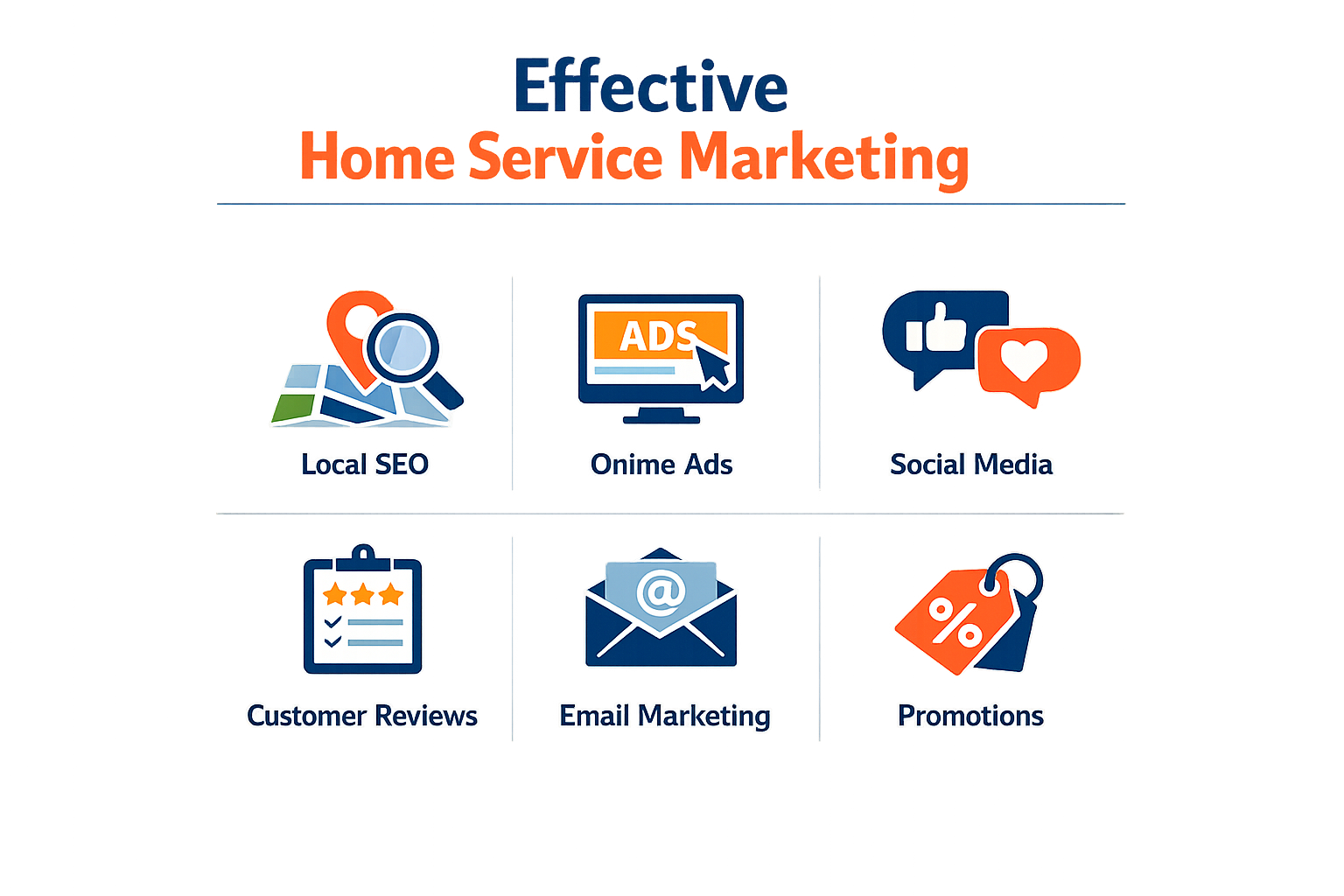
Once your channel plan is built, execution determines whether it produces revenue or just fills a folder. The gap between a documented strategy and one that actually brings in work lives in the operational details — the response time to inbound leads, the consistency of your service pages, and whether your calendar stays current when a customer tries to book. These tips focus on the points where most owner-operated service businesses lose traction.
Answer Leads Immediately, Not When Convenient
A lead that arrives by phone or web form expects an answer within minutes, not hours. Voicemail and auto-replies signal that you are unavailable, and the customer moves to the next name on the list. If you cannot staff a live line during business hours, route inbound calls to a service that captures the inquiry and forwards the details while the lead is still warm. The same urgency applies to web leads — an automated acknowledgment buys you time, but only if it includes a specific callback window and honors it.
Use a Rules-Based Estimator to Standardize Pricing
Manual estimates introduce variance that confuses customers and eats time. A calculator built from your actual rate card produces consistent pricing and frees you to verify scope rather than reinvent the quote for every job. The estimate should reflect real measurements and conditions — square footage, linear feet, condition factors — so that the number the customer sees matches the number you can deliver. When the estimate lands in writing, it becomes a reference point for booking and a filter that moves serious inquiries forward while letting tire-kickers self-select out.
Let Customers Book Against Live Availability
A calendar that shows open slots and accepts bookings directly removes one round-trip from the sales process. Customers who see availability and claim a time slot have already committed mentally; all that remains is confirmation. The calendar must reflect your real capacity — block out jobs already booked, travel time, and days you are unavailable. A calendar that shows phantom availability and requires rescheduling after booking damages trust and adds friction exactly where you need momentum.
The tightest operating loops let the customer move from inquiry to scheduled appointment without waiting for a callback.
Document Completion and Invoice Immediately
Once the work is done, the clock starts on payment. Invoices sent days after completion lose urgency and invite questions about what was actually delivered. Capture before-and-after documentation on-site — photos, measurements, condition notes — and attach them to the invoice so the customer sees proof of completion alongside the charge. The invoice should go out the same day the work finishes, with payment terms that default to immediate settlement unless you have explicitly agreed to net terms.
Automate the Repetitive Steps, Retain Approval on the Ones That Matter
Automation handles the tasks that do not require judgment — lead acknowledgment, appointment reminders, follow-up sequences, invoice generation. The business owner retains control over pricing, scope changes, and customer commitments that carry risk or affect margin. This division keeps the operating loop moving without forcing you to choose between speed and oversight. For businesses that need growth without adding office overhead, small business automation focuses effort on the steps that require a human decision and removes the rest.
Maintain Consistent NAP Data Across Every Listing
Your business name, address, and phone number must match exactly across your website, Google Business Profile, directory listings, and any other platform where customers find you. Inconsistent NAP data confuses search engines and fragments your local authority. Audit your listings quarterly and correct any discrepancies immediately — a single transposed digit or an outdated suite number can cost you visibility in local search results. For comprehensive guidance on this foundational work, review the Local SEO Checklist for Service Businesses.
Conclusion
A targeted marketing channel plan gives owner-operated service businesses control over where leads come from and what they cost. The framework outlined here—claiming your local presence, building content that answers real questions, automating follow-up, and tracking what converts—works because it aligns with how customers actually find and choose service providers. When you know which channels produce qualified leads and which produce noise, you stop spending on hope and start spending on data.
The operating loop described throughout this article—lead capture, estimate, booking, job execution, documentation, invoicing—only works when marketing feeds it consistently. A Google Business Profile that ranks, service pages that convert search traffic, and email sequences that nurture quotes all reduce the friction between inquiry and payment. For businesses where the owner still answers the phone and runs the jobs, that reduction in friction is the difference between sustainable growth and constant scramble.
We built the Local Service Business OS around this reality: owner-operators need systems that handle repetitive marketing and administrative work without requiring a marketing department. The right channel plan is not the one with the most tactics—it is the one that runs predictably while you are in the field, turning inbound interest into booked work without manual intervention at every step.
Start with the foundation: local SEO, a functional website, and one reliable lead channel. Add automation where you lose leads to slow follow-up. Expand only when the current system runs without you watching it. Marketing for home service businesses works when the plan matches the operation—small, deliberate, and built to scale with the owner's capacity rather than against it.
FAQ
What is the most important marketing channel for home service businesses?Organic search and Google Business Profile optimization deliver the highest-intent leads for most owner-operated service businesses, because prospects searching for specific services in their area are ready to book.
How quickly should I respond to inbound leads?Respond within two hours at most. Most prospects who call three companies will book with the first one who answers and can provide a clear estimate.
Should I publish my prices online?Publish starting prices or price ranges based on common job types. This helps prospects self-qualify and reduces time spent on estimates for work outside your target scope or budget.
How do I track which marketing channels produce the most revenue?Assign a unique phone number or tracking parameter to each channel, then measure conversion rates from lead to completed job. Calculate cost per completed job, not just cost per lead.
What should I automate first in my marketing?Automate lead acknowledgment, appointment reminders, and follow-up sequences for open estimates. Reserve your judgment for pricing, scope verification, and customer commitments that affect margin.
Sources(18)
- Google Business Profile guidelines
- Google Business Profile Help — Guidelines for representing your business on Google
- Google Business Profile guidelines
- Google Business Profile guidelines
- Local Service Business OS
- Xenco Labs — Digital Growth Strategy
- Google Search Central documentation
- Google Search Central — Local business (LocalBusiness) structured data
- Xenco Labs — Services
- Managed Search & Content Intelligence
- Xenco Labs — Terms of Service (last updated March 11, 2025)
- Xenco Labs — Sonoma Wash Co. case study
- Xenco Labs — Local Service Business OS SEO/AEO/content strategy (2026-10-08)
- Google Business Profile guidelines
- Housecall Pro
- Housecall Pro — Pricing page
- Google Search Central documentation
- local-service-business-os (xl_local_os_editorial)
Written by
Xenco Labs Editorial
Published October 20, 2026 · 16 min read
The Xenco Labs editorial team writes about building and shipping AI products to production.
You Might Also Like
More from the Xenco Labs blog

How to Design a Request a Quote Form That Captures Qualified Jobs
Learn how to design a request a quote form that effectively captures qualified jobs and leads for your business with proven field strategies.

Speed to Lead: Lead Response Time for Service Businesses: Why Speed
Discover how lead response time impacts conversion rates for service businesses and learn proven strategies to improve your response speed. Speed to lead is crucial
General Contractor Website Design: Features for Winning Jobs
Learn the essential features of general contractor website design that help service businesses win jobs and attract clients effectively.

Landscaping SEO: SEO for Landscaping: How to Get Found Locally
Learn effective landscaping SEO strategies to enhance local visibility and attract customers to your landscaping business online.