
Local SEO Checklist: NAP Consistency for Service Businesses
Follow this local SEO checklist to ensure NAP consistency and optimize your service business online presence before spending on ads.
Introduction
Local SEO checklist is essential for service businesses to ensure NAP consistency.
Service businesses spend thousands on Google Ads and Facebook campaigns before verifying that their basic business information matches across the web. When a potential customer searches for your service in their area, inconsistent listings mean Google may not show your business at all — no matter how much you bid on keywords.
NAP consistency — ensuring your business Name, Address, and Phone number appear identically everywhere online — is not optional infrastructure. It is the signal layer that tells search engines your business exists as a single, trustworthy entity rather than three different companies with similar names. When your Google Business Profile lists one phone number, your website footer shows another, and Yelp displays a third variation, search algorithms cannot confidently connect those citations to the same business.
This checklist walks through the local SEO work that must happen before you authorize the first ad spend. Service businesses that fix citation errors and structured data before turning on paid campaigns often double their lead volume, because Google finally understands where to send traffic. The steps are not complicated, but they are exact — and deploying technical infrastructure correctly the first time saves the cost of fixing it under pressure later.
The following sections break down the specific tasks: identifying the problems that inconsistent citations create, the step-by-step checklist for auditing and correcting your local presence, and the operational tricks that keep your NAP data clean as your business changes. If your next marketing meeting includes a conversation about ad budget, make sure this checklist is complete first.
Problem Statement
Service businesses routinely spend thousands on paid advertising before verifying that their foundational local presence is intact. The result is predictable: ads drive traffic to listings with mismatched phone numbers, incomplete addresses, or conflicting business names across directories. Prospects call the wrong number, navigate to the wrong location, or abandon the search entirely when trust signals fail.
The core issue is not a lack of visibility — it is inconsistent NAP data (name, address, phone number) scattered across Google Business Profile, directory aggregators, and third-party citation sources. When your business name appears as "ABC Plumbing" on Google but "ABC Plumbing LLC" on Yelp and "A.B.C. Plumbing Services" on a local directory, search engines cannot confidently associate those entities. The fragmentation dilutes ranking signals and erodes the trust that converts searchers into paying customers.
The Hidden Cost of Neglecting Local SEO Before Advertising
Paid campaigns amplify whatever foundation exists. If your Google Business Profile lists a phone number that rings to a disconnected line, every ad click becomes wasted spend. If your service area is undefined or your category selection is generic, the traffic you buy will include unqualified leads from outside your territory or outside your service offering.
Many service businesses discover these gaps only after launching a campaign, when call tracking reveals that prospects are reaching competitors or when conversion rates remain stubbornly low despite high click volume. By that point, the advertising budget has already been consumed, and the business is left troubleshooting foundational issues that should have been resolved before the first dollar was spent.
Organic local search success is measured by qualified consultations and signed contracts, not by ranking movement alone.
The discipline required to audit and correct NAP consistency, verify citation accuracy, and configure Google Business Profile settings is the same discipline that separates profitable ad campaigns from expensive experiments. Businesses that skip this step are effectively paying to expose their operational weaknesses to the market.
Solution Steps: Local SEO Checklist
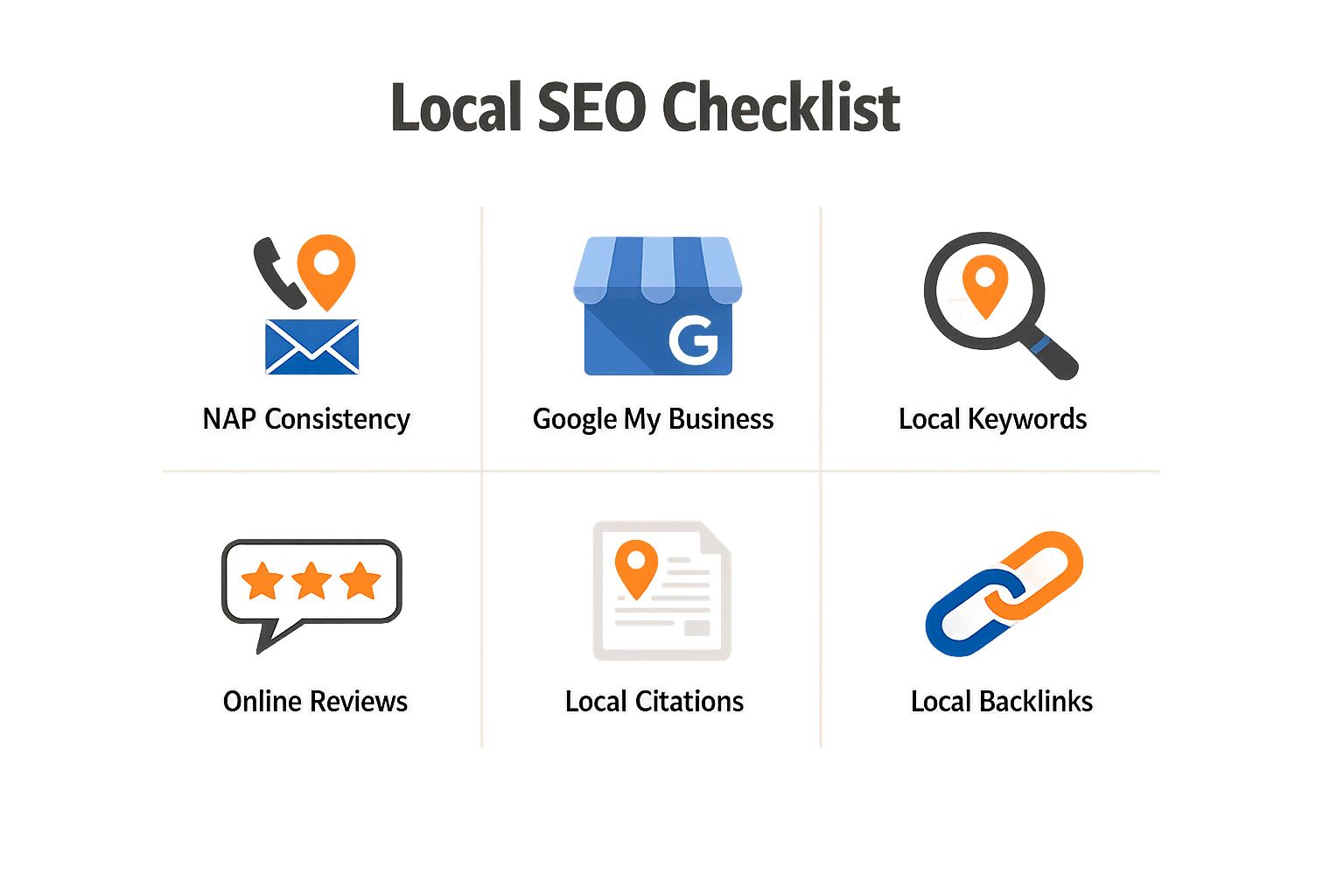
Before you allocate budget to ads, lock down the foundational elements that determine whether searchers can find you, trust you, and contact you. This checklist addresses the technical and operational steps that turn a service business website into a local search asset.
How Do You Audit and Standardize NAP Consistency Across All Listings?
Start by documenting your business name, address, and phone number exactly as they appear on your Google Business Profile. This becomes your canonical NAP. Then audit every directory, citation source, and social profile where your business appears — Yelp, Facebook, industry directories, chamber of commerce listings, and any legacy Yellow Pages entries.
Step 1
Document your canonical NAP
Open your Google Business Profile dashboard and copy your business name, full street address, and primary phone number character-for-character. This is your reference string. Save it in a spreadsheet with columns for platform, current NAP, match status, and correction date.
Step 2
Inventory all public listings
Search your business name in Google, Bing, and Apple Maps. Note every directory result. Add manual checks for Yelp, Facebook, Nextdoor, Angi, HomeAdvisor, and any trade-specific platforms. Record the NAP displayed on each.
Step 3
Correct discrepancies immediately
Where the listed NAP differs from your canonical version — even by a suite number, abbreviation, or phone format — log in and update it. If you cannot access the listing, submit a claim or correction request. Track each correction with a date stamp.
Inconsistent NAP data fragments your local search authority. Google does not penalize a single mismatch, but when citations conflict across a dozen sources, the algorithm cannot confidently associate reviews, links, and mentions with your business. You lose ranking signal that you already earned.
According to Google's Local Business structured data documentation, maintaining identical NAP information across all platforms helps search engines verify your business identity and improve local ranking signals.
Implement Local Business Structured Data on Your Website
Structured data translates your business details into a machine-readable format that search engines parse directly. Google's Local Business schema communicates operating hours, service areas, departments, and contact methods without relying on the visual layout of your page.
Add JSON-LD markup to your homepage and location pages. Include your canonical NAP, business type (using schema.org/LocalBusiness subtypes like Plumber or HVAC), geo-coordinates, hours of operation, and same-day service flags if applicable. Validate the markup using Google's Rich Results Test before deployment.
Once live, monitor Search Console for structured data errors. A missing closing brace or an invalid property can silence the entire block. Fix critical errors within 24 hours; non-critical warnings are lower priority but still worth addressing to improve data quality.
Optimize Your Google Business Profile for Service-Area Coverage
Your Google Business Profile is the highest-authority citation you control. Set your primary category to the most specific service type you offer — "pressure washing service" outranks "cleaning service" when someone searches for pressure washing. Add secondary categories only if you genuinely perform that work; category stuffing triggers manual review.
Define your service area by ZIP code or city if you operate without a public storefront. For businesses with a physical location customers visit, display your street address and mark service-area boundaries separately. Upload recent photos every two weeks — exterior shots, team at work, completed projects. Google favors profiles with fresh visual content.
Post weekly updates about seasonal services, project completions, or operational changes. Posts expire after seven days, but the activity signal persists. When you respond to every review within 48 hours — positive and negative — you signal operational responsiveness that both users and algorithms notice.
Build Service and Problem Pages That Match Local Search Intent
Service businesses earn local visibility by publishing pages that answer the exact queries customers type. A generic "Services" page does not rank for "emergency water heater repair near me." You need individual pages for each core service and each problem condition you solve.
| Page Type | Example | Search Intent |
|---|---|---|
| Core service | Commercial Pressure Washing | Searcher knows the service name |
| Problem/condition | Algae Removal from Siding | Searcher describes the problem |
| Service + location | Gutter Cleaning in [City] | Geo-modified service query |
Each page requires a local anchor: mention the city or service area in the H1, include a neighborhood map or service-area list, and reference local landmarks or regulations when relevant. Thin pages with 200 words of filler do not rank. Aim for substantive content that explains process, pricing structure, timelines, and what the customer should expect.
For a practical example of this structure, deploying AI-driven web applications follows similar principles — match the page architecture to the user's decision journey and provide enough detail that the page becomes the authoritative answer.
Set Up Tracking and Conversion Measurement Before Spending
You cannot optimize what you do not measure. Before the first ad dollar goes out, install call tracking on your primary phone number, set up Google Analytics 4 goals for form submissions, and configure Search Console to monitor impressions and click-through rates for your target keywords.
Tag every inbound lead source — organic search, Google Business Profile, paid search, directory referral. When a customer calls, your intake process should capture how they found you. This attribution data tells you whether your local SEO work is generating qualified leads or just traffic.
Run a baseline report for 30 days after implementing this checklist. Record organic traffic, GBP actions (calls, direction requests, website clicks), and lead volume by source. When you later add paid campaigns, you will have clean before-and-after data showing whether ads are filling gaps or duplicating organic performance.
Tips and Tricks for Effective Local SEO
Beyond the core checklist, several lesser-known practices can amplify your local search visibility without requiring additional ad spend. These tactics focus on content quality, technical optimization, and strategic prioritization — elements that compound over time rather than delivering one-time wins.
Prioritize Content by Expertise and Trustworthiness
Not all content carries equal weight in local search. Google allocates crawling resources based on signals like experience, expertise, authoritativeness, and trustworthiness. For service businesses, this means your homepage and core service pages should demonstrate clear qualifications, certifications, and verifiable contact information. A plumber's page about emergency leak repair earns more crawl budget when it includes license numbers, insurance documentation, and response-time guarantees than when it repeats generic advice copied from competitors.
Build People-First Content Around Local Intent
Search engines reward content created for users rather than algorithms. When writing service area pages or blog posts, answer the questions your customers actually ask during consultations. A roofing contractor serving multiple zip codes should explain how local weather patterns affect material choices, not just repeat "roof repair [city name]" in every paragraph. This approach naturally incorporates location context while providing genuine utility.
Content that solves real problems for your service area earns links and shares without manipulation — the foundation of sustainable local visibility.
If you're scaling content operations across multiple locations, best practices for deploying AI web apps can help maintain quality while automating repetitive tasks like schema markup generation or NAP consistency checks.
Optimize Server Resources for Consistent Crawling
Technical performance directly impacts how often search engines index your updates. If your site experiences slow load times or server errors during peak hours, crawlers may reduce their visit frequency — meaning NAP updates or new service pages take longer to appear in search results. Monitor your server response times in Google Search Console and address capacity issues before they become ranking problems. For service businesses running booking systems or customer portals, ensure these tools don't compete with public pages for server resources.
What Content Strategy Works Best for Different Google Products?
Google allocates crawling resources differently depending on which product surfaces your content. Local Pack results prioritize Google Business Profile signals and on-page NAP consistency, while organic results weight content depth and backlink authority more heavily. If your primary goal is appearing in the map pack for "emergency plumber [city]," your homepage and contact page optimization matters more than a 2,000-word blog post about pipe materials. Conversely, if you want to rank for informational queries that lead to service calls, invest in comprehensive guides that demonstrate subject-matter expertise.
| Goal | Content Priority | Technical Priority |
|---|---|---|
| Local Pack visibility | NAP consistency, GBP completeness | Schema markup, mobile speed |
| Organic service rankings | Service page depth, local keywords | Internal linking, crawl efficiency |
| Informational queries | Long-form guides, expertise signals | Content freshness, server stability |
Conclusion
NAP consistency and the broader local SEO checklist are not optional steps — they are the foundation that determines whether your paid advertising budget converts or evaporates. Service businesses that launch campaigns before confirming citation accuracy, schema markup, and Google Business Profile completeness pay twice: once for the ad spend, and again to fix the broken funnel after the traffic arrives and bounces.
The checklist in this article gives you a repeatable system to audit and correct the structural issues that cost you customers. Work through each section methodically — citations first, then on-page signals, then schema and reviews — before you allocate budget to ads. The businesses that treat local SEO as a prerequisite rather than an afterthought see higher conversion rates, lower cost-per-acquisition, and sustainable growth that compounds over time.
If your service business operates across multiple locations or needs integrated workflow automation alongside local search visibility, exploring best practices for deploying AI web apps can help you scale operations without sacrificing the precision your local presence requires. The work you do now to ensure NAP consistency and complete your local SEO foundation will pay dividends in every channel you activate later.
FAQ
Why does NAP consistency matter for local SEO?NAP consistency helps search engines verify your business identity across multiple platforms. When your Name, Address, and Phone number match exactly on Google Business Profile, Yelp, Facebook, and other directories, algorithms can confidently connect reviews, links, and mentions to a single entity, strengthening your local ranking signals.
How often should I audit my business citations?Audit your NAP data quarterly or whenever you make operational changes like moving offices, changing phone systems, or rebranding. Set calendar reminders to check your top 10-15 citation sources every three months to catch discrepancies before they accumulate.
What is the fastest way to fix citation errors?Claim your listings directly on major platforms (Google, Yelp, Facebook, Bing Places) and update them manually. For smaller directories, use aggregators like Yext or BrightLocal to push corrections in bulk, but verify the changes took effect by spot-checking listings 30 days later.
Do I need structured data if my Google Business Profile is complete?Yes. Structured data on your website gives search engines a second authoritative source for your NAP information, operating hours, and service details. It also enables rich results in organic search, separate from your Business Profile display in the Local Pack.
How long does it take to see results from NAP consistency fixes?Most businesses see indexing updates within 2-4 weeks after correcting citations. Ranking improvements typically appear 4-8 weeks later, once search engines have re-crawled your updated listings and recalculated trust signals across all platforms.
Sources(12)
- Local Service Business OS
- FieldPulse
- ServiceTitan
- Google Business Profile guidelines
- Google Search Central — Local business (LocalBusiness) structured data
- Google Business Profile guidelines
- Google Business Profile guidelines
- Google Business Profile Help — Guidelines for representing your business on Google
- Google Search Central documentation
- Google Search Central documentation
- Google Search Central documentation
- Google Search Central documentation
Written by
Xenophon Giannis
Published October 18, 2026 · 13 min read
Xenophon Giannis is the founder and CEO of Xenco Labs, where he designs, builds, deploys and operates production AI software solo — on his own multi-node cluster, with his own LLM gateway and automation infrastructure. Twenty-five years in enterprise technology came first: a decade at AboveNet, hired as its first sales rep after bankruptcy and promoted until he ran the entire Western Pacific region, then sales leadership at Black Lotus and Nexusguard in DDoS mitigation. He writes about what he actually ships, and what actually breaks in production.
You Might Also Like
More from the Xenco Labs blog

How to Design a Request a Quote Form That Captures Qualified Jobs
Learn how to design a request a quote form that effectively captures qualified jobs and leads for your business with proven field strategies.

Speed to Lead: Lead Response Time for Service Businesses: Why Speed
Discover how lead response time impacts conversion rates for service businesses and learn proven strategies to improve your response speed. Speed to lead is crucial

General Contractor Website Design: Features for Winning Jobs
Learn the essential features of general contractor website design that help service businesses win jobs and attract clients effectively.

Landscaping SEO: SEO for Landscaping: How to Get Found Locally
Learn effective landscaping SEO strategies to enhance local visibility and attract customers to your landscaping business online.