
Local SEO for Contractors: The Owner-Operator's Playbook
Master local SEO for contractors with actionable strategies and insights tailored for owner-operators. Boost visibility and attract more customers.
Introduction
Local SEO for home services is the practice of optimizing your online presence to attract customers searching for contractors in a specific geographic area. When a homeowner's water heater fails at 9 PM or a storm damages their roof, they don't browse multiple pages of search results—they call the first qualified contractor who appears in their local search. That first-page visibility isn't luck or advertising budget; it's the result of deliberate local SEO work that positions your home services business exactly where customers are looking.
For owner-operators running plumbing, HVAC, electrical, roofing, or other contracting businesses, local SEO represents the most cost-effective path to consistent lead generation. Unlike paid ads that stop working the moment you pause spending, local search optimization builds compounding visibility over time. A well-optimized Google Business Profile, strategically structured website content, and consistent local citations create a foundation that continues attracting customers whether you're on a job site or handling administrative work.
The challenge most contractors face isn't understanding that local SEO matters—it's finding practical approaches that fit into an already-packed schedule. You're managing crews, estimating jobs, handling permits, and maintaining equipment. Best practices for deploying AI web apps can streamline some operational tasks, but your local search presence requires a different kind of systematic attention. This playbook breaks down local SEO for home services into concrete actions you can implement incrementally, without needing to become a marketing expert or sacrifice the fieldwork that pays your bills.
The strategies ahead assume you're working with limited time and a practical budget. Every recommendation prioritizes measurable impact over theoretical best practices, focusing on the specific ranking factors that matter most for contractor and home service searches. Whether you're a solo operator or managing a small crew, the tactical framework in this guide will help you claim the local search visibility your business needs to grow sustainably.
Master local SEO for home services with actionable strategies for contractors.
What is Local SEO for Home Services?
Local SEO for home services is the practice of optimizing your online presence to attract customers searching for contractors in a specific geographic area. When someone in your service radius searches for "plumber near me" or "HVAC repair in [city name]," local SEO determines whether your business appears in those results. Unlike traditional SEO that targets broad national audiences, local SEO focuses on the people who can actually hire you — those within your service territory.
The Three Pillars of Local Search Visibility
Local SEO operates through three interconnected systems. Your Google Business Profile functions as your primary storefront in local search, displaying your business name, hours, service area, and reviews directly in search results and Google Maps. Your website provides the detailed information search engines need to understand what services you offer and where you operate. Citation consistency — ensuring your business name, address, and phone number appear identically across directories, review sites, and social platforms — signals legitimacy to search algorithms.
These elements work together. A strong Google Business Profile with inconsistent citations creates confusion. A well-optimized website without a claimed Business Profile leaves visibility on the table. Contractors who treat local SEO as a system rather than isolated tactics see measurable improvements in lead volume.
How Local SEO Differs from General SEO
General SEO prioritizes content authority and backlink profiles to rank for broad informational queries. Local SEO prioritizes proximity, relevance to local intent, and reputation signals like reviews. A national HVAC manufacturer might rank for "how to choose an air conditioner" through content depth alone. A local HVAC contractor ranks for "air conditioner installation [city]" through location signals, service-area clarity, and review velocity.
The ranking factors shift accordingly. For local queries, Google weighs your physical distance from the searcher, the specificity of your service-area settings, review quantity and recency, and whether your website content matches local search intent. Best practices for deploying AI web apps can help automate some optimization tasks, but the foundational work remains manual and location-specific.
Why Location-Based Marketing Matters for Service Businesses
Contractors operate in defined service areas with fixed travel costs. A lead 50 miles outside your territory costs more to serve than one 5 miles away. Local SEO filters prospects geographically before they contact you, improving lead quality and reducing wasted time on unqualified inquiries. When your visibility aligns with your actual service radius, you spend less effort qualifying leads and more time closing jobs.
This geographic precision also affects competitive dynamics. You are not competing with every plumber in the state — you are competing with the plumbers in your zip codes. Local SEO lets a two-truck operation outrank a regional franchise in specific neighborhoods by concentrating optimization efforts where the work actually happens.
Why Local SEO for Home Services Matters
Local SEO for home services determines whether a homeowner finds your plumbing service or your competitor's when their water heater fails at 9 PM. For home service businesses, visibility in local search results directly translates to phone calls, service requests, and revenue. When potential customers search for contractors in their area, search engines prioritize businesses with strong local signals—optimized profiles, consistent citations, and verified locations.
Local SEO Drives Qualified Leads
Unlike broad national campaigns, local SEO for home services targets customers who are ready to hire. Someone searching "emergency HVAC repair near me" has immediate intent and a specific location. Your local SEO efforts ensure you appear in that critical moment. This precision reduces wasted marketing spend and increases conversion rates because you're reaching people who need your services now, not someday.
The mechanics are straightforward: search engines match user location data with business information. When your Google Business Profile lists accurate service areas, hours, and contact details, you qualify for local pack results—the map listings that appear above organic results. These placements capture attention before users scroll to traditional search results.
Competitive Advantage in Saturated Markets
In competitive service areas, local SEO separates established businesses from invisible ones. Two roofing companies with similar capabilities compete on digital presence, not just price or experience. The contractor who maintains updated business information, collects customer reviews, and publishes location-specific content wins the visibility battle.
Local Business structured data enhances this advantage by providing search engines with explicit signals about your business hours, service departments, and customer reviews. This markup helps search engines understand your business context and display rich results that stand out in search listings.
Measurable Impact on Business Growth
Local SEO delivers trackable results. You can measure profile views, direction requests, phone calls, and website clicks directly from local search features. This data reveals which service areas generate the most interest and which search terms drive customer action. For owner-operators managing tight budgets, this visibility into marketing performance justifies continued investment.
The cumulative effect compounds over time. Consistent local optimization builds domain authority and trust signals. Each positive review, each accurate citation, and each piece of location-relevant content strengthens your position in local rankings. Businesses that treat local SEO as ongoing operations rather than one-time projects see sustained lead generation.
How to Optimize Local SEO for Home Services
Local SEO for home services is not a set-it-and-forget-it checklist. It is a system where each component — your business profile, citation network, and review stream — reinforces the others. When you approach it methodically, you build a foundation that compounds over time rather than requiring constant intervention.
Claim and Verify Your Google Business Profile
Your Google Business Profile is the single highest-leverage asset in local search. Start by claiming your listing at google.com/business. If you operate from a home office or service multiple territories, choose a service-area business model rather than displaying a street address. Verification typically happens via postcard, phone, or email; complete it before making any other changes.
Once verified, fill every available field. Add your primary service categories first — Google weights the first category most heavily. Include business hours, service areas by city or ZIP code, and a complete description that mentions your core services and geography naturally. Upload photos of completed jobs, your team, and your vehicles; profiles with photos receive more engagement than those without.
Build and Maintain Local Citations
Citations are mentions of your business name, address, and phone number on other websites. They function as distributed verification that your business exists and operates in a specific geography. Focus first on the major data aggregators — Yelp, Yellowpages, Bing Places, Apple Maps — because downstream directories pull from them.
Consistency matters more than volume. Use the exact same business name format, address, and phone number across every listing. If your legal name is "ABC Plumbing LLC" but you market as "ABC Plumbing," pick one and use it everywhere. Inconsistent NAP data dilutes the signal each citation sends.
For contractors, industry-specific directories carry additional weight. Angi, HomeAdvisor, Houzz, and Thumbtack are not just citation sources; they are active lead channels where verified listings rank in their own internal search results. Claim your profiles, complete them fully, and monitor them for accuracy.
Step 1
Audit your existing citations
Search for your business name and phone number in Google. Note every listing that appears, and check whether the name, address, and phone match your current information. Flag inconsistencies for correction.
Step 2
Claim and correct major platforms
Start with Google, Yelp, Bing, and Apple Maps. Log in, verify ownership, and update any outdated details. Then move to industry directories like Angi and Houzz.
Step 3
Monitor quarterly
Set a recurring calendar reminder to re-check your top ten citation sources. Data aggregators occasionally overwrite manual edits with stale information from upstream sources.
Implement Local Business Structured Data
Structured data is code you add to your website that tells search engines exactly what your business is, where it operates, and when it is available. Local Business structured data allows you to inform Google about business hours, service areas, and contact details in a machine-readable format.
Add JSON-LD structured data to your homepage and location pages. Include your business name, address, phone number, business type (use schema.org/LocalBusiness or a more specific subtype like schema.org/Electrician), service areas, and hours. If you have multiple locations or service territories, create separate location pages with unique structured data for each.
Validate your markup using Google's Rich Results Test. Errors in structured data can prevent Google from parsing it entirely, which means you lose the benefit without knowing it failed.
Collect and Respond to Customer Reviews
Reviews are both a ranking signal and a conversion factor. Businesses with higher review volume and better average ratings appear more frequently in local pack results, and users trust them more when they do appear. The goal is not perfection — it is recency, volume, and responsiveness.
Ask for reviews immediately after project completion, when satisfaction is highest. Send a follow-up email or text with a direct link to your Google Business Profile review form. Make the ask specific: "If you were happy with the work, a Google review helps other homeowners find us."
Respond to every review, positive and negative, within 48 hours. Thank customers for positive feedback and address concerns in negative reviews with specifics about how you resolved the issue or what you learned. Public responses signal to future customers that you are engaged and accountable.
Optimize for Local Search Intent on Your Website
Your website must answer the questions users ask when they search for contractors in your area. That means service pages that name the service, the geography, and the problem you solve. A page titled "Emergency Plumbing Repair in Austin, TX" is more useful to both users and search engines than a generic "Services" page.
Create individual pages for each major service you offer, and mention the cities or neighborhoods you serve within the content. If you operate across multiple territories, build location-specific landing pages with unique content — not duplicates with only the city name swapped.
Include your NAP information in the footer of every page, and link to your contact page prominently. Use click-to-call phone links for mobile users. The easier you make it to contact you, the more likely users are to convert when they land on your site.
If you are looking for a system that ties together your local SEO, lead pipeline, and operations in one place, best practices for deploying AI web apps can help you think through the technical and workflow foundations that make automation reliable.
Track What Matters
Local SEO success is not measured by rankings alone. Track Google Business Profile views, direction requests, phone calls, and website clicks in your profile dashboard. Monitor organic traffic to location and service pages in Google Analytics, and tag phone calls and form submissions so you know which channels drive conversions.
Set up Google Search Console and filter by query to see which local search terms bring you impressions and clicks. If you rank for terms that do not convert, adjust your targeting. If you convert well for terms where you rank poorly, invest more in content and citations around those keywords.
Best Practices for Local SEO for Home Services Success
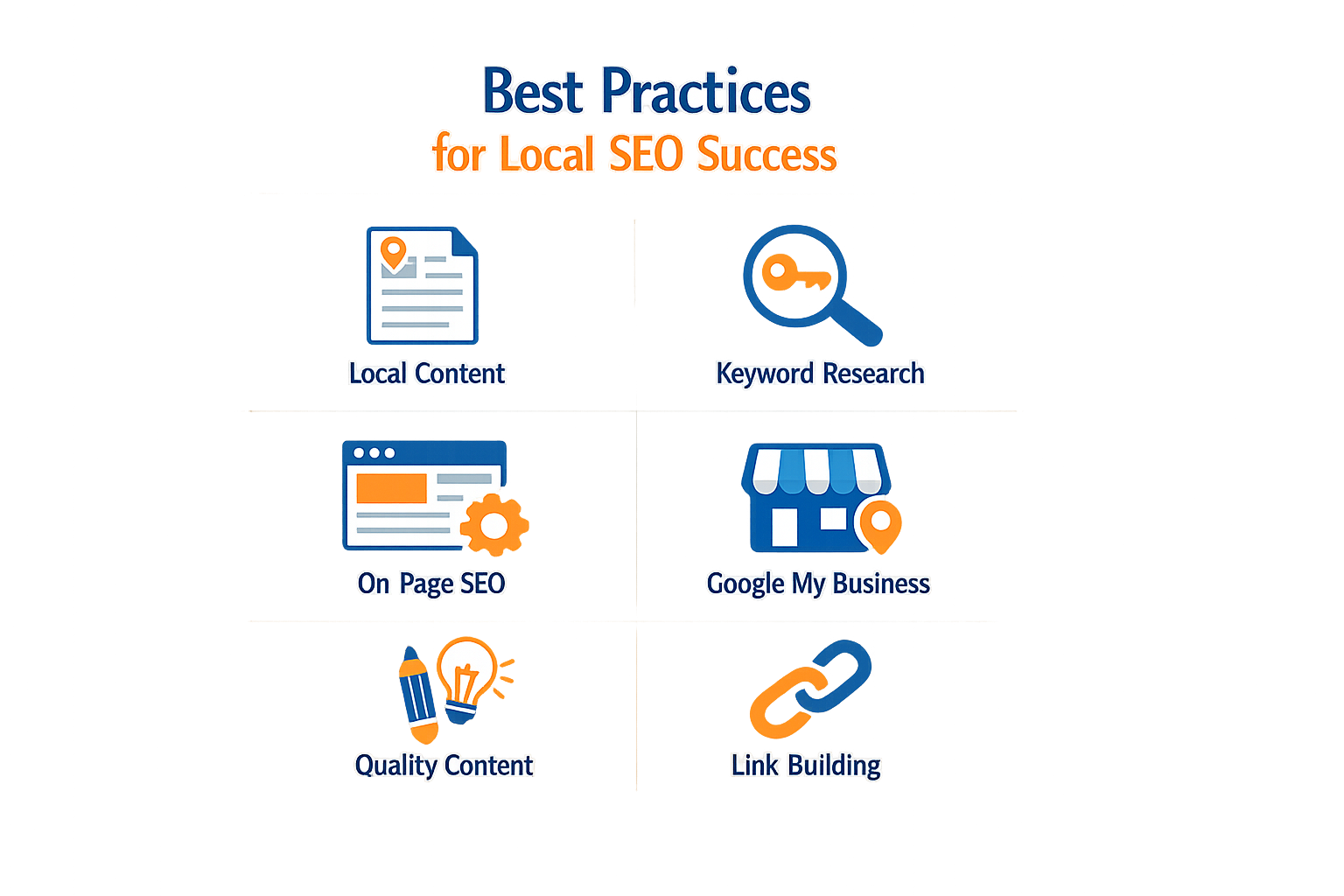
Local SEO for home services isn't a one-time setup. It's a system that compounds when you maintain it consistently. The contractors who rank year after year treat local SEO as operations work, not marketing theater. They update what matters, ignore what doesn't, and measure the gap between effort and calls.
The core practices below separate businesses that show up in local packs from those that disappear when a competitor updates their profile or publishes a few service pages.
Build Content Around Real Service Delivery
Write pages that answer the questions prospects ask before they call. A plumber in Denver doesn't need a blog post about "10 Ways to Save Water" — they need a page explaining what emergency drain clearing costs, how long it takes, and what happens if tree roots are involved. That page should name the neighborhoods they serve, the brands they work with, and the scenarios they handle daily.
Google's guidance emphasizes creating content for people first, then applying SEO to help that content rank. This means your service pages should reflect actual work, not keyword-stuffed templates. If you offer HVAC repair in three counties, each county page should detail the systems common to that area, the permit requirements, and the response time you commit to.
Target Keywords That Match Service Intent
Ranking for "plumber" doesn't matter if everyone searching that term is 40 miles away. Target keywords that include your city, your service, and the job type: "emergency furnace repair Minneapolis," "sewer line replacement Portland," "roof leak repair near me." These phrases convert because they come from people ready to hire, not research.
Use your Google Business Profile insights to see what queries already bring up your profile. If "water heater installation" shows impressions but no clicks, you likely need a dedicated page for that service. If "same-day HVAC repair" drives calls, make sure that phrase appears in your page title, H2, and first paragraph.
Keyword targeting isn't about density — it's about clarity. When someone searches "electrician license lookup California," they're not hiring; when they search "electrician San Jose emergency," they are. Write for the second query.
Update Your Profile and Citations Regularly
Your Google Business Profile should reflect current hours, services, and service areas every quarter. If you stop serving a city, remove it. If you add a new trade (like adding duct cleaning to HVAC), list it. Outdated information costs you calls when prospects see conflicting details across your profile, website, and Yelp listing.
Citations — your business name, address, and phone number on directories like Yelp, Angi, and HomeAdvisor — must match exactly. "ABC Plumbing LLC" on Google and "ABC Plumbing" on Yelp creates ambiguity that search engines penalize. Audit your top 10 citations twice a year and correct any drift.
The contractors who rank consistently treat profile updates like truck maintenance: scheduled, non-negotiable, and tracked.
Collect and Respond to Reviews on a Schedule
Reviews signal trust to both prospects and algorithms. A profile with 40 reviews and a 4.7 average ranks better than one with 10 reviews at 5.0, because volume indicates sustained service delivery. Ask every satisfied customer for a review within 48 hours of job completion — texts with a direct Google review link convert better than email.
Respond to every review, positive or negative, within 72 hours. Thank customers by name, mention the specific service, and keep it short. For negative reviews, acknowledge the issue, state what you'll do, and move the conversation offline. Prospects read your responses to see how you handle problems, not whether you're perfect.
Set a weekly reminder to check review platforms. If you go silent for a month, it signals neglect.
Maintain Consistent NAP Across All Platforms
Your Name, Address, and Phone number (NAP) must be identical everywhere: website footer, Google Business Profile, Facebook, invoices, and every directory listing. Use the same format — if your address is "123 Main St. Suite 4" on Google, don't write "123 Main Street #4" on Yelp.
Inconsistent NAP confuses search engines trying to verify your location. If five sources say "Street" and three say "St.," algorithms can't confidently associate reviews, citations, and searches with your business. This fragments your local authority and pushes you down in rankings.
For multi-location businesses, each location needs its own unique phone number and landing page. Sharing a single number across three cities makes it impossible for Google to determine which location should rank for a given search.
Publish Locally Relevant Content Monthly
A blog post every month that ties your service to local context — new construction permits in your county, seasonal HVAC issues in your climate zone, code changes affecting your trade — keeps your site active and gives you content to share when customers ask questions.
This isn't about traffic. It's about authority. When your site has a page explaining why basements flood in your city every spring, you become the obvious call when someone's sump pump fails in April. When you write about the permit process for deck builds in your township, you rank for "deck builder [township] permit" before competitors who only have a generic services page.
For more on deploying content systems that scale without adding headcount, see our guide on best practices for deploying AI web apps.
Track What Drives Calls, Not Just Rankings
Ranking #1 for "plumber [city]" means nothing if the phone doesn't ring. Use call tracking numbers on your website, Google Business Profile, and any paid ads to see which sources convert. If your Google profile drives 60% of calls but your website drives 10%, you know where to focus effort.
Most contractors discover that their Google Business Profile and a few well-optimized service pages generate the majority of leads. Once you know that, you stop wasting time on low-return tactics like directory spam or blog posts no one reads. You double down on what works: profile completeness, review velocity, and service page clarity.
Measure monthly: total calls, calls by source, and conversion rate (calls that became booked jobs). If any metric drops two months in a row, audit your profile, citations, and top-ranking pages for drift.
Common Local SEO Mistakes to Avoid
Local SEO mistakes cost contractors real jobs. A missing category or an inconsistent phone number can push you below competitors who may deliver worse work but maintain cleaner digital infrastructure. The margin between page one and page two is often a handful of fixable errors.
Most mistakes fall into two categories: ignoring fundamentals or chasing shortcuts. Both leave money on the table.
Treating Your Google Business Profile as Set-and-Forget
Your Google Business Profile is not a business card you print once. It requires regular updates — new photos, recent reviews, current hours, and service area adjustments. Profiles that go dormant signal to Google that the business may be inactive or unreliable.
Contractors who upload three photos at setup and never return miss opportunities to showcase completed projects, seasonal services, and crew capabilities. Fresh content keeps the profile competitive in local pack rankings.
Inconsistent NAP Across Directories
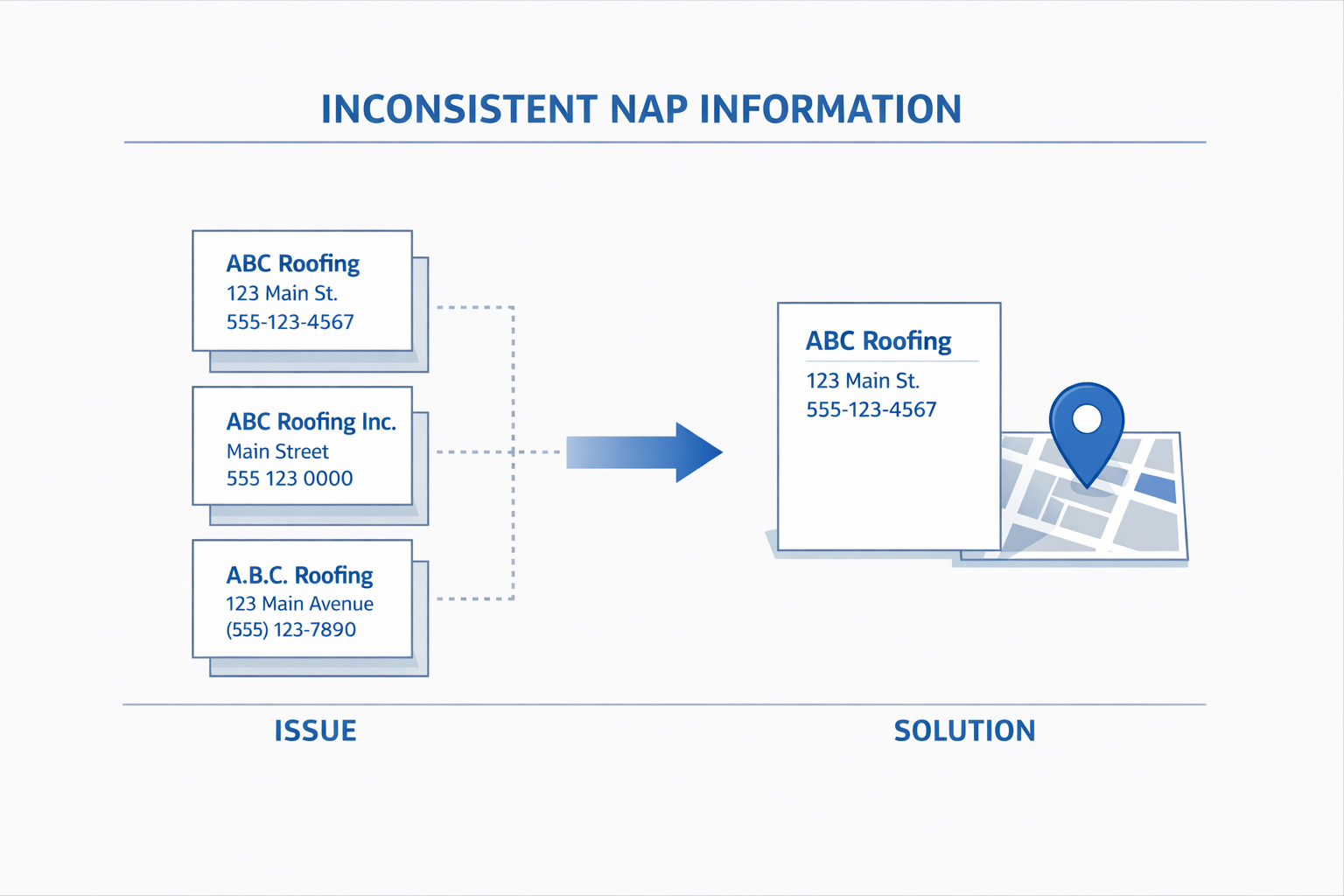
Name, Address, and Phone Number (NAP) consistency is foundational. When your business appears as "ABC Plumbing" on Google, "ABC Plumbing LLC" on Yelp, and "ABC Plumbing Services" on your website, search engines struggle to verify which entity is authoritative.
Variations in street abbreviations, suite numbers, or phone formats create the same problem. If your address reads "123 Main St." in one place and "123 Main Street" in another, you dilute citation strength.
Audit every directory listing, social profile, and website footer. Standardize the exact formatting and update any discrepancies immediately.
Ignoring Negative Reviews or Responding Defensively
Negative reviews happen. Ignoring them signals that you either do not monitor your reputation or do not care about customer feedback. Responding with hostility or defensiveness makes the problem worse and often becomes the story prospects remember.
A professional response acknowledges the issue, offers a path to resolution, and demonstrates accountability. Potential customers read review responses to gauge how you handle problems — not whether problems occur.
The way you respond to a two-star review often matters more than the review itself.
Keyword Stuffing in Business Descriptions
Repeating "emergency plumber Denver" fifteen times in your Google Business Profile description does not improve rankings. It triggers spam filters and makes your business look untrustworthy to both search engines and potential customers.
Write descriptions for humans. Include your primary service and location naturally, then focus on what makes your business distinct — certifications, response times, guarantees, or specializations.
Neglecting Mobile Experience
Most local searches happen on mobile devices, often while the user is actively looking for immediate service. If your website takes more than three seconds to load or requires zooming and horizontal scrolling to read, you lose the lead before the phone rings.
Test your site on multiple devices. Ensure click-to-call buttons work, forms are simple, and contact information is visible without scrolling. A poor mobile experience is a direct conversion killer.
Hiring Unvetted SEO Providers
Not all SEO services operate with the same standards. Some promise fast results through tactics that violate search engine guidelines — fake reviews, spammy backlinks, or cloaked content. These shortcuts may produce short-term visibility, but they carry long-term penalties that can remove your business from search results entirely.
Before engaging any provider, research their methods and verify references. Ask how they plan to improve your rankings and whether their approach aligns with search engine guidelines. If an offer sounds too good to be true, it usually is. For a broader perspective on evaluating technical service providers, see best practices for deploying AI web apps, which covers similar due diligence frameworks.
Failing to Track Performance
Running local SEO without measurement is guesswork. If you do not monitor which keywords drive calls, which pages convert visitors, or how your rankings shift over time, you cannot identify what works or where to invest effort.
Set up Google Analytics and Google Search Console. Track phone calls, form submissions, and direction requests. Review monthly trends and adjust your strategy based on data, not assumptions.
Frequently Asked Questions about Local SEO for Contractors
Owner-operators ask the same core questions when they start optimizing for local search. Below are the answers that matter most when you're running the business and doing the SEO work yourself.
Do I need to hire an SEO company, or can I do local SEO myself?
You can do local SEO for home services yourself if you're willing to learn the systems and commit time each week. The foundational tasks — claiming your Google Business Profile, building citations, collecting reviews, and publishing service pages — are all within reach for an owner-operator who follows a checklist.
Hiring help makes sense when you lack the time to stay consistent or when technical issues (site speed, schema markup, mobile errors) exceed your comfort level. If you do hire, research thoroughly: ask for client references, request examples of past local SEO work, and verify that the provider follows Google's guidelines. An irresponsible SEO can damage your site's visibility and reputation, so due diligence is not optional.
For many home service businesses, a hybrid approach works best: handle the ongoing tasks (reviews, posts, content updates) in-house and bring in a specialist for the technical setup and periodic audits.
How long does it take to see results from local SEO?
Most contractors see measurable changes in local rankings and call volume within 90 to 180 days of consistent effort. The timeline depends on how competitive your market is, how much existing authority your site has, and how aggressively you execute the core tasks.
Early wins — like appearing in the Local Pack for branded searches or showing up for hyper-local neighborhood queries — can happen in weeks. Ranking for competitive service terms in a metro area typically takes months of sustained work: regular content publishing, citation building, review accumulation, and backlink acquisition.
Expect the first 60 days to feel slow. You're building the foundation (GBP optimization, citation cleanup, on-page SEO) that supports everything else. The compounding effect kicks in after that initial phase, especially if you maintain a weekly publishing and review-collection rhythm.
What's the difference between organic SEO and local SEO?
Organic SEO targets visibility in the standard blue-link search results, regardless of the searcher's location. Local SEO targets the map pack, local finder results, and geographically qualified searches where proximity and local signals determine ranking.
For home service businesses, local SEO is the higher-ROI channel because most of your customers search with local intent: "plumber near me," "roof repair [city name]," or just "electrician" from a mobile device where Google infers location. The ranking factors overlap (content quality, backlinks, mobile usability) but local SEO adds location-specific signals: Google Business Profile completeness, NAP consistency, review velocity, and proximity to the searcher.
You need both. Organic SEO builds domain authority and captures informational searches that lead to service calls later. Local SEO captures high-intent searches from people ready to hire today. Prioritize local SEO first if resources are limited; it delivers faster returns for service businesses.
How many reviews do I need to rank well locally?
There is no fixed number, but review volume and recency both matter. In competitive markets, the businesses ranking in the top three Local Pack positions typically have 50+ Google reviews, with new reviews appearing every few weeks. In smaller markets, 20–30 reviews may be enough if they're recent and well-distributed over time.
What matters more than total count is velocity and consistency. A contractor with 40 reviews, 10 of them from the past 60 days, will often outrank a competitor with 60 reviews but none newer than six months. Google interprets fresh reviews as a signal of active business and customer satisfaction.
Focus on building a repeatable system: ask every satisfied customer, send follow-up texts or emails within 24 hours of job completion, and make the review link easy to access. Aim for at least two new reviews per week if you're in a competitive metro market. Quality and authenticity matter — never buy reviews or incentivize them with discounts, as both violate Google's policies and risk penalties.
Can I rank in multiple cities with one website?
Yes, but it requires dedicated location pages for each service area, not just a single homepage targeting multiple cities. Google ranks pages, not websites, so each city you serve needs its own optimized landing page with unique content, local citations, and ideally some backlinks from local sources.
A strong multi-city strategy includes:
- Individual service-area pages with unique descriptions of your work in that city
- Embedded Google Maps showing your service radius or office location
- Testimonials or case studies from customers in that city
- Local backlinks (chamber of commerce, local business directories, community sponsorships)
- Consistent NAP listings in local directories for each city
If you have a physical location or registered office in a city, your ranking potential is higher. If you're purely service-area-based with no physical presence, you can still rank but face stiffer competition from businesses with verified addresses in those cities.
Avoid creating thin, duplicate pages that just swap out the city name. Google penalizes low-quality doorway pages. Each location page should offer real value and distinct content.
Do social media profiles help with local SEO?
Social profiles contribute indirectly. Google does not use social signals (likes, shares, follower counts) as direct ranking factors, but an active social presence supports local SEO in three ways:
- Citation and NAP consistency: Your Facebook, LinkedIn, and Instagram profiles are citation sources. Consistent business name, address, and phone number across these platforms reinforces your local identity.
- Traffic and engagement: Social posts that drive traffic to your website, especially to service pages or blog content, signal relevance and authority. Engaged visitors who spend time on your site improve behavioral metrics that correlate with rankings.
- Local backlinks and mentions: Community engagement on social platforms (tagging local businesses, participating in neighborhood groups, sponsoring events) can lead to backlinks from local blogs, news sites, and directories.
Maintain complete, accurate profiles on the platforms where your customers spend time. For most home service businesses, that means Facebook and Instagram. Post regularly (weekly at minimum), respond to messages and comments promptly, and use location tags to reinforce your service areas. Social media won't replace core local SEO work, but it amplifies the signals you're already building.
What if I don't have a physical storefront — can I still do local SEO?
Yes. Service-area businesses (SABs) without a public-facing storefront can still rank in local search, but the setup differs slightly. When you configure your Google Business Profile, you hide your street address and instead define your service areas by city, ZIP code, or radius.
Google allows SABs to rank in the Local Pack for searches within their defined service areas, but you won't appear for searches at your hidden address location. This levels the playing field: a plumber based in one suburb can rank for searches across the metro area, as long as the service-area settings are configured correctly and the rest of the local SEO work is solid.
Key tactics for SABs:
- Define service areas precisely in your GBP settings (up to 20 areas)
- Create dedicated location pages for each major city or region you serve
- Build citations in local directories that support service-area businesses
- Collect reviews mentioning the cities where you completed jobs
- Use schema markup (
LocalBusinessandServicetypes) to specify service regions on your website
You're competing against businesses with physical locations, so your content, reviews, and backlink profile need to be stronger to compensate. It's harder but entirely achievable with consistent effort.
How often should I update my Google Business Profile?
Weekly is ideal; monthly is the minimum to stay competitive. Google rewards active profiles with better visibility, and regular updates signal that your business is operational and engaged with customers.
Update types that matter:
- Posts: Share project photos, seasonal offers, or service reminders at least once per week. Posts appear in your GBP knowledge panel and can improve click-through rates.
- Photos: Upload new images every week — completed jobs, team members, equipment, before-and-after shots. Profiles with fresh photos get more engagement than those with static galleries.
- Q&A: Monitor and respond to questions in the Q&A section. Seed it with common questions (and answers) if customers haven't asked yet.
- Business information: Update hours immediately for holidays, service changes, or seasonal schedules. Inaccurate hours hurt rankings and frustrate customers.
- Reviews: Respond to every review within 48 hours, ideally within 24. Response rate and speed are both ranking factors.
Set a recurring calendar event for GBP maintenance. Fifteen minutes per week is enough to post an update, upload photos, and check for new reviews or questions. Consistency beats intensity — a steady drip of activity outperforms sporadic bursts.
For more technical guidance on deploying digital tools that scale with your business, see our best practices for deploying AI web apps.
Conclusion
Local SEO for home services isn't a set-it-and-forget-it project — it's an operational discipline that compounds over time. Owner-operators who treat their Google Business Profile as live infrastructure, not a listing, see consistent lead flow without the volatility of paid channels. The contractors who win local search are the ones who answer the phone, update their hours when they change, and ask every satisfied customer for a review before the truck leaves the driveway.
The mechanics are straightforward: claim and verify your profile, build citations that match your NAP exactly, earn reviews systematically, and publish content that answers the questions your market actually searches. What separates effective local SEO from busywork is the willingness to track which actions produce calls and which produce only activity. If a tactic doesn't increase qualified inquiries within 90 days, you replace it.
For service businesses ready to move beyond manual tracking and fragmented tools, deploying AI-powered web applications can centralize lead routing, review requests, and citation monitoring into a single operational layer. The goal is not more rankings — it's more signed work from customers who found you because you showed up when and where they searched.
Start with your Google Business Profile today. Verify every field is current, add this week's project photos, and send a review request to your last three completed jobs. Local SEO works when you work it consistently, and the market rewards operators who show up reliably in search the same way they show up reliably on site.
Sources(8)
- Google Search Central documentation
- Google Search Central — Local business (LocalBusiness) structured data
- Google Business Profile guidelines
- Google Business Profile guidelines
- Google Business Profile Help — Guidelines for representing your business on Google
- Google Search Central documentation
- Google Search Central documentation
- google-search-central (source_extract)
Written by
Xenophon Giannis
Published October 18, 2026 · 29 min read
Xenophon Giannis is the founder and CEO of Xenco Labs, where he designs, builds, deploys and operates production AI software solo — on his own multi-node cluster, with his own LLM gateway and automation infrastructure. Twenty-five years in enterprise technology came first: a decade at AboveNet, hired as its first sales rep after bankruptcy and promoted until he ran the entire Western Pacific region, then sales leadership at Black Lotus and Nexusguard in DDoS mitigation. He writes about what he actually ships, and what actually breaks in production.
You Might Also Like
More from the Xenco Labs blog

How to Design a Request a Quote Form That Captures Qualified Jobs
Learn how to design a request a quote form that effectively captures qualified jobs and leads for your business with proven field strategies.

Speed to Lead: Lead Response Time for Service Businesses: Why Speed
Discover how lead response time impacts conversion rates for service businesses and learn proven strategies to improve your response speed. Speed to lead is crucial

General Contractor Website Design: Features for Winning Jobs
Learn the essential features of general contractor website design that help service businesses win jobs and attract clients effectively.

Landscaping SEO: SEO for Landscaping: How to Get Found Locally
Learn effective landscaping SEO strategies to enhance local visibility and attract customers to your landscaping business online.