
Speed to Lead: Lead Response Time for Service Businesses: Why Speed
Discover how lead response time impacts conversion rates for service businesses and learn proven strategies to improve your response speed. Speed to lead is crucial
Discover how lead response time for service businesses impacts job success and learn strategies to improve response speed.
Introduction
Lead response time measures the interval between when a prospect contacts your business and when they receive a substantive reply. In the realm of local service businesses, the speed at which we respond to web-form leads can make or break a potential deal. When a homeowner submits a quote request for HVAC repair, plumbing work, or lawn care, they're often reaching out to multiple providers simultaneously. The business that responds first — with a real answer, not just an acknowledgment — typically wins the job before the others finish checking voicemail.
For service businesses, this metric matters more than almost any other operational measure because it directly correlates with conversion rates. According to a Harvard Business Review study, firms that contacted potential customers within an hour of receiving a query were nearly seven times more likely to qualify the lead than those that waited even 60 minutes longer. A lead that waits six hours for a callback has likely already booked with someone else. At Xenco Labs, our work building operating systems for local service businesses has confirmed what the data shows: faster response doesn't just improve conversion — it often determines whether conversion happens at all.
The challenge isn't awareness. Most service business owners know speed matters. The problem is that traditional operations — where the owner handles phones, estimates, scheduling, and fieldwork — create structural delays. A plumber finishing a job can't answer the phone. An electrician driving between sites misses the web lead notification. By the time they circle back to inquiries, the prospect has moved on. Improving lead response time requires changing how the business captures, qualifies, and moves leads through the pipeline, which is why small business automation has become essential for competitive service operations.
The sections ahead examine why delayed responses cost jobs, what systems eliminate delays, and how owner-operated businesses implement faster response workflows without hiring additional staff. The goal is a process where leads receive estimates, book appointments, and enter your pipeline in minutes rather than hours — regardless of whether you're on a ladder or in a crawl space when they contact you.
The Problem: Slow Response Times Cost Jobs
When a potential customer submits a web form or calls your business, they are signaling immediate intent. That window of engagement is narrow. Every minute you wait to respond, the likelihood of conversion drops — not because your service is inadequate, but because competitors who answer first capture the conversation. In service industries where jobs are won on availability and responsiveness, a delayed reply often means the lead has already moved on.
Slow Responses Signal Low Priority
Customers interpret response speed as a proxy for how you will treat them throughout the engagement. If it takes hours or days to receive an acknowledgment, they assume the same delays will plague estimates, scheduling, and project completion. A prompt response, by contrast, signals commitment to high-quality service and respect for the customer's time. This perception shapes their decision before you ever discuss scope or price.
The Cost of Manual Follow-Up
Many service businesses rely on the owner or a single admin to monitor inbound leads. When that person is on a job site, in a meeting, or simply overwhelmed, inquiries sit unattended. Without automation, follow-up depends on memory and availability, creating gaps that competitors exploit. Small business automation can address these bottlenecks by ensuring every lead receives immediate acknowledgment and structured follow-up, even when the team is busy.
Missed Opportunities Compound Over Time
A single slow response may seem like a minor inconvenience, but the pattern compounds. Each lost lead represents not just one job, but the potential for repeat business, referrals, and reviews. Over weeks and months, inconsistent response times erode your pipeline and hand market share to competitors who have systematized their intake process. The businesses that treat speed to lead as a competitive advantage consistently outperform those that treat it as an afterthought.
What Is Lead Response Time?
Lead response time is the elapsed duration from the moment a prospect initiates contact — via phone call, web form, chat message, or email — until they receive a substantive reply from your business. "Substantive" means more than an automated "we got your message" acknowledgment; it means a human or AI-powered response that addresses their specific inquiry, provides information about availability, pricing, or next steps, and moves them closer to booking.
For service businesses, lead response time is typically measured in minutes or hours rather than days. Industry benchmarks show that response times under five minutes yield the highest qualification and conversion rates, while delays beyond an hour significantly reduce the likelihood of securing the job. The metric matters because it directly reflects operational capacity: businesses with structured intake systems, automated acknowledgments, and real-time notifications consistently achieve faster response times than those relying on manual processes.
Measuring lead response time requires tracking when the inquiry arrives and when the first meaningful interaction occurs. Modern CRM systems and marketing automation platforms timestamp both events automatically, allowing businesses to calculate average response times, identify bottlenecks, and set performance targets. For owner-operated service businesses, improving this metric often means replacing ad-hoc workflows with systems that handle intake, qualification, and initial outreach without requiring the owner to be physically present.
Solution Steps: Improving Your Lead Response Time
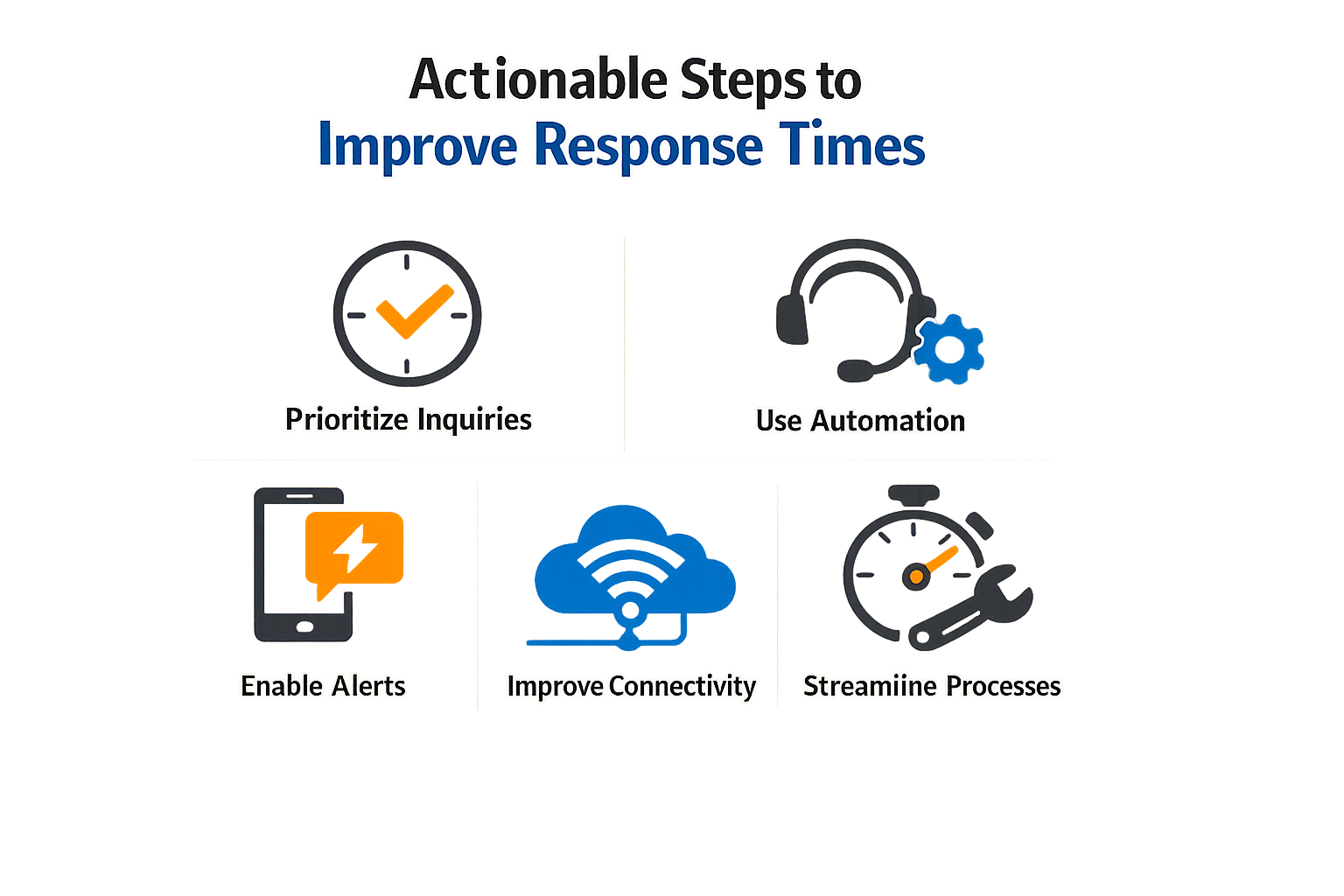
Improving lead response time requires deliberate changes to how your business handles incoming inquiries. The steps below address the core friction points that slow down most service businesses — from the moment a lead arrives to the moment they receive a written estimate.
The customer gets an answer instead of voicemail. Deploy an AI phone receptionist trained on your business knowledge to handle calls 24/7, or configure web-form submissions to trigger instant acknowledgment. Leads that reach a human voice or structured response within minutes convert at significantly higher rates than those sent to voicemail or a generic auto-reply.
A rules-based calculator produces a written estimate from your real rate card. Build a configurable estimator that uses your service catalog and pricing structure to generate PDF estimates automatically. The owner retains final field verification, but the customer receives a ballpark number immediately — not days later after manual quoting.
Customers schedule the right appointment against live calendar availability. Integrate real-time scheduling that shows open slots and allows leads to book directly. Flexible scheduling gets your team to the right place at the right time without the back-and-forth that adds hours or days to the response cycle.
Quote nurture, customer updates, and follow-up workflows run from the CRM without depending on memory. Campaign automation manages follow-ups and recurring-service reminders, so no lead falls through the cracks. Using CRM automation for structured follow-ups removes the office-manager bottleneck and ensures every inquiry receives timely contact.
Optimize daily or weekly routes for your whole team in seconds. Route optimization reduces drive time and allows teams to respond to new leads more quickly. When scheduling adjusts instantly to changing conditions, you can slot urgent leads into the same-day calendar instead of pushing them to next week.
Prioritize High-Value Leads
Get notified when a quote represents a high-value job so you can prioritize and respond quickly. Lead qualification based on your criteria surfaces the prospects worth immediate personal attention. High-priority leads screened and identified early let you allocate owner time where it matters most — closing the jobs that move the revenue needle.
Integrate the Full Loop
The operating loop from first contact to money in the bank should flow without manual handoffs. Lead arrives, estimate generates, customer books, you verify scope in the field, work completes, invoice sends. Automations prepare and move the work; the business owner retains approval where pricing, scope, and customer commitments matter. When each step triggers the next automatically, lead response time shrinks from days to minutes.
For service businesses looking to build this kind of operating system, small business automation provides a framework for deciding which workflows to automate first.
Tips and Tricks for Faster Response Times
Beyond implementing structured workflows, service businesses can deploy specific tools and techniques to reduce lead response time even further. The difference between a five-minute response and a two-hour response often comes down to the quality of your operational stack and how well your team uses it.
How Can I Automate Initial Contact Without Losing the Human Touch?
AI phone receptionists now handle inbound calls 24/7, capturing caller details and routing high-priority leads to the right team members with full context. These systems transcribe calls, generate structured summaries, and deliver instant notifications — so your team knows what the caller needs before they pick up the phone. The technology works in English and Spanish, ensuring language barriers do not slow down your intake process.
CRM automation handles follow-up sequences without requiring an office manager. Quote nurture workflows, recurring-service reminders, and customer update campaigns run on schedules you define once and refine over time. When a lead does not respond to an initial estimate, the CRM triggers a follow-up email three days later — no manual tracking required.
What Tools Help Reduce Lead Response Time?
Flexible scheduling tools let customers book appointments against live calendar availability, eliminating phone tag and reducing the time between inquiry and site visit. When a high-value quote request comes in, the system flags it immediately so you can prioritize your response.
Route optimization cuts drive time by reorganizing daily or weekly schedules in seconds. Faster routes mean your team spends less time in the truck and more time in front of customers — which directly improves your capacity to respond to new leads the same day they arrive.
The faster you can put a qualified technician in front of a prospect, the less time competitors have to insert themselves into the decision.
How Do Instant Estimate Workflows Work?
Rules-based estimators produce written quotes from your rate card as soon as a lead provides job details. Customers receive a PDF estimate within minutes, and you retain final verification before committing to scope or price. This approach removes the bottleneck of manual quoting while keeping quality control in your hands.
Customizable quote templates with signature approval and automated calendar reminders keep prospects moving through your pipeline. When the system auto-drafts quotes from new requests, you review and send rather than build from scratch — cutting lead response time from hours to minutes.
For businesses that need a complete operating loop, small business automation strategies can help you identify which manual tasks to automate first for maximum impact on lead response time.
Why Does Local SEO Matter for Lead Response Time?
Technical SEO, structured data, and optimized local landing pages ensure inbound leads arrive with context — service type, location, and urgency already captured in the form submission. When your website collects the right information up front, your team spends less time gathering details and more time responding with relevant solutions. For comprehensive guidance on optimizing your local presence, see our local SEO checklist for service businesses.
Service pages that rank well in local search attract higher-intent leads who are ready to book. These prospects convert faster because they have already researched your services and decided you are a fit before they contact you. Learn more about building this foundation in our local SEO for contractors playbook.
Conclusion: Making Lead Response Time a Priority
Improving lead response time is not a technical nicety — it is a competitive requirement for service businesses operating in markets where customers compare multiple providers before committing. The evidence is consistent: faster response correlates with higher conversion, and delays create opportunities for competitors to claim work that could have been yours. When a lead arrives via phone or web form, the clock starts immediately, and every hour of delay reduces the likelihood that the inquiry turns into a booked job.
The solution is not heroic effort; it is system design. Businesses that treat lead response time as an operational priority build workflows that answer leads without depending on owner availability, deliver estimates based on structured rate cards, and route high-priority prospects with context intact. These are not aspirational practices — they are implementations we have deployed across local service business projects at Xenco Labs, where the operating system handles intake, estimation, and scheduling so that no lead waits for someone to check voicemail. The faster you respond, the higher your chances of securing the job, and that principle applies whether you are optimizing search programs or configuring CRM automation.
Prioritizing lead response time requires commitment at the business-model level. It means choosing tools that support 24/7 intake, training AI receptionists on your actual service knowledge, and designing estimate workflows that produce written quotes without manual intervention. It also means measuring response intervals, identifying bottlenecks, and iterating on the process until speed becomes the default rather than the exception. The businesses that win in competitive service markets are the ones that treat every inbound lead as perishable inventory and act accordingly.
If your current process depends on checking messages twice a day or manually drafting estimates after hours, you are already behind competitors who have automated those steps. The path forward is clear: audit your intake process, identify the longest delays, and replace manual handoffs with structured automation. Lead response time is not about working harder — it is about building systems that respond faster than you can, ensuring no lead is left unattended and no opportunity is lost to a competitor with better infrastructure. For guidance on implementing these systems, see our Small Business Automation: Workflow Automation for Small Business resource.
FAQ
What is a good lead response time for service businesses? Industry research shows that responding within five minutes yields the highest conversion rates. Businesses that contact leads within an hour are nearly seven times more likely to qualify the prospect than those who wait longer.
How does lead response time affect conversion rates? Faster lead response time directly increases conversion because prospects are still actively researching when you reply. Delays allow competitors to capture the conversation and book the job before you respond.
Can small service businesses compete on lead response time? Yes. Owner-operated businesses can deploy AI receptionists, automated estimators, and CRM workflows that respond instantly — even when the owner is on a job site. System design beats manual effort.
What tools improve lead response time? AI phone receptionists, CRM automation, rules-based estimators, real-time scheduling platforms, and route optimization software all reduce the time between inquiry and substantive reply.
Why do leads stop responding after initial contact? Leads often go silent because they've already booked with a competitor who responded faster. If your follow-up arrives hours or days late, the prospect has likely moved on.
Sources(21)
- Xenco Labs — Websites & Landing Pages
- ServiceTitan
- Housecall Pro
- FieldPulse
- Smith.ai
- Local Service Business OS
- Smith.ai — AI Receptionist pricing
- Google Search Central documentation
- Google Business Profile guidelines
- Google Business Profile guidelines
- Google Search Central — Local business (LocalBusiness) structured data
- Jobber — Pricing page
- Xenco Labs — Local Service Business OS SEO/AEO/content strategy (2026-10-08)
- Xenco Labs — Digital Growth Strategy
- Google Business Profile Help — Tips to get more reviews
- local-service-business-os (shared_fact)
- websites-landing-pages (shared_fact)
- servicetitan (competitive_claim)
- google-search-central (source_extract)
- sonoma-wash-co (xl_local_os_editorial)
- jobber (competitive_claim)
Written by
Xenco Labs Editorial
Published October 20, 2026 · 13 min read
The Xenco Labs editorial team writes about building and shipping AI products to production.
You Might Also Like
More from the Xenco Labs blog

How to Design a Request a Quote Form That Captures Qualified Jobs
Learn how to design a request a quote form that effectively captures qualified jobs and leads for your business with proven field strategies.

General Contractor Website Design: Features for Winning Jobs
Learn the essential features of general contractor website design that help service businesses win jobs and attract clients effectively.

Landscaping SEO: SEO for Landscaping: How to Get Found Locally
Learn effective landscaping SEO strategies to enhance local visibility and attract customers to your landscaping business online.

Home Service Marketing: A Channel Plan for Owner-Operated Businesses
Discover practical home service marketing strategies. Build an effective channel plan for owner-operated service companies.