
Landscaping SEO: SEO for Landscaping: How to Get Found Locally
Learn effective landscaping SEO strategies to enhance local visibility and attract customers to your landscaping business online.
Introduction
Landscaping companies compete in a local market where visibility determines survival. When a homeowner searches for lawn care, hardscaping, or seasonal cleanup, the businesses that appear in the top three map results capture the majority of calls. The ones that do not appear might as well not exist.
SEO for landscaping is not about gaming algorithms or keyword stuffing. It is about making your business discoverable when people in your service area need exactly what you offer. That means managing how search engines understand your location, your services, and your authority in the local market. Modern search visibility has expanded beyond traditional Google results to include AI-generated answers, voice search responses, and local service ads — each channel requiring specific technical and content strategies.
Most landscaping business owners treat SEO as a mystery or delegate it entirely without understanding what actually moves the needle. The reality is simpler: local search visibility follows predictable patterns. Businesses that control their foundational data, publish service-specific content, and maintain consistent citations across directories outrank competitors who ignore these basics. For owner-operators managing tight margins, understanding which SEO activities produce returns — and which are distractions — makes the difference between profitable growth and expensive experiments. Home service marketing channels work together, but local search remains the primary driver for service businesses operating in defined geographic areas.
The technical work is not optional. Search engines and AI systems need machine-readable signals about what you do and where you do it. When those signals conflict or disappear, your rankings drop. When they align and strengthen over time, you show up consistently for high-intent searches that turn into jobs.
The Challenge of Being Found Local
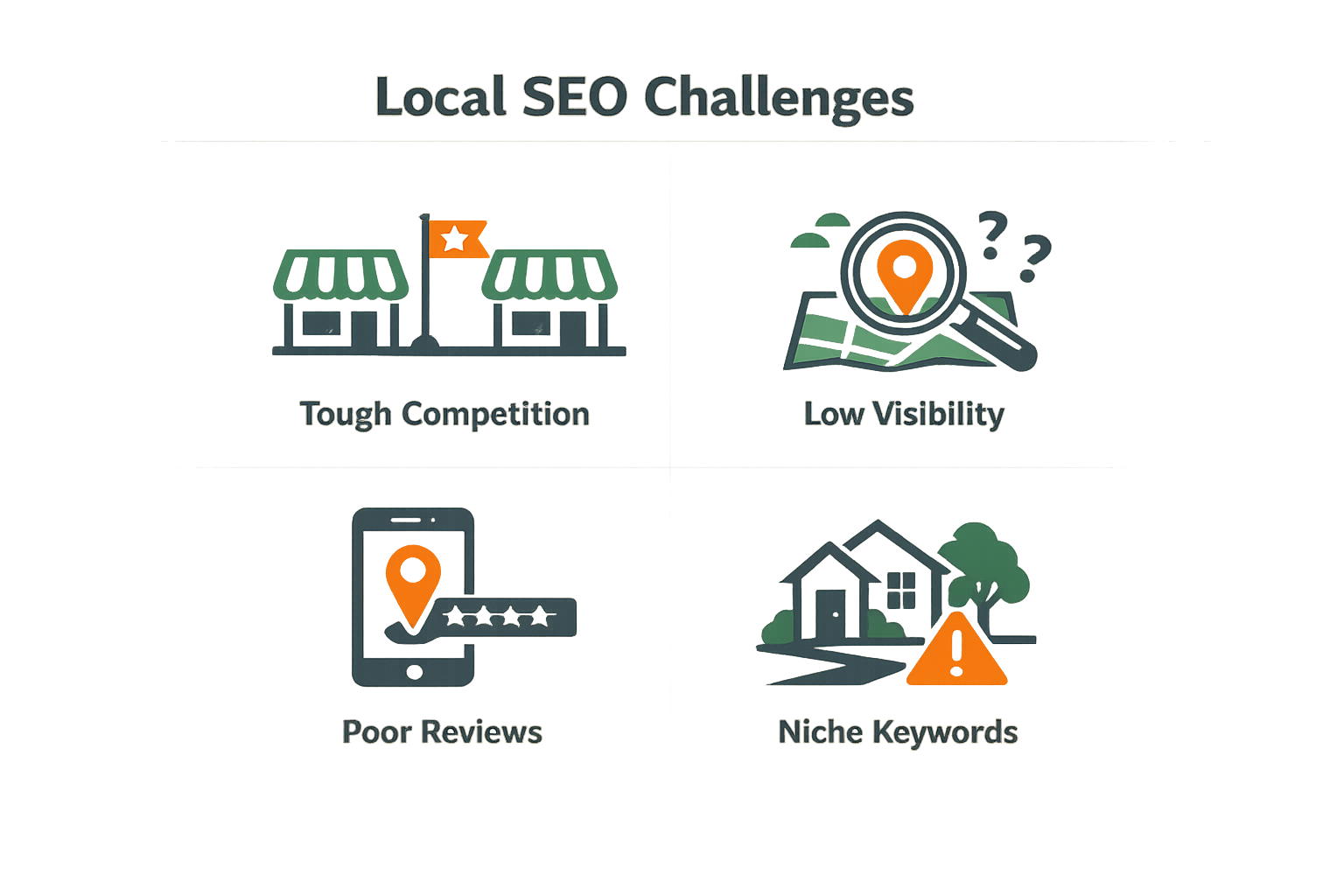
Landscaping companies operate in a visibility paradox. Your service area is bounded by drive time, but search engines present your business alongside competitors from neighboring ZIP codes, franchise operations with national backing, and lead-generation sites that outrank actual service providers. The customer searching "landscape design near me" sees a grid of ten results — and unless your business occupies one of those slots, the phone does not ring.
Why Local Visibility Breaks Down
Most landscaping businesses treat SEO as a checklist: claim the Google Business Profile, add photos, ask for reviews. That foundation matters, but it does not solve the structural problems that keep you out of the local pack. Search engines evaluate hundreds of signals to determine which businesses deserve visibility for a given query and location. If your NAP data (name, address, phone) is inconsistent across directories, if your website lacks location-specific content, or if your service pages describe what you do without anchoring it to where you do it, the algorithm has no reason to promote you over a competitor who got those details right.
The stakes are higher than rankings. Organic search success is not measured by position alone — the objective is qualified consultations and signed contracts. A landscaping company that ranks third in the local pack but converts poorly has not solved the visibility problem; it has simply moved the bottleneck from discovery to conversion. Your SEO for landscaping strategy must connect search visibility to the actions that generate revenue: phone calls, form submissions, and appointment bookings.
The Multi-Channel Reality
Local SEO for landscaping is not a single-channel effort. Modern search roles combine technical SEO, content operations, structured data, and conversion optimization — functions that most small businesses assign to one person or leave unmanaged entirely. You are competing against companies that treat search as an operating system: they publish location pages for every service area, they structure their content so AI search tools can cite it, and they measure performance by pipeline contribution rather than traffic volume.
If you are handling SEO between job estimates and crew scheduling, you are not operating at the same level as competitors who have systematized these functions. The gap shows up in search results, and it shows up in your phone activity. For a clearer picture of how owner-operated service businesses can structure their marketing efforts across channels, see our guide on home service marketing channel planning.
What Are the Steps to Improve SEO for Landscaping?

Local SEO for landscaping companies requires a structured approach. The steps below prioritize the work that produces measurable visibility gains in local search results. Each step builds on the previous one, so sequence matters.
Step 1: Claim and Verify Your Google Business Profile
Step 1
Claim and verify your Google Business Profile
Your Google Business Profile is the foundation of local visibility. Claim your listing, verify ownership through Google's process, and ensure your business name, address, and phone number match exactly what appears on your website and other directories. Mismatches confuse Google and dilute your local ranking signals.
Once verified, fill out every available field: service areas, business hours, categories, and a complete business description. Google rewards completeness. If you operate as a service area business rather than a storefront, configure your profile accordingly and list all service zones. According to Google's own documentation, businesses with complete profiles receive 7x more clicks than those with incomplete information.
Step 2: Implement Local Business Structured Data
Step 2
Add Local Business structured data to your website
Structured data tells Google exactly what your business does and where you operate. Use the LocalBusiness schema to mark up your name, address, phone, hours, and service offerings. Google Search supports multiple formats; choose the one easiest for you to maintain and validate it with Google's testing tools after deployment.
With Local Business structured data, you can tell Google about business hours, different departments within a business, and more. Include all required properties for your markup to be eligible for enhanced display in search results. Fewer but accurate properties outperform incomplete data every time.
Step 3: Build NAP Consistency Across Directories
Step 3
Audit and standardize your NAP citations
Your name, address, and phone number must appear identically across every online directory, social profile, and citation source. Run an audit of your current listings and correct any variations in formatting, abbreviations, or outdated information. Consistency signals legitimacy to search engines.
For landscaping businesses, prioritize directories that serve your local market and industry-specific platforms. A local SEO checklist can help you systematically verify each citation source before investing in paid advertising.
Step 4: Optimize On-Page Content for Local Intent
Step 4
Create service pages targeting local search terms
Build dedicated pages for each service you offer and each geographic area you serve. Use local modifiers naturally in your headings, body copy, and meta descriptions. A page titled "Lawn Maintenance in [City Name]" targets a specific search query and gives Google clear geographic signals.
Write for the homeowner or property manager searching for help, not for search engines. Answer the questions your prospects ask: what the service includes, how long it takes, and what makes your approach different. Include real project examples and local references where relevant.
Step 5: Collect and Display Customer Reviews
Step 5
Develop a review acquisition process
Reviews improve credibility and influence local rankings. Ask satisfied customers to leave reviews on your Google Business Profile immediately after project completion. Make the process easy: send a direct link, provide brief instructions, and follow up once if needed.
Incorporating reviews into your website can improve your landscaping business's credibility and attract more customers. Display recent reviews prominently on your homepage and service pages. Respond to every review, positive or negative, to show you're engaged and accountable. Research from BrightLocal indicates that 87% of consumers read online reviews for local businesses in 2024, making review management a critical component of SEO for landscaping companies.
How Can You Optimize SEO for Landscaping More Effectively?
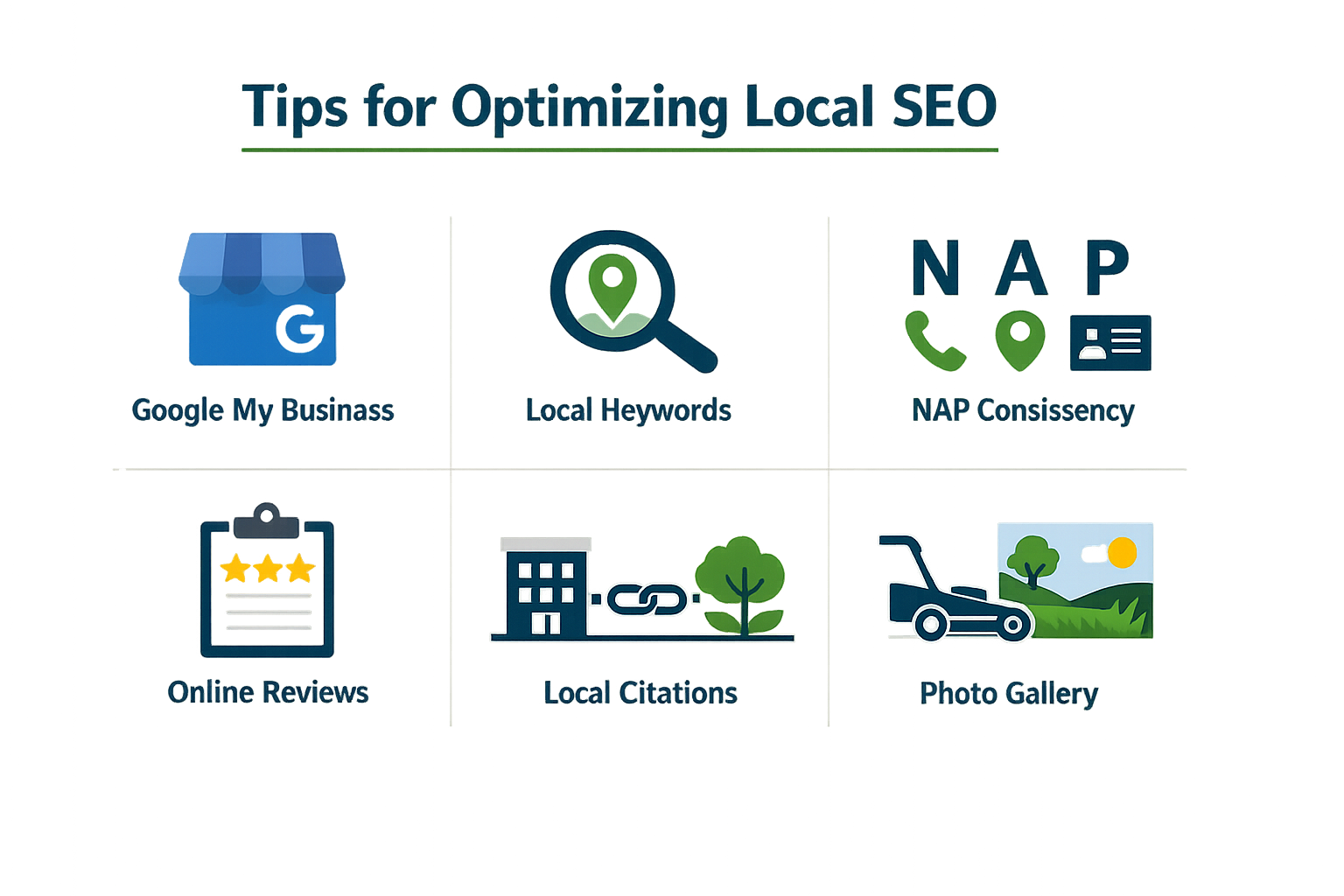
Once the foundational work is in place, a few targeted practices can sharpen your local visibility and make your landscaping business easier to find. These tips address common gaps we see in service-area operations — where small adjustments produce measurable gains in search performance.
Design for Search Engine-Friendliness From the Start
If you are launching a new site or rebuilding an existing one, build with search visibility in mind rather than retrofitting later. Ensure your site structure, URL patterns, and navigation support both user experience and crawlability. When search engines can easily discover and understand your content, you avoid the expensive remediation work that comes from bolting SEO onto a finished design.
Demonstrate Experience, Expertise, Authoritativeness, and Trustworthiness
Search engines prioritize content that demonstrates experience, expertise, authoritativeness, and trustworthiness. For landscaping companies, this means showcasing completed projects with detailed descriptions, explaining your process and methodology, and providing clear contact information and service-area details. Avoid generic content that could apply to any business — specificity signals credibility.
Include real project examples, explain why you chose certain plants or materials for local conditions, and document your approach to common challenges like drainage or soil composition. This level of detail separates knowledgeable practitioners from content farms.
Avoid Manipulative Date Updates and Content Churn
Do not change publication dates to make pages appear fresh when the underlying content has not changed. Similarly, avoid adding or removing large volumes of content solely to influence search rankings. These tactics are transparent to search algorithms and undermine trust. Update content when you have new information to share or when accuracy requires it — not as a ranking trick.
Assess Your Search Footprint and Execution Burden
Companies should assess their existing search footprint and execution burden to determine the right SEO structure for their landscaping business. Not every business needs a full-time SEO hire. Some operations benefit from managed capabilities or software-supported workflows, while others require dedicated in-house expertise. Understanding what belongs with a person, what belongs in software, and what can be operated as a managed service prevents both under-investment and waste.
For a structured assessment of how search functions map to your business model, see our Local SEO for Contractors: The Owner-Operator's Playbook. Our analysis of service businesses shows that companies using workflow automation for routine SEO tasks free up 8-12 hours per month for revenue-generating activities.
An effective SEO should show genuine interest in your business and ask questions about what makes it unique — if they do not ask, they cannot optimize for it.
Frequently asked questions
How long does it take to see results from SEO for landscaping?
Most landscaping companies see initial improvements in local search visibility within 3-6 months of implementing foundational SEO work. Google Business Profile optimization and NAP consistency corrections often produce faster results, while content-based strategies require more time to compound. Sustained effort over 12 months typically delivers the strongest ROI.
What is the most important factor in local SEO for landscaping businesses?
NAP consistency across all online directories and your Google Business Profile forms the foundation. Without accurate, consistent name, address, and phone data, other SEO efforts produce diminished returns. Once NAP is solid, focus shifts to service-specific content and review acquisition.
Should landscaping companies focus on organic SEO or paid ads?
Both channels serve different purposes. Paid ads deliver immediate visibility and work well for seasonal promotions or new service launches. Organic SEO for landscaping builds long-term visibility and costs less per lead over time. Most successful landscaping companies allocate budget to both, using paid ads for speed and SEO for sustainable growth.
How many reviews does a landscaping company need for good local rankings?
While there is no fixed number, competitive local markets typically require 50+ reviews to rank consistently in the top three map pack results. More important than volume is review velocity — recent reviews signal active business operations. Aim for 3-5 new reviews monthly to maintain momentum.
Conclusion
SEO for landscaping is not a one-time project — it is an operating discipline that compounds over time. The steps outlined in this guide — optimizing your Google Business Profile, building consistent local citations, creating service-specific content, and earning local backlinks — form the foundation of a sustainable visibility strategy. Each element reinforces the others: a well-optimized profile surfaces your business in local search, structured content answers the questions prospects ask, and local citations confirm your legitimacy to both search engines and customers.
The measure of success is not rankings alone. Organic SEO is not deemed successful solely based on improved rankings; the true goal is to generate qualified consultations and signed implementations. Track the metrics that matter: phone calls from the Google Business Profile, contact form submissions from service pages, and the conversion rate of organic traffic to scheduled estimates. If traffic increases but consultations do not, the problem is not visibility — it is message-market fit or conversion path friction.
Ongoing SEO effort means maintaining what you have built. Update service pages when you add offerings or expand service areas. Refresh your Google Business Profile with new photos, posts, and customer reviews. Monitor Search Console for indexing issues and Core Web Vitals warnings. As search engines integrate AI-generated overviews and answer engines, the fundamentals remain: clear, authoritative, locally relevant content that answers real questions. For landscaping businesses, the work is iterative, not episodic — small, consistent improvements outperform sporadic campaigns.
If you are ready to build a repeatable local SEO system, start with the Local SEO Checklist: NAP Consistency for Service Businesses to ensure your foundational elements are in place before scaling content production or paid campaigns. Understanding SEO reporting metrics helps you track what matters and avoid vanity metrics that do not translate to revenue. The businesses that win local search are the ones that treat SEO as an operating capability, not a marketing expense.
Sources(11)
- Google Search Central documentation
- Google Search Central documentation
- Google Search Central documentation
- Google Search Central documentation
- Local Service Business OS
- Google Business Profile guidelines
- Google Search Central — Local business (LocalBusiness) structured data
- Google Business Profile Help — Guidelines for representing your business on Google
- ServiceTitan
- Google Business Profile guidelines
- Google Business Profile guidelines
Written by
Xenco Labs Editorial
Published October 20, 2026 · 12 min read
The Xenco Labs editorial team writes about building and shipping AI products to production.
You Might Also Like
More from the Xenco Labs blog

How to Design a Request a Quote Form That Captures Qualified Jobs
Learn how to design a request a quote form that effectively captures qualified jobs and leads for your business with proven field strategies.

Speed to Lead: Lead Response Time for Service Businesses: Why Speed
Discover how lead response time impacts conversion rates for service businesses and learn proven strategies to improve your response speed. Speed to lead is crucial

General Contractor Website Design: Features for Winning Jobs
Learn the essential features of general contractor website design that help service businesses win jobs and attract clients effectively.

Home Service Marketing: A Channel Plan for Owner-Operated Businesses
Discover practical home service marketing strategies. Build an effective channel plan for owner-operated service companies.