
How to Respond to Negative Reviews: How to Respond to Negative
Learn how to respond to negative reviews with effective strategies for service businesses to improve customer relations and reputation.
Learn responding to negative reviews examples as a service business with effective strategies to improve customer relations and reputation.
Introduction
Responding to negative reviews examples start with understanding that every service business eventually faces critical feedback. The difference between businesses that thrive and those that struggle often comes down to how they handle criticism in public view. When a one-star review appears on your Google Business Profile, you have minutes to decide whether to ignore it, delete it, or respond — and only one of those options actually works.
Negative reviews do not disappear when you pretend they are not there. Potential customers read them, weigh them against positive feedback, and make decisions about whether to call you or move on to a competitor. The businesses that convert those skeptical readers into customers are the ones that respond with transparency, acknowledge legitimate concerns, and demonstrate a commitment to improvement. This is not about damage control — it is about showing that you take accountability seriously.
Most service business owners know they should respond to reviews, but few have a systematic approach. They draft replies in anger, post generic apologies, or share details that violate customer privacy. These mistakes compound the original problem and create new reputation risks. The alternative is a structured response framework that protects your business, respects the reviewer, and signals competence to everyone watching. For businesses deploying customer-facing systems at scale, the same principles apply — whether you are managing review responses or deploying AI web apps, consistency and accountability matter.
The sections that follow break down the specific impact of negative reviews on service businesses, provide step-by-step response protocols, and offer tactical advice for managing feedback at scale. Each recommendation is grounded in platform policies and operational realities that service businesses face daily.
Understanding the Problem: The Impact of Negative Reviews
Negative reviews do more than sting — they reshape how potential customers evaluate your service business before they ever contact you. When a one-star review sits at the top of your Google Business Profile, it becomes the first impression for prospects searching for your services. For service businesses operating in competitive local markets, a handful of unaddressed negative reviews can deflect qualified leads to competitors who appear more responsive and customer-focused.
The visibility problem compounds over time. Search engines and map platforms prioritize recent, engaging content, which means a negative review with no response signals inactivity or indifference. Prospective customers interpret silence as confirmation that the complaint is valid. When you leave critical feedback unanswered, you forfeit the opportunity to demonstrate accountability and problem-solving — two qualities service buyers actively seek when evaluating providers.
How Negative Reviews Erode Trust
Customer trust operates on pattern recognition. A single negative review might be dismissed as an outlier, but multiple complaints about the same issue — late arrivals, poor communication, incomplete work — form a narrative that potential customers accept as predictive. Service businesses depend on trust more than product-based companies because buyers commit to an outcome they cannot inspect before purchase. A plumbing repair, HVAC installation, or pest control service is evaluated entirely on reputation signals until the work begins.
When negative reviews go unmanaged, they create a credibility gap. Prospects compare your response behavior against competitors who actively engage with feedback. A business that responds thoughtfully to criticism demonstrates operational maturity; one that ignores complaints appears either overwhelmed or dismissive. Both perceptions damage conversion rates, but the latter also signals poor service recovery processes — a red flag for buyers who assume they will eventually need support.
The Ripple Effect on Reputation
Reputation damage from negative reviews extends beyond the immediate prospect pool. Unhappy customers who receive no response often escalate their complaints to secondary platforms: social media, industry forums, or local community groups. What begins as a contained Google Maps review can evolve into a multi-channel reputation issue that requires significantly more effort to resolve. Service businesses with thin review volumes are especially vulnerable — a single negative review can shift your average rating from 5.0 to 3.5, triggering algorithmic penalties in local search rankings.
The operational cost of ignoring negative reviews includes both lost revenue and increased customer acquisition expenses. Businesses with lower ratings must compensate through higher ad spend, deeper discounts, or extended sales cycles to overcome trust deficits. Over time, the cumulative effect of unaddressed negative feedback creates a competitive disadvantage that becomes difficult to reverse without a systematic review management process.
Using platforms like Google Maps to mislead others is against the spirit of delivering useful information, which can harm a business's reputation.
For service businesses looking to build resilient operations that handle feedback systematically, integrating review management into broader digital workflows is essential. Understanding best practices for deploying AI web apps can help automate monitoring and response triggers, ensuring no critical feedback slips through unnoticed.
Responding to Negative Reviews Examples: Step-by-Step Process
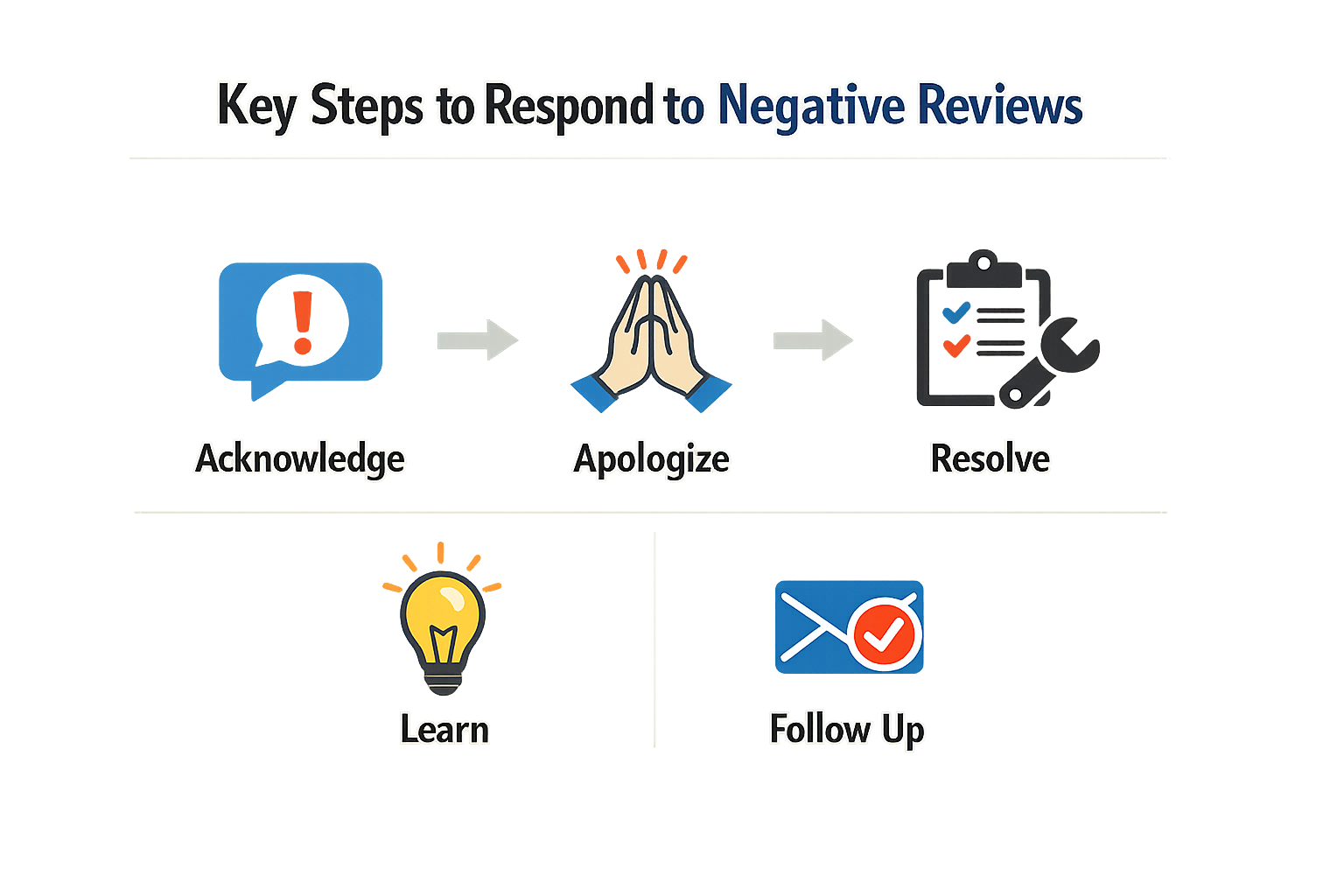
A structured approach to responding to negative reviews examples turns customer complaints into opportunities for relationship repair. The steps below outline a repeatable process that protects your reputation while addressing legitimate concerns.
What Are Responding to Negative Reviews Examples?
Responding to negative reviews examples are proven reply templates and frameworks that service businesses use to address customer complaints professionally. These examples demonstrate how to acknowledge issues, protect privacy, and offer resolution without creating additional liability. Effective responding to negative reviews examples follow platform policies, maintain a respectful tone, and convert criticism into trust-building opportunities.
The Core Response Process
Every negative review response follows the same framework: acknowledge the issue, address the specifics, and offer resolution without overpromising. This pattern works whether the complaint is justified or based on a misunderstanding.
Step 1
Read the review completely before responding
Review the complaint in full to identify the specific issue. Note whether the reviewer mentions names, dates, or service details that help you locate the transaction in your records. If the review is vague, you still respond — but your reply will focus on inviting private follow-up rather than addressing phantom details.
Step 2
Respond in a timely manner
Post your reply within 24 to 48 hours. Delayed responses signal that you either did not see the review or do not prioritize customer feedback. Timely replies demonstrate that you monitor your reputation channels and take concerns seriously.
Step 3
Personalize your reply
Address the reviewer by name if their profile displays one, and reference the specific service or issue they mentioned. A personalized response shows that you read their feedback rather than pasting a template. Sign off with your name or initials to reinforce that a real person is handling the complaint.
Step 4
Acknowledge mistakes without overcommitting
If your business made an error, state it plainly: "We missed the scheduled window" or "The technician should have called ahead." Do not take responsibility for conditions outside your control, such as weather delays or third-party vendor failures. Be honest about what you can fix and what you cannot.
Step 5
Protect privacy and avoid personal attacks
Never share the reviewer's contact information, account details, or any other private data in your public reply. If the situation requires discussing specifics, ask the reviewer to contact you directly via phone or email. Avoid defensive language or personal attacks, even when the review is unfair — your reply is visible to every future prospect reading your profile.
Step 6
Offer resolution or next steps
Provide a clear path forward: "Please call our office at [number] so we can schedule a follow-up visit" or "We've refunded the service charge to your original payment method." If you cannot resolve the issue immediately, explain what you will investigate and when the customer can expect an update.
Applying the Framework Across Review Platforms
These steps apply to Google Business Profile, Yelp, Facebook, and industry-specific review sites. Platform policies vary slightly — Google discourages promotional language in replies, while Yelp allows business owners to flag reviews that violate content guidelines — but the core response structure remains consistent.
When you follow this process, you create a public record that shows prospects how you handle problems. A well-crafted reply to a one-star review often carries more weight than a dozen five-star ratings, because it proves you fix mistakes instead of ignoring them. For teams managing multiple locations or high review volume, consider best practices for deploying AI web apps to streamline response workflows without losing the personal touch.
How Do You Craft Effective Review Responses?
Effective review management goes beyond responding to individual complaints. Service businesses that treat negative feedback as operational intelligence rather than reputation damage build stronger customer relationships and clearer internal processes. The following practices help you turn criticism into a systematic advantage.
Personalize Every Response
Address the reviewer by name and reference their specific concern. Generic thank-you messages signal that you're managing volume rather than listening to individuals. A personal sign-off with your name or initials reinforces that a real person reviewed their feedback and takes accountability for the experience.
Respond Quickly Without Rushing Quality
Timeliness shows commitment to service quality, but speed should never compromise the substance of your reply. A prompt response within 24–48 hours signals that you monitor feedback actively. If you need time to investigate the complaint, post an initial acknowledgment and follow up publicly once you have the full picture.
Protect Privacy and Avoid Defensiveness
Never share a reviewer's private information or engage in personal attacks. If the situation is complex or involves account details, politely request that the reviewer contact you via phone or email. Acknowledge mistakes when they occurred, but be honest about limitations outside your control—taking false responsibility creates liability and confuses future customers reading the thread.
Protect privacy and avoid personal attacks: Never share a reviewer's private information or engage in personal attacks.
Make Replies Count, Not Repetitive
Instead of sending the same "thank you" to everyone, focus on reviews where you can share a helpful update or answer a question. This shows prospective customers that you listen and adjust based on feedback. Avoid promotional language in responses—reviewers are already customers, so use the space to clarify what happened and what you've changed as a result.
Know When to Flag, Not Just Respond
If a review violates platform content policies, report it through the proper channel rather than responding publicly. Review evaluation typically takes several days. You can check the status of your report in the Reviews Management Tool. If a flagged review doesn't qualify for removal, you can submit a one-time appeal. Understanding content policies helps you distinguish between legitimate criticism and policy violations.
For service businesses managing multiple review platforms and customer touchpoints, integrating review monitoring into your broader operational workflow ensures no feedback goes unaddressed. Tools that centralize review alerts across Google, Yelp, and industry-specific directories reduce the risk of missing time-sensitive complaints. You can explore best practices for deploying AI web apps to see how automation fits into customer feedback systems without losing the personal touch that makes responses effective.
Conclusion
Negative reviews are not setbacks — they are structured feedback that tells you exactly where your service delivery diverges from customer expectations. The businesses that treat each critical review as a diagnostic tool rather than a reputation threat build stronger operations over time. When you respond promptly, acknowledge the specific issue, and outline what changed as a result, you demonstrate accountability that prospective customers value more than a perfect star rating.
The steps outlined in this guide — timely acknowledgment, personalized responses, privacy protection, and honest explanations of limitations — form a repeatable system that scales across your team. Assign clear ownership for review monitoring, document your response templates, and track patterns in customer complaints so you can address root causes instead of symptoms. A single well-handled negative review often converts a dissatisfied customer into a repeat client and shows dozens of silent observers that your business takes service seriously.
Proactive reputation management starts before the first negative review arrives. Build review solicitation into your service workflow, train every customer-facing team member on response protocols, and treat your Google Business Profile as a living asset that requires the same attention as your CRM or scheduling system. The businesses that get this right do not avoid criticism — they use it to refine their service model and communicate those improvements publicly.
Frequently asked questions
What should I include in a response to a negative review?
Include a personalized greeting using the reviewer's name, acknowledge the specific issue they raised, take responsibility for any legitimate mistakes, protect their privacy by avoiding account details, and offer a clear next step such as a phone number or email for private follow-up.
How quickly should I respond to negative reviews?
Respond within 24 to 48 hours. Prompt responses signal that you actively monitor feedback and prioritize customer concerns, which builds trust with both the original reviewer and prospective customers reading your profile.
Can I ask customers to remove negative reviews?
You can politely request a review update after resolving the issue, but never pressure customers or offer incentives in exchange for removal. Most platforms prohibit review manipulation, and such requests can backfire by appearing defensive or unethical.
Should I respond to fake or fraudulent reviews?
Report fraudulent reviews through the platform's official channels rather than engaging publicly. If the review does not violate platform policies and cannot be removed, post a brief, professional response stating that you have no record of the transaction and invite the reviewer to contact you privately with details.
What tone should I use when responding to angry reviews?
Maintain a calm, professional tone regardless of the reviewer's language. Acknowledge their frustration, avoid defensive or dismissive phrasing, and focus on what you can do to resolve the issue rather than debating who was at fault.
Related reading
Sources(7)
- Google Business Profile Help — Tips to get more reviews
- Google Maps — Prohibited and restricted content (user contributions policy)
- Google Maps review policy and Business Profile review guidance
- Local Service Business OS
- Google Business Profile Help — Guidelines for representing your business on Google
- Google Search Central — Local business (LocalBusiness) structured data
- Google Business Profile guidelines
Written by
Xenophon Giannis
Published October 18, 2026 · 13 min read
Xenophon Giannis is the founder and CEO of Xenco Labs, where he designs, builds, deploys and operates production AI software solo — on his own multi-node cluster, with his own LLM gateway and automation infrastructure. Twenty-five years in enterprise technology came first: a decade at AboveNet, hired as its first sales rep after bankruptcy and promoted until he ran the entire Western Pacific region, then sales leadership at Black Lotus and Nexusguard in DDoS mitigation. He writes about what he actually ships, and what actually breaks in production.
You Might Also Like
More from the Xenco Labs blog

How to Design a Request a Quote Form That Captures Qualified Jobs
Learn how to design a request a quote form that effectively captures qualified jobs and leads for your business with proven field strategies.

Speed to Lead: Lead Response Time for Service Businesses: Why Speed
Discover how lead response time impacts conversion rates for service businesses and learn proven strategies to improve your response speed. Speed to lead is crucial

General Contractor Website Design: Features for Winning Jobs
Learn the essential features of general contractor website design that help service businesses win jobs and attract clients effectively.

Landscaping SEO: SEO for Landscaping: How to Get Found Locally
Learn effective landscaping SEO strategies to enhance local visibility and attract customers to your landscaping business online.