
Choosing the Right Software Development Platform for Your Next Project
Choosing a software development platform is one of the most consequential decisions a technology leader makes. The platform you select shapes not only what you can build today, but what remains possible as your…
Introduction
Choosing a software development platform is one of the most consequential decisions a technology leader makes. The platform you select shapes not only what you can build today, but what remains possible as your organization grows and market demands shift. A platform that cannot adapt to changing workflows or scale with increasing complexity becomes a constraint rather than an enabler.
The challenge extends beyond feature checklists. The right software development platform must support your existing processes while providing room to evolve them. It must integrate with your current infrastructure without forcing wholesale replacement of working systems. Most critically, it must empower every role in your organization—from developers building custom applications to operations teams managing service delivery—to perform at their highest level.
Modern platforms are built to manage diverse workflows and support bespoke business processes. Project management software represents one category within the broader platform ecosystem, but the principles of selection apply across the spectrum. Whether you're building internal tools, customer-facing applications, or enterprise infrastructure, the platform decision cascades through every subsequent technical choice.
The stakes are high because platform migrations are expensive and disruptive. Organizations that choose poorly often find themselves locked into systems that cannot support their growth trajectory, forcing costly rewrites or painful transitions years later. Those that choose well gain a compounding advantage: each new capability builds on a stable foundation, and technical investments retain their value as requirements evolve.
This guide provides a structured approach to platform selection grounded in real-world implementation experience. The framework presented here helps you evaluate platforms against your actual operational needs, not just vendor marketing claims. By understanding what truly matters in a software development platform, you can make decisions that serve your organization for years rather than quarters.
Problem Statement
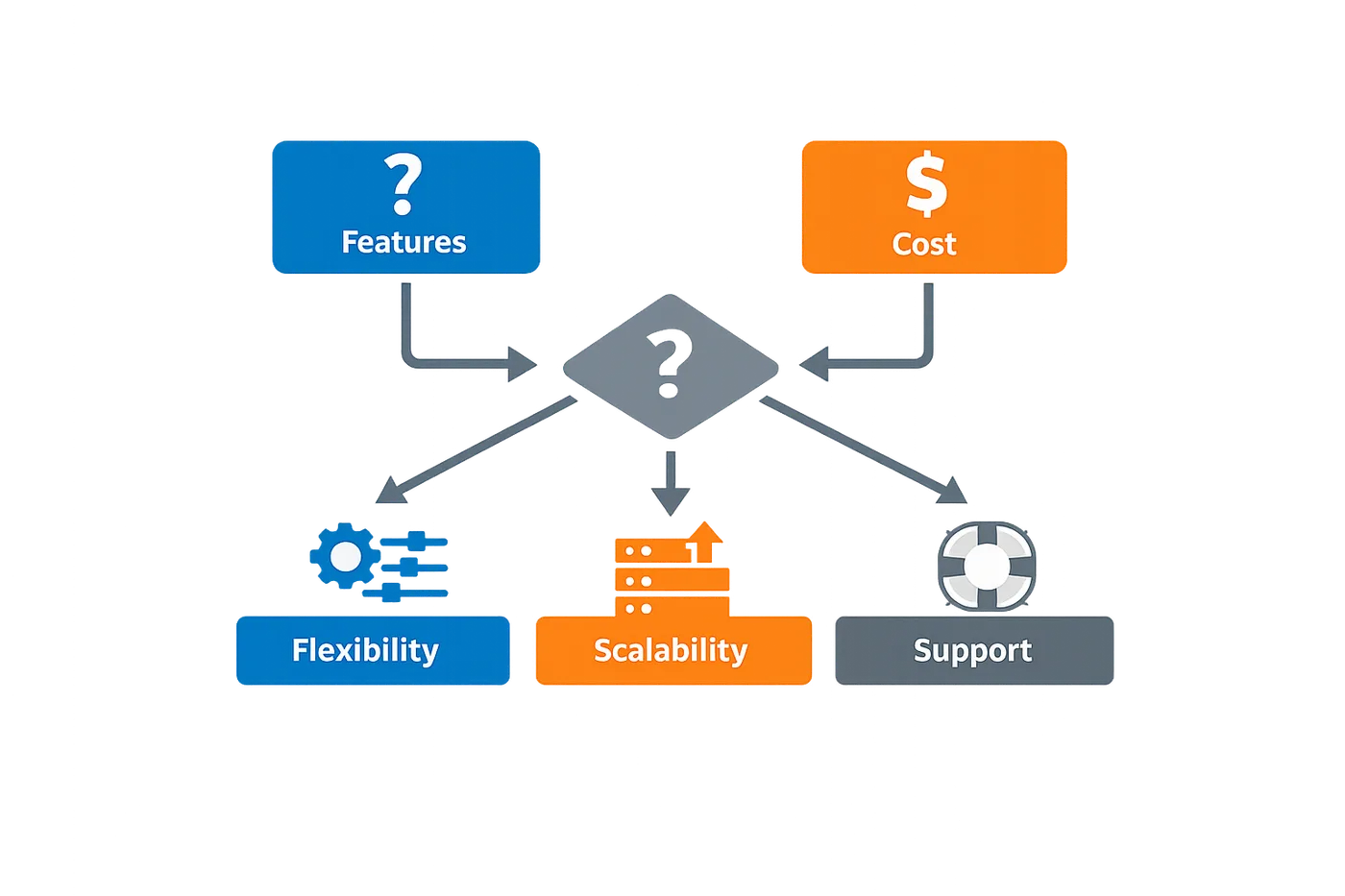
Choosing a software development platform is rarely straightforward. Organizations face a landscape crowded with options, each promising efficiency, scalability, and seamless integration. Yet beneath the marketing claims lies a harder truth: the wrong platform choice compounds over time, creating technical debt, workflow friction, and integration headaches that slow every subsequent project.
The challenge begins with misalignment between platform capabilities and actual project requirements. Teams often select tools based on popularity or vendor relationships rather than production stack compatibility. A platform that excels at rapid prototyping may lack the infrastructure to support enterprise-scale deployments. One optimized for mobile applications may impose unnecessary complexity on backend-focused projects. Without clear criteria tied to your specific workload, even well-intentioned decisions become expensive mistakes.
The Hidden Cost of Platform Mismatch
Platform selection errors surface in predictable patterns. Development velocity stalls when the chosen environment lacks native support for required frameworks or languages. Integration costs balloon when APIs don't align with existing systems. Operational overhead multiplies when the platform demands specialized skills your team doesn't possess or server resources that strain your infrastructure budget.
These problems intensify when platforms fail to account for non-functional requirements. Performance bottlenecks emerge under real-world load. Security gaps appear when compliance frameworks weren't considered upfront. Vendor lock-in becomes apparent only after significant investment, when switching costs feel prohibitive. The platform that seemed adequate during evaluation proves inadequate in production.
Evaluation Paralysis and Information Overload
The abundance of platform options creates its own problem. Teams spend weeks comparing feature matrices, reading reviews, and conducting proof-of-concept tests, yet still lack confidence in their choice. Technical documentation varies wildly in quality. Vendor claims about scalability, uptime, and support responsiveness prove difficult to verify independently.
Decision-makers struggle to weight competing factors. Should you prioritize developer experience over operational simplicity? Does a richer feature set justify higher licensing costs? When does customization flexibility become a maintenance burden? Without a structured framework for evaluation, teams either rush to judgment or delay indefinitely, both of which carry real costs.
The cheapest platform is rarely the one with the lowest license fee — it's the one that minimizes total cost of ownership across the project lifecycle.
Organizations also underestimate the importance of their production stack when evaluating platforms. A platform built on unfamiliar technologies introduces learning curves, hiring challenges, and dependency risks. Custom applications and internal tools built on a mismatched stack require more effort to maintain and extend. The platform decision shapes not just one project, but your team's technical trajectory for years.
Competing Stakeholder Priorities
Platform selection becomes political when different stakeholders have conflicting priorities. Developers want modern tooling and flexible APIs. Operations teams prioritize stability and ease of deployment. Finance focuses on licensing costs and contract terms. Security demands compliance certifications and audit trails. Product owners need speed to market. No single platform satisfies everyone equally.
This tension often results in compromise solutions that leave all parties partially dissatisfied. The platform chosen to keep peace internally may lack the decisive strengths needed to succeed externally. Without executive alignment on what matters most — and what tradeoffs are acceptable — platform selection devolves into negotiation rather than strategic decision-making.
The challenge isn't finding a perfect platform. It's identifying which imperfections your organization can tolerate and which will prove fatal to project success. That requires honest assessment of current capabilities, realistic projection of future needs, and willingness to prioritize ruthlessly among competing concerns.
Solution Steps for Choosing the Right Software Development Platform
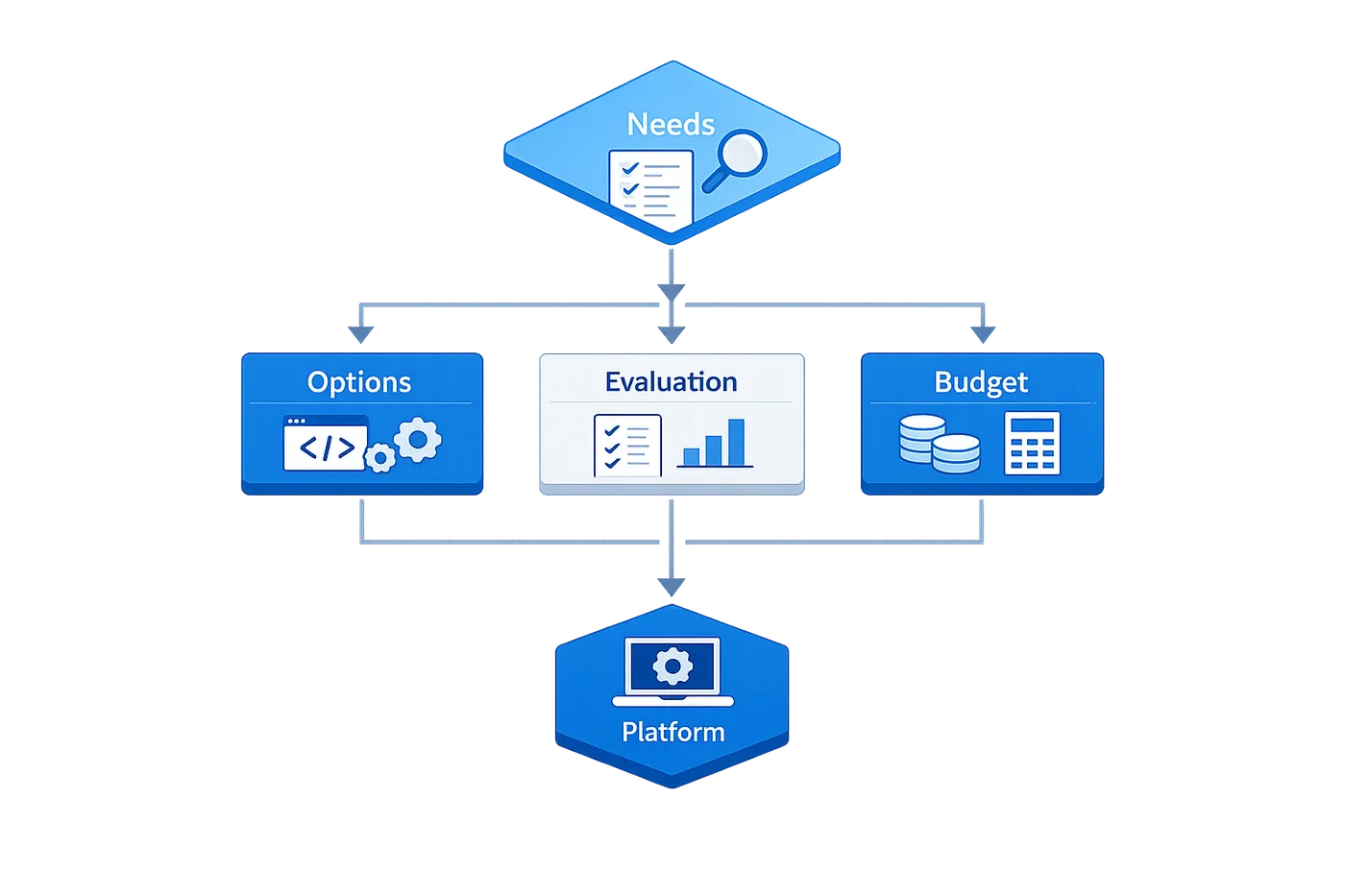
Selecting the right software development platform requires a structured approach that aligns technical capabilities with business objectives. The following steps provide a framework for evaluating platforms systematically, ensuring your choice supports both immediate project needs and long-term scalability.
Step 1: Measure Your Current State and Requirements
Before evaluating any platform, document what already exists in your technology stack and identify gaps. Start by measuring what already exists and prioritize the highest-value opportunities to ensure effective platform selection. Catalog your current tools, workflows, integrations, and pain points. This baseline assessment prevents redundant capabilities and reveals where a new platform must bridge critical gaps.
Step 1
Inventory existing systems
Create a comprehensive list of your current development tools, deployment infrastructure, collaboration platforms, and integration points. Note which systems are underutilized, which create friction, and which must remain in place due to regulatory or contractual requirements.
Step 2: Define Integration and Workflow Requirements
A platform's value extends beyond its core features to how well it connects with your broader ecosystem. Choosing a software development platform should consider the integration of multiple functionalities such as phone, web, estimating, contracts, field work, and payment in one journey. Map the complete workflow from initial customer contact through project delivery and payment collection.
Identify which third-party services must connect to your platform — version control, CI/CD pipelines, monitoring tools, customer communication channels, and financial systems. Test integration depth during evaluation: some platforms offer superficial connections that require manual data transfer, while others provide true bidirectional sync.
Step 3: Evaluate Customization and Workflow Alignment
Generic platforms that cannot adapt to your processes force you to change how your team works. Personalizing the software to support existing processes is essential, allowing users to easily configure the platform to align with their unique workflows. During evaluation, request demonstrations of workflow customization — not just configuration options, but how the platform handles exceptions, approval chains, and role-based permissions specific to your organization.
Step 2
Test workflow configuration
Provide vendors with a specific workflow scenario from your operation — including edge cases and approval requirements. Ask them to configure the platform to handle it without custom code. Platforms that require developer intervention for basic workflow changes will create ongoing dependencies.
For teams seeking comprehensive solutions that handle multiple aspects of project delivery, consider platforms designed for agile project management software tools for sprints and iterations that support iterative development cycles.
Step 4: Assess Automation and Efficiency Capabilities
Utilizing a platform that supports workflow automation and dashboards can enhance the efficiency of your project. Evaluate how the platform reduces manual tasks — automated testing, deployment pipelines, status updates, and reporting. Strong platforms provide pre-built automation templates while allowing custom logic for organization-specific processes.
| Capability | Basic Platform | Advanced Platform |
|---|---|---|
| Workflow automation | Manual triggers only | Event-driven with conditional logic |
| Dashboard customization | Fixed templates | Fully configurable with custom metrics |
| Reporting | Standard reports | Custom queries and scheduled exports |
| Integration automation | Manual data sync | Real-time bidirectional sync |
Request access to analytics and reporting capabilities during evaluation. Platforms should provide visibility into team velocity, bottlenecks, resource utilization, and project health without requiring manual data aggregation.
Step 5: Validate Scalability and Long-Term Viability
A platform that meets today's needs but cannot scale creates a future migration burden. Evaluate how the platform handles increased user counts, project complexity, data volume, and geographic distribution. Ask vendors for customer references at your target scale, not just your current size.
The right platform grows with your operation without requiring architectural rewrites or forced migrations when you cross arbitrary usage thresholds.
Assess the vendor's product roadmap, update frequency, and commitment to backward compatibility. Platforms with infrequent updates or a history of breaking changes create technical debt. Review the vendor's financial stability and market position — platforms from struggling vendors carry abandonment risk.
Step 6: Conduct Hands-On Evaluation with Real Scenarios
Paper evaluations and sales demonstrations rarely reveal how a platform performs under real conditions. Insist on trial periods where your team works with actual project data and workflows. Identify whether the platform's claimed capabilities translate to practical efficiency gains.
Step 3
Run a pilot project
Select a small but representative project to execute entirely within the candidate platform. Include all workflow stages, integrations, and user roles. Measure time spent on setup, daily operations, and common tasks compared to your current process.
Gather feedback from all user roles — developers, project managers, stakeholders, and administrators. A platform that delights developers but frustrates project managers creates adoption resistance. Document friction points, workarounds required, and features that exceeded expectations.
Tips and Tricks for a Successful Platform Selection
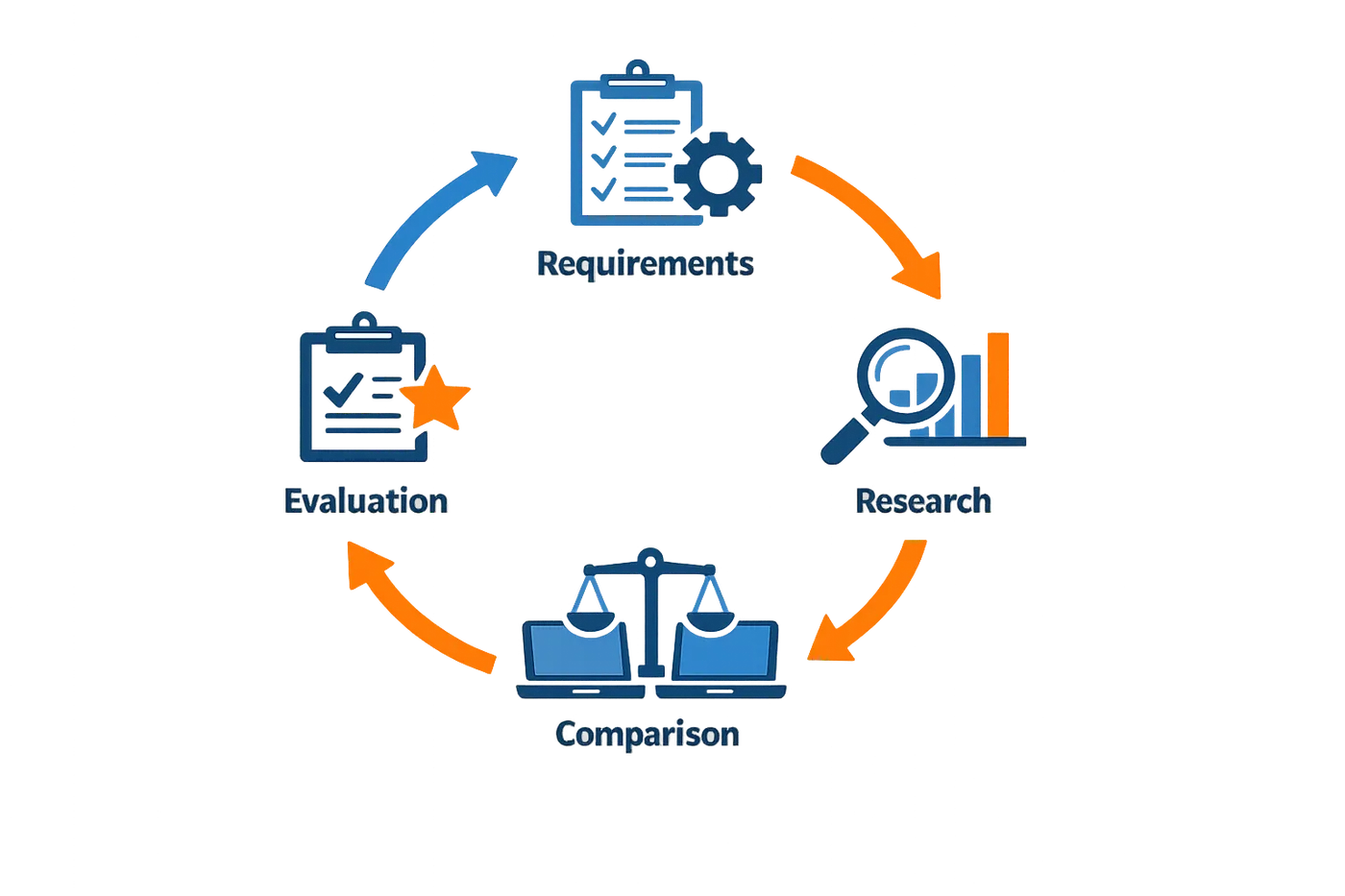
Selecting the right software development platform requires more than checking boxes on a feature list. The difference between a smooth implementation and a costly misstep often comes down to how thoroughly you evaluate quality, scalability, and real-world usability before committing.
Prioritize Human Review and Quality Assurance
Automation accelerates delivery, but quality demands human judgment. Every build should include a human review before launch to catch edge cases, validate business logic, and ensure the platform behaves as expected under real conditions. Automated testing catches regressions; human review catches what makes sense to users.
Platforms that emphasize quality assurance from the start reduce technical debt and post-launch firefighting. Look for vendors who treat review as a standard step, not an optional add-on.
Track Progress in Real Time
Visibility into project status prevents surprises. Platforms that support real-time progress tracking and resource allocation let teams identify bottlenecks early, adjust timelines proactively, and keep stakeholders informed without manual status meetings.
When evaluating platforms, test their dashboards with realistic data. Can you see where work is stalled? Can you reallocate resources without leaving the interface? If the answers are unclear during the demo, they'll be worse in production.
The best platform is the one that surfaces problems before they become crises.
Simplify Billing and Subscription Management
Revenue operations matter as much as development velocity. Platforms that integrate no-code subscription features—like automatic payment retries and reminder emails—reduce administrative overhead and improve cash flow predictability. Choose systems that let you configure billing logic without writing custom code or waiting on vendor support.
For teams managing recurring revenue, look for platforms that handle dunning, proration, and multi-currency billing natively. The fewer third-party integrations you need to maintain billing workflows, the lower your operational risk.
Build for People First
The platform you choose shapes the experience your users have with your product. Prioritize tools that encourage creating people-first content and interfaces—systems that make it easy to deliver value to end users rather than optimizing solely for internal metrics or search rankings.
Ask whether the platform supports clear documentation, intuitive navigation, and accessible design patterns. If your team struggles to explain how a feature works during the evaluation phase, your users will struggle even more after launch.
For teams managing cross-functional collaboration, intranet software with project management can centralize communication and reduce context-switching across tools.
Test with Real Scenarios Before Committing
Demos show the happy path; real projects encounter edge cases. Before finalizing your choice, run the platform through scenarios that mirror your actual workload: complex approval chains, high-concurrency operations, integration with legacy systems, and recovery from partial failures.
Document what breaks, what requires workarounds, and what the vendor's support team says is "coming in the next release." Those gaps are where your team will spend unplanned hours once the contract is signed.
Conclusion
Choosing the right software development platform isn't a one-time decision—it's a strategic investment that shapes how your team works, how your systems scale, and how quickly you can respond to changing business needs. Throughout this guide, we've covered the critical factors that separate platforms built for short-term convenience from those engineered for long-term adaptability. The platforms that succeed are the ones that align with your existing workflows, support your team's unique processes, and grow alongside your organization without forcing you into rigid constraints.
The most successful platform selections share a common trait: they prioritize people-first design over feature checklists. A platform that adapts to how your team actually works—rather than forcing your team to adapt to the platform—delivers measurable improvements in productivity, collaboration, and project outcomes. This means looking beyond surface-level capabilities and evaluating whether the platform can be configured to support your bespoke workflows, whether it provides the visibility your stakeholders need, and whether it scales without introducing complexity that slows your team down.
As you move forward with your selection process, remember that the right platform is one you can trust to evolve with your business. Revisit your requirements regularly, involve the people who will use the platform daily, and don't underestimate the value of platforms that offer transparent processes and clear documentation. For organizations managing complex projects across distributed teams, centralized collaboration tools can provide the integrated foundation that keeps everyone aligned and accountable.
Ultimately, thoughtful platform selection is about reducing friction, increasing transparency, and building systems that support the work your team needs to do. Take the time to evaluate thoroughly, involve the right stakeholders, and choose a platform that serves your team's needs first—the technology will follow.
Learn how to choose the right software development platforms for your next project with these expert tips and strategies.
Table of Contents
- Introduction — Introduce the importance of selecting the right software development platform.
- Problem Statement — Discuss the challenges faced when choosing a software development platform.
- Solution Steps for Choosing the Right Software Development Platform — Outline the steps to select the appropriate software development platform.
- Tips and Tricks for a Successful Platform Selection — Provide practical tips and best practices for selecting a platform.
- Conclusion — Summarize the key points and encourage thoughtful selection of software platforms.
- Table of Contents
Related reading
Written by
Xenophon Giannis
Published November 15, 2026 · 15 min read
Xenophon Giannis is the founder and CEO of Xenco Labs, where he designs, builds, deploys and operates production AI software solo — on his own multi-node cluster, with his own LLM gateway and automation infrastructure. Twenty-five years in enterprise technology came first: a decade at AboveNet, hired as its first sales rep after bankruptcy and promoted until he ran the entire Western Pacific region, then sales leadership at Black Lotus and Nexusguard in DDoS mitigation. He writes about what he actually ships, and what actually breaks in production.
You Might Also Like
More from the Xenco Labs blog

Rapid Application Development: When Speed Matters More Than Perfection

Understanding the Software Development Lifecycle for Better Project Planning

How Software Architecture Decisions Affect Long-Term Costs

How to Choose Custom Software Development Tools for Team Efficiency
Every development team faces the same tension: the promise of a new tool versus the reality of implementation. A platform that automates opportunity tracking or surfaces real-time project health can eliminate entire…