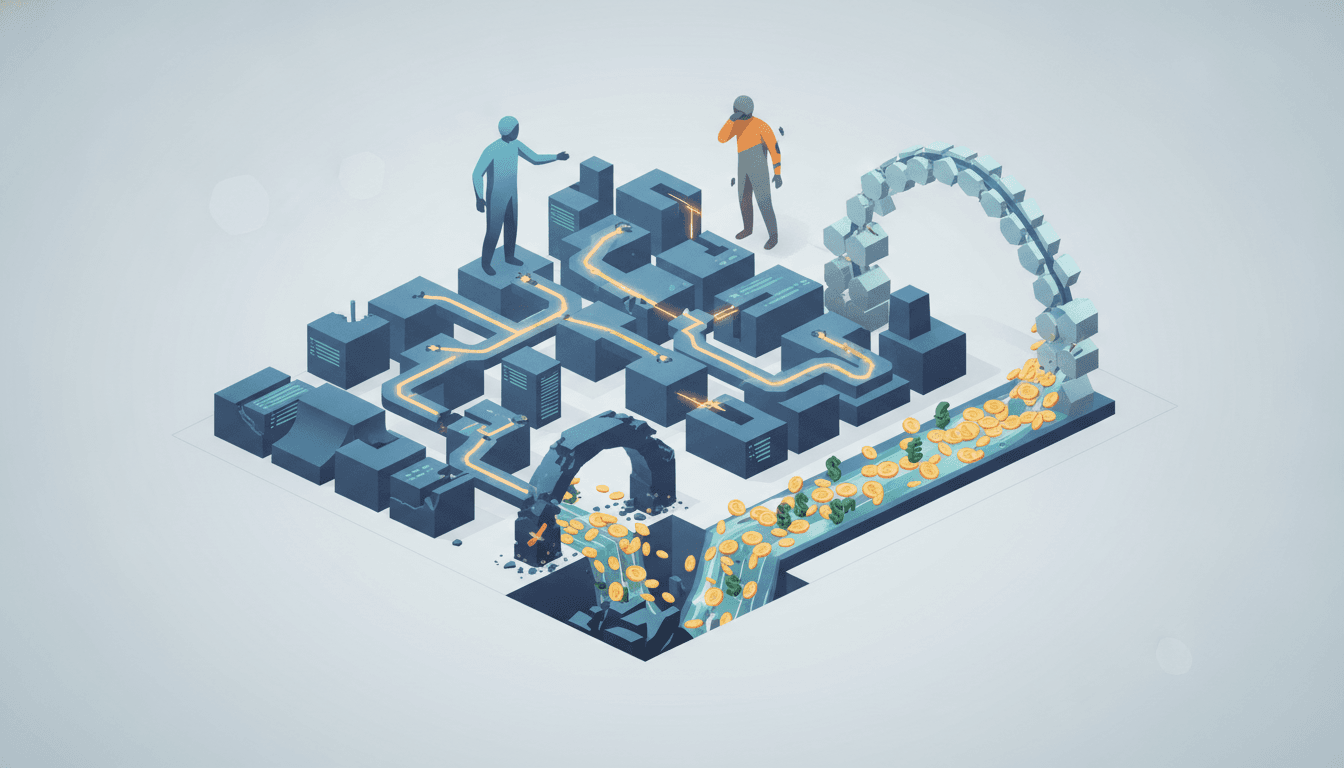
How Software Architecture Decisions Affect Long-Term Costs
Introduction
Every software architecture decision you make today sets the cost structure for everything that follows. The framework you choose, the data model you design, the integration patterns you establish—these choices don't just affect the initial build. They determine how quickly your team ships new features three years from now, how much you spend keeping the lights on, and whether you can pivot when the market demands it.
Most organizations discover the true cost of their architecture decisions long after the initial launch, when adding a simple feature requires touching dozens of files, when scaling to handle growth means rewriting core systems, or when a promising integration opportunity becomes technically impossible without starting over. At Xenco Labs, we've seen this pattern repeatedly: businesses that treat architecture as a one-time decision rather than an operating function end up paying the bill in slower development cycles, higher maintenance costs, and missed market opportunities.
The difference between architecture that compounds value and architecture that compounds cost comes down to how you approach the decision-making process. Organizations that establish a recurring operating cadence around architectural evaluation—measuring what exists, prioritizing based on actual business impact, and treating architecture as a continuous function rather than a project phase—build systems that get cheaper and faster to change over time. Those that don't find themselves trapped in technical debt, where every new requirement becomes more expensive than the last.
The goal is not to find the perfect architecture—it's to build a system that adapts as your understanding of the problem deepens and as your business evolves. That requires treating software architecture as an operating discipline, not a one-time design exercise. When you configure architecture around the business rather than forcing the business to adapt to rigid technical choices, you create systems that reduce long-term costs instead of accumulating them. The integrated approach to software development treats architecture as the foundation of an operating system for the entire business, where technical decisions directly enable or constrain business capabilities.
This article walks through how software architecture decisions create long-term cost impacts, the specific problems that arise from architectural missteps, and the practical steps you can take to make architecture decisions that reduce costs over time rather than multiplying them.
Problem Statement
When software architecture decisions are made without considering long-term consequences, the resulting technical debt compounds rapidly. Systems that appear functional at launch often reveal critical weaknesses under real operational load. The initial savings from cutting corners on architecture evaporate when teams spend months retrofitting foundational capabilities that should have been designed in from the start.
The Hidden Cost of Disconnected Systems
Many organizations assemble their technology stack from disconnected components, each purchased or built in isolation. The expensive part is not any single piece—it is connecting the business. Phone intake, estimate logic, calendar, contracts, job scope, documentation, customer records, recurring service, invoicing and follow-up all have to agree about the same customer and the same job. When these systems do not share a coherent architecture, every interaction becomes a manual handoff, every data point requires re-entry, and every process change demands updates in multiple places.
This fragmentation manifests in several costly ways. Customer data lives in one system while job history sits in another, forcing service teams to toggle between screens during support calls. Pricing logic exists in spreadsheets rather than integrated calculators, making it impossible to offer instant estimates. Approved scope fails to flow automatically into work orders, creating gaps where commitments get lost. The result is not just inefficiency—it is revenue leakage, customer frustration, and teams spending hours on work that proper architecture would handle automatically.
Scale Amplifies Architectural Mistakes
What works for ten customers per month breaks catastrophically at one hundred. Architectural choices that seem adequate during early growth lock organizations into patterns that cannot scale. Implementation timelines stretch from weeks to months as complexity multiplies. A system designed around manual approvals cannot suddenly support automated workflows. A database schema optimized for single-location operations cannot efficiently serve multi-site deployments without fundamental restructuring.
Consider the timeline variability in implementation: projects scoped for 2–4 weeks can extend indefinitely when service complexity, integrations and approval turnaround expose architectural gaps. Teams discover too late that their chosen approach requires custom development for basic features, or that vendor platforms lack the APIs needed to connect critical systems. The cost of these discoveries is not just delayed launch—it is the opportunity cost of markets entered late and the technical debt of workarounds built to compensate for poor foundational decisions.
The most expensive architectural decision is the one that forces you to rebuild when you should be scaling.
The Compounding Effect on Maintenance
Poorly architected systems demand constant attention. Every feature addition requires evaluating impact across loosely coupled components. Bug fixes in one area introduce regressions in another because shared state is managed inconsistently. Security updates cannot be applied cleanly because dependencies are tangled. Teams spend more time maintaining the architecture than building new capabilities, and the maintenance burden grows faster than the feature set.
This maintenance tax shows up in team velocity, deployment frequency, and incident response time. Organizations find themselves unable to respond to competitive threats because their architecture cannot accommodate rapid change. They watch newer entrants ship features in days that would take them months to implement. The gap between what the business needs and what the architecture can support becomes a strategic liability, and closing that gap requires either living with the constraints or undertaking expensive re-platforming efforts.
For organizations evaluating their current architecture, understanding how to choose custom software development tools for team efficiency provides a framework for identifying where architectural decisions support or hinder operational goals.
Solution Steps
Making software architecture decisions that minimize long-term costs requires a deliberate, staged approach. The goal is not to chase the cheapest option upfront, but to select a structure that reduces friction, compounds value over time, and keeps control where it matters. The steps below outline a practical framework for evaluating architecture choices against real operational constraints.
Step 1: Map the Full Journey Before Selecting Components
Step 1
Map the full journey before selecting components
Start by documenting the complete workflow your system must support — from the first customer touchpoint through final payment and record-keeping. Identify every handoff, approval gate, and data transformation. This map becomes the specification against which you evaluate architectural options. A system designed around disconnected tools will introduce costly integration work and ongoing maintenance; a system designed around the actual workflow reduces both.
When the architecture reflects how work actually moves through the business, fewer workarounds are needed later. The business owner retains approval where pricing, scope and customer commitments matter, ensuring that automation prepares and moves work without removing necessary judgment.
Step 2: Prioritize Recurring Operating Cadence Over One-Time Builds
Step 2
Prioritize recurring operating cadence over one-time builds
Establish a recurring operating cadence rather than relying on short bursts of development activity. The goal is not a single deployment, but a function that compounds. Architecture decisions should favor systems that support iterative improvement, monitoring, and adjustment. One-time builds often become technical debt; systems designed for continuous operation reduce the cost of change.
This approach ensures that the architecture remains aligned with evolving business needs, reducing the likelihood of expensive rewrites or parallel systems.
Step 3: Choose Integrated Workflows Over Disconnected SaaS Subscriptions
Step 3
Choose integrated workflows over disconnected SaaS subscriptions
Evaluate whether the architecture integrates core functions — estimating, scheduling, contracts, field work, invoicing — into a single workflow, or whether it stitches together separate SaaS products. Disconnected systems introduce hidden costs: data synchronization failures, duplicate entry, training overhead, and subscription sprawl. An integrated architecture reduces these friction points and lowers total cost of ownership.
For example, when approved scope flows directly into contracts, job tasks, completion records and invoicing without manual re-entry, the business eliminates both labor cost and error risk. The system is designed around the way the business actually works, not around a collection of independent tools.
Step 4: Retain Control Over Critical Decision Points
Step 4
Retain control over critical decision points
Ensure the architecture allows the business to retain approval authority over pricing, scope, and customer commitments. Automation should prepare and move work forward, but final decisions on matters that carry financial or reputational risk should remain with the owner or designated decision-maker. This balance reduces the cost of mistakes while capturing the efficiency gains of automation.
Architectures that remove human judgment entirely often require expensive rollback mechanisms or customer service interventions. Architectures that require manual approval at every step eliminate the efficiency benefit. The optimal design automates preparation and routing while preserving control at the points that matter.
Step 5: Validate Against a Live Reference Implementation
Step 5
Validate against a live reference implementation
Before committing to an architecture, evaluate whether a live reference implementation exists. A working system demonstrates that the architecture handles real-world complexity, not just theoretical requirements. It also reveals the true implementation timeline, integration challenges, and operational behavior under load.
For businesses evaluating field-service architectures, a live proof point reduces the risk of costly trial-and-error. When you can observe how a system performs in production — handling customer calls, generating estimates, managing field work, and processing payments — you gain confidence that the architecture will deliver the promised cost savings.
Implementing Software Architecture Decisions That Scale
Once you've completed the evaluation steps above, the implementation phase should follow a defined sequence: intake and scoping, configuration around your specific workflows, integration with existing systems, and deployment with a managed support cadence. Choosing the right software development platform for your next project ensures that the architecture you select can grow with your business without requiring expensive re-platforming.
The most cost-effective architectures are those that reduce the distance between customer intent and completed work, eliminate redundant data entry, and preserve decision authority where it creates the most value. When these principles guide your architecture decisions, long-term costs fall even as capability expands.
Tips and Tricks
Architecture decisions compound over time. A choice that saves three weeks today can add three months to every major feature next year. The teams that control long-term costs treat architecture as a continuous discipline, not a one-time blueprint.
Retain Control Over High-Impact Decisions
Automation should prepare the work, not remove oversight where it matters. The business owner retains approval where pricing, scope and customer commitments matter. Build guardrails that surface decisions to the right person at the right time, rather than routing everything through a single approval queue or pushing everything into unmonitored automation.
When components must agree about shared state — customer records, job scope, pricing — define one authoritative source for each entity and make every other system read from it. Synchronization logic that tries to keep five systems "eventually consistent" becomes the maintenance burden that never ends.
Design for Component Alignment
Various components such as phone intake, estimate logic, calendar, contracts, job scope, documentation, customer records, recurring service, invoicing, and follow-up must all align to effectively manage customer interactions and jobs. When these systems operate from independent data models, every schema change cascades into integration rewrites.
Step 1
Identify the authoritative system for each entity
For each shared concept — customer, job, appointment, invoice — choose one system that owns the canonical record. Mark it explicitly in architecture documentation, and configure dependent systems to pull from that source rather than maintaining parallel copies.
Step 2
Standardize identifiers across boundaries
Use the same customer ID, job ID and reference format in every system that touches a transaction. When one system calls a customer "account_id" and another calls it "client_ref," every integration becomes a translation layer that breaks when field names change.
Step 3
Limit the number of systems that write shared state
If three systems can all update a customer's contact information, you will spend the next five years reconciling conflicts and explaining why the invoice went to the wrong address. Let one system own writes; let the others request changes through a controlled interface.
Build Interfaces That Survive Replacement
No vendor survives forever. The CRM you choose today will be acquired, deprecated or outgrown within three to five years. Design integration points that isolate vendor-specific behavior behind a stable internal contract. When you replace the underlying system, the rest of the architecture continues working because the interface did not change.
For guidance on selecting platforms that support stable integration patterns, see Choosing the Right Software Development Platform for Your Next Project.
The expensive part is not the website. It is connecting the business.
Document the assumptions each integration makes about upstream and downstream systems. When you upgrade one component, that documentation tells you which other components expect the old behavior and will break silently if you do not update their configuration.
Measure Architecture Costs in Maintenance Hours
Track how much time the team spends adapting existing systems to new requirements versus building new features. When adaptation work consistently exceeds 40 percent of engineering capacity, the architecture is fighting you. Refactor the highest-friction integration points before they consume the entire roadmap.
Architecture decisions that feel elegant in a diagram often become expensive in operation. The system that requires the least code today is not always the system that requires the least maintenance tomorrow. Optimize for the work your team will actually do, not the work you wish they would do.
Conclusion
Software architecture decisions shape cost trajectories long after the initial commit. The choices you make today — monolith versus microservices, cloud-native versus hybrid, tightly coupled versus modular — determine whether your maintenance budget compounds or collapses under technical debt. Teams that treat architecture as a one-time event pay for it in perpetuity; teams that install a recurring operating cadence turn architecture into a compounding asset.
The evidence is clear: systems designed for adaptability cost less to change, and systems designed for observability cost less to diagnose. But adaptability and observability are not features you bolt on later — they are constraints you enforce from the first sprint. When architecture decisions are made without visibility into long-term operational load, the business inherits hidden liabilities that surface only when scale, regulation, or market pressure demands a response the system cannot deliver.
The goal is not a burst of activity. It is a function that compounds.
At Xenco Labs, we have seen the cost of deferred architecture decisions in every vertical — from field service platforms where a single monolithic deployment blocked regional expansion, to SaaS products where poorly scoped APIs forced complete rewrites to meet compliance timelines. The pattern is consistent: architecture debt accrues interest faster than feature debt, and the interest is paid in engineer-hours, incident response, and lost market windows.
The most effective architecture strategies are not the most sophisticated — they are the ones that align technical constraints with business priorities and install the feedback loops to detect misalignment early. Whether you are building a new product or refactoring a legacy system, the question is not whether architecture will impact long-term costs. The question is whether you have the operating cadence to measure, prioritize, and course-correct before the cost becomes structural.
For teams ready to move from reactive patching to strategic architecture, choosing the right software development platform is the first step toward a system that scales with intent rather than accident. The best architecture decision is the one you can defend in an incident review — and the one that never triggers the incident in the first place.
Written by
Xenophon Giannis
Published November 23, 2026 · 14 min read
Xenophon Giannis is the founder and CEO of Xenco Labs, where he designs, builds, deploys and operates production AI software solo — on his own multi-node cluster, with his own LLM gateway and automation infrastructure. Twenty-five years in enterprise technology came first: a decade at AboveNet, hired as its first sales rep after bankruptcy and promoted until he ran the entire Western Pacific region, then sales leadership at Black Lotus and Nexusguard in DDoS mitigation. He writes about what he actually ships, and what actually breaks in production.
You Might Also Like
More from the Xenco Labs blog

Rapid Application Development: When Speed Matters More Than Perfection

Understanding the Software Development Lifecycle for Better Project Planning

Choosing the Right Software Development Platform for Your Next Project
Choosing a software development platform is one of the most consequential decisions a technology leader makes. The platform you select shapes not only what you can build today, but what remains possible as your…

How to Choose Custom Software Development Tools for Team Efficiency
Every development team faces the same tension: the promise of a new tool versus the reality of implementation. A platform that automates opportunity tracking or surfaces real-time project health can eliminate entire…