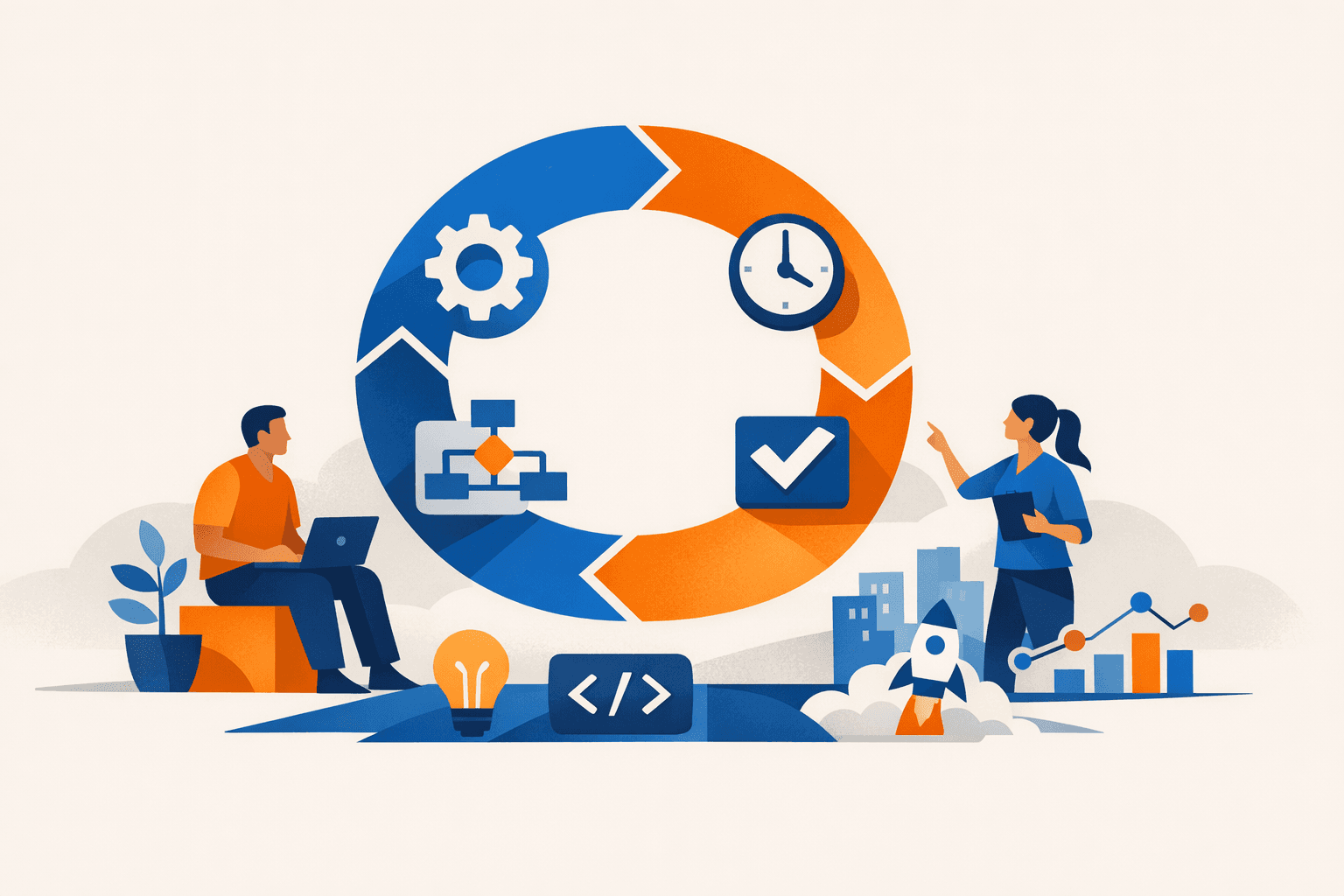
Understanding the Software Development Lifecycle for Better Project Planning
Introduction
Every software project starts with ambition and ends with reality. The distance between those two points determines whether your team delivers value or burns resources chasing moving targets. The software development lifecycle offers a systematic approach to closing that gap — not through rigid process for its own sake, but through deliberate structure that surfaces problems when they're still manageable.
Most project failures don't announce themselves with dramatic collapses. They accumulate through a thousand small decisions made without visibility: a requirement misunderstood in week two, a technical constraint discovered in month four, a testing phase compressed because no one planned for it. The software development lifecycle addresses this by breaking complex initiatives into distinct phases, each with clear objectives, deliverables, and transition criteria. When your team understands where they are in the lifecycle, they know what questions to ask, what risks to monitor, and what success looks like at each stage.
The value isn't in following a prescribed sequence — it's in establishing shared expectations. Development teams know when they can safely make architectural decisions. Stakeholders understand when they can influence scope and when changes carry exponential cost. Project managers gain the structure needed to forecast accurately and intervene early when trajectories shift. For organizations building custom software development tools for team efficiency, understanding the lifecycle becomes the foundation for choosing platforms and processes that support rather than constrain your methodology.
Why the Software Development Lifecycle Matters for Planning
Project planning without lifecycle awareness produces schedules that look reasonable on paper but fracture under contact with reality. Teams commit to timelines before understanding requirements. Budgets assume linear progress through non-linear work. Risk registers list generic concerns without connecting them to specific phases where those risks materialize.
The software development lifecycle provides the scaffolding that transforms wishful thinking into executable plans. It forces explicit conversations about what must happen before development begins, what can be parallelized, and what dependencies create critical paths. This structure doesn't eliminate uncertainty — it makes uncertainty visible early enough to address.
Organizations that integrate lifecycle thinking into their planning processes gain predictability without sacrificing adaptability. They build schedules that account for the reality that requirements evolve, that testing uncovers rework, and that deployment requires coordination beyond pushing code. They create budgets that fund the full journey, not just the development phase that generates visible output. Most importantly, they establish the measurement framework needed to learn from each project and improve the next one.
Problem Statement
Project teams routinely encounter predictable failures that stem from a common root: they begin building before they understand what the software development lifecycle requires at each stage. Without a structured approach, requirements drift, timelines expand, and stakeholders discover misalignments only after significant resources have been committed. The cost is not merely budget overrun — it is the compounding inefficiency of rework, scope creep, and team frustration.
The Visibility Gap
Most planning breakdowns occur because teams lack real-time insight into where work stands and what dependencies exist. When project phases are not clearly defined, tasks overlap unpredictably, and bottlenecks emerge without warning. Field verification becomes an afterthought rather than a planned checkpoint, leading to costly corrections late in the cycle. Confirming measurements and conditions from the field before proceeding with the job helps to align expectations and reduce disputes.
Workflow Fragmentation
Disconnected tools and manual handoffs create friction at every transition. Approved scope does not automatically flow into task lists, documentation lives in separate systems from the work itself, and follow-up depends on individual memory rather than systematic triggers. This fragmentation forces team members to spend more time coordinating than executing, and critical steps fall through the cracks when workload spikes.
The absence of a unified operating loop means that each project reinvents its own process. Teams waste cycles debating how to handle routine transitions — estimate to contract, contract to execution, execution to invoicing — because no standard workflow exists. The result is inconsistent quality, unpredictable delivery timelines, and a planning process that cannot scale beyond the capacity of a few key individuals.
Resource Allocation Failures
When project phases are not explicitly mapped, resource planning becomes guesswork. Teams overcommit during development while underestimating the effort required for testing and deployment. Skills are misaligned to tasks because no one has visibility into what each phase actually demands. The lack of structured checkpoints means that budget and schedule risks accumulate silently until they become crises.
The cheapest project is the one where every stakeholder knows what phase they are in, what gate they must pass, and what the next phase will require.
Without a clear lifecycle framework, even experienced teams struggle to answer basic questions: Are we ready to move from design to build? Have we validated requirements with the right stakeholders? What acceptance criteria must be met before we call this phase complete? These gaps do not reflect a lack of skill — they reflect the absence of a repeatable system that defines what "done" means at each stage.
Solution Steps
Implementing the software development lifecycle in your project planning requires a systematic approach that transforms abstract phases into actionable workflows. The following steps provide a practical framework for integrating lifecycle discipline into your planning process, moving from initial intelligence gathering through execution and continuous improvement.
Step 1: Establish the Intelligence Layer
Step 1
Build your baseline
Before you can plan effectively, you need to know what you're working with. Catalog your current technical assets, document existing workflows, and map dependencies between systems and teams. This baseline becomes your reference point for all subsequent planning decisions. Without it, you're estimating in a vacuum—scope creep and missed requirements become inevitable.
The intelligence layer isn't a one-time audit. It's the foundation that tells you where integration points exist, which components are stable, and where technical debt will constrain your timeline. Document what already works before you design what comes next.
Step 2: Convert Requirements into Structured Workflows
Once you understand your starting position, translate business requirements into development workflows with clear handoffs. Break large features into discrete tasks that move through defined stages: specification, design, implementation, testing, and deployment. Each stage should have entry criteria, exit criteria, and a responsible owner.
This structured approach prevents the common failure mode where requirements exist in one document, design in another, and implementation drifts from both. When scope flows into execution artifacts automatically, the project dashboard setup reflects reality rather than aspiration.
Step 3: Implement Validation Gates
Every transition between lifecycle phases needs a validation checkpoint. Before moving from design to implementation, verify that designs are complete, approved, and technically feasible. Before deployment, confirm that testing coverage meets your quality threshold and that rollback procedures are documented.
Gates aren't bureaucracy—they're the mechanism that prevents expensive rework. A missing requirement caught in design costs hours. The same requirement discovered in production costs weeks and damages credibility with stakeholders.
Step 3
Test before and after each transition
Validation isn't a single event at the end. Test architectural decisions before implementation begins. Test integration points before components are combined. Test deployment procedures in staging before production release. Each gate reduces the blast radius of errors and keeps the project moving forward rather than cycling through rework loops.
Step 4: Create Feedback Loops
The software development lifecycle isn't linear—it's iterative. Build feedback mechanisms that capture what's working and what isn't at every stage. Usage data, error rates, performance metrics, and stakeholder input should flow back into your planning queue continuously.
The goal is not a burst of activity. It is a function that compounds.
Feedback loops transform the lifecycle from a project management framework into an operating system. When deployment metrics automatically generate the next optimization queue, planning becomes responsive rather than speculative. Issues surface before they become crises, and improvements compound over time.
Step 5: Operate the Recurring Cadence
Once the structure is in place, the lifecycle becomes a repeating rhythm: plan, build, validate, deploy, measure, improve. Each cycle refines the intelligence layer, tightens the workflows, and strengthens the feedback loops. The cadence should be predictable enough that stakeholders know when to expect updates and teams know when decisions need to be made.
This operating cadence is what separates mature development organizations from those that lurch from crisis to crisis. When the lifecycle runs as a function rather than a project, capacity becomes predictable and quality becomes consistent.
Tips and Tricks
Successful software development lifecycle implementation requires more than following phases in sequence. Teams that consistently deliver on time and within budget apply practical techniques that align planning artifacts with operational reality. These tips address common friction points where theoretical process meets field execution.
Automate Scope-to-Execution Handoffs
Manual transcription between planning documents and work instructions creates version drift. When approved scope flows directly into task checklists, field teams execute what was actually sold rather than what someone remembers from a meeting three weeks ago. Rules-based calculators produce written estimates from your real rate card, ensuring pricing consistency across the entire lifecycle. The approved scope becomes an e-signable agreement with your terms, then automatically generates the job checklist so field work matches the signed contract.
Build Verification Gates Into Every Transition
Phase transitions are where scope creep enters and assumptions break. Confirm measurements, conditions, scope and pricing from the field before converting an estimate into a binding contract. Before-and-after media creates a job record that reduces disputes and provides objective evidence of completion criteria. Each gate forces explicit sign-off on deliverables before the next phase begins, turning implicit handoffs into documented checkpoints.
Step 1
Implement a pre-contract verification step
Schedule a field verification appointment between estimate approval and contract signing. Use this visit to confirm physical conditions, validate measurements, and adjust scope or pricing before the customer commits. Document findings in the estimate system so the contract reflects verified reality, not initial assumptions.
Step 2
Require completion documentation before invoicing
Block invoice generation until the job record includes required completion media and checklist sign-offs. This simple gate ensures you have the evidence you need if a customer disputes scope or quality, and it prevents premature billing for incomplete work.
Maintain a Single Source of Truth for Project State
Multiple tools with overlapping data create reconciliation overhead and version conflicts. When customer records, scheduling, contracts, task lists, and invoicing share a unified data model, changes propagate automatically instead of requiring manual synchronization. CRM and nurture workflows keep quote follow-up from depending on memory, while completion generates the final invoice and payment flow automatically. For teams managing complex service delivery, work order management software can centralize these workflows and eliminate the gaps between planning and execution.
The difference between a plan and an outcome is the quality of the handoff between each phase—automate the handoff and you automate the outcome.
Track What Actually Predicts Success
Vanity metrics feel productive but don't drive decisions. Track field tech events including work time and idle time to identify process bottlenecks. Monitor budgets versus actuals to catch cost overruns while you can still correct them. Measure the gap between estimated and actual task duration to improve future planning accuracy. Features that improved payroll satisfaction by 1.5 times indicate that employee experience metrics often correlate with delivery performance—teams that feel supported execute more reliably.
Conclusion
The software development lifecycle provides the structural foundation that transforms project planning from reactive firefighting into predictable execution. By establishing clear phases—from requirements gathering through deployment and maintenance—teams gain the visibility needed to allocate resources effectively, identify risks early, and deliver on schedule. Organizations that treat SDLC as an operating discipline rather than a documentation exercise consistently outperform those that approach development as an ad-hoc process.
The value of a structured lifecycle extends beyond individual projects. When development phases become repeatable and measurable, planning becomes more accurate, stakeholder communication improves, and technical debt decreases. Teams can forecast timelines with confidence, surface bottlenecks before they cascade, and build the institutional knowledge that compounds across releases. The lifecycle doesn't eliminate complexity—it makes complexity manageable.
For teams ready to implement these principles across their development operations, choosing the right software development platform provides the tooling foundation that supports lifecycle discipline at scale. The platform should reinforce the phases you've defined, not force you to adapt your process to its constraints.
Project planning improves when the software development lifecycle becomes the shared language between business stakeholders, product owners, and engineering teams. The phases create checkpoints where everyone validates assumptions, confirms priorities, and commits to the next stage with full context. This alignment—more than any individual phase—is what turns the lifecycle from a framework into a competitive advantage.
Written by
Xenophon Giannis
Published November 24, 2026 · 12 min read
Xenophon Giannis is the founder and CEO of Xenco Labs, where he designs, builds, deploys and operates production AI software solo — on his own multi-node cluster, with his own LLM gateway and automation infrastructure. Twenty-five years in enterprise technology came first: a decade at AboveNet, hired as its first sales rep after bankruptcy and promoted until he ran the entire Western Pacific region, then sales leadership at Black Lotus and Nexusguard in DDoS mitigation. He writes about what he actually ships, and what actually breaks in production.
You Might Also Like
More from the Xenco Labs blog

Rapid Application Development: When Speed Matters More Than Perfection
How Software Architecture Decisions Affect Long-Term Costs

Choosing the Right Software Development Platform for Your Next Project
Choosing a software development platform is one of the most consequential decisions a technology leader makes. The platform you select shapes not only what you can build today, but what remains possible as your…

How to Choose Custom Software Development Tools for Team Efficiency
Every development team faces the same tension: the promise of a new tool versus the reality of implementation. A platform that automates opportunity tracking or surfaces real-time project health can eliminate entire…