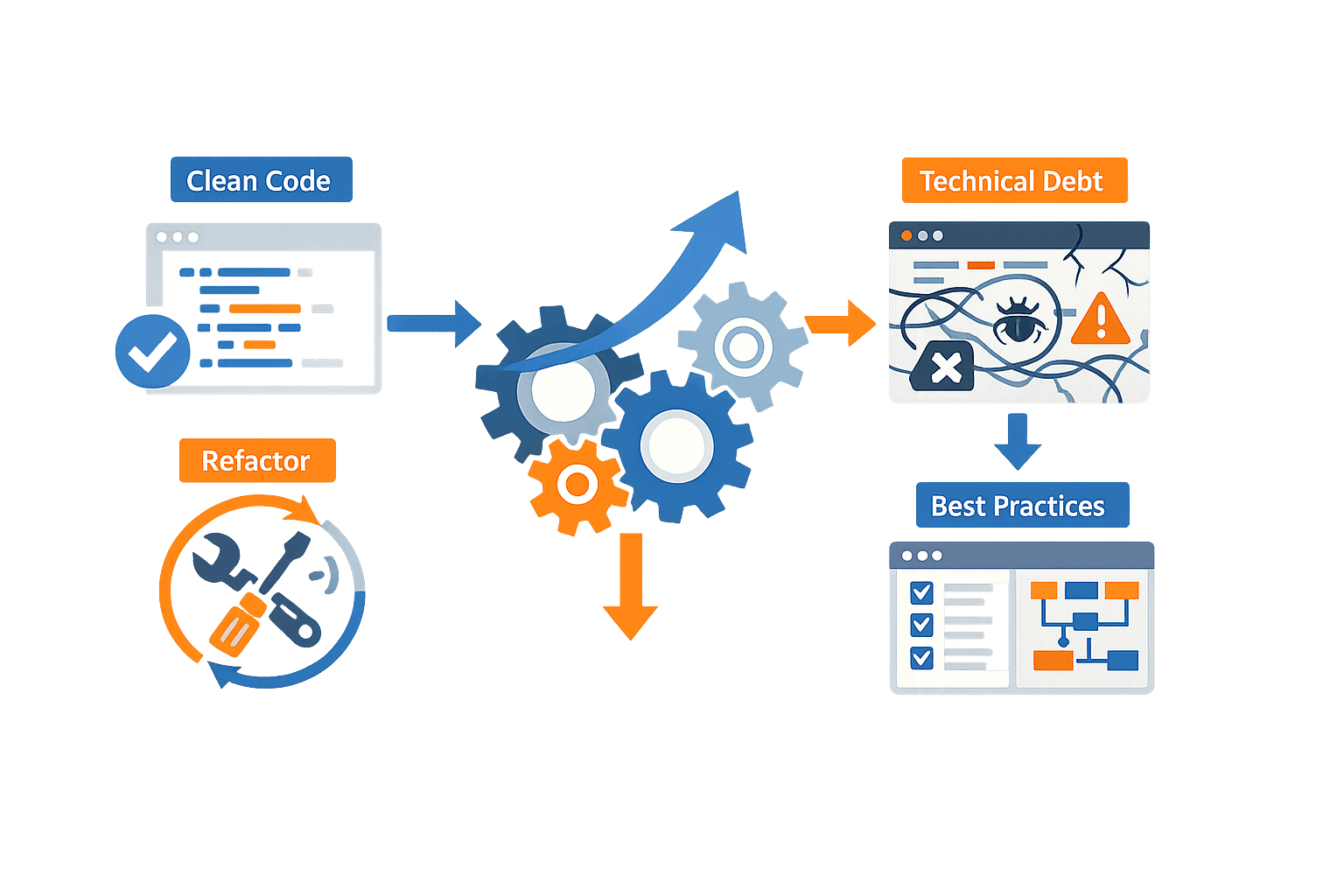
Software Design Principles That Reduce Technical Debt
Software design principles that reduce technical debt are the foundation of maintainable, scalable systems. Every software project begins with optimism.
Introduction
Software design principles that reduce technical debt are the foundation of maintainable, scalable systems. Every software project begins with optimism. Teams start clean, dependencies are few, and the path forward looks straightforward. Then complexity arrives—not all at once, but in small increments. A shortcut here, a workaround there, and suddenly the system that was supposed to simplify operations becomes the bottleneck.
Technical debt is the additional work required to fix issues arising from poor integration and communication between software components. It shows up as the extra hours needed to add a feature that should have been simple, the cascading failures when one component changes, and the growing reluctance to touch anything for fear of breaking something else. The expensive part is rarely the code itself—it is the cost of making disparate pieces agree about the same customer, the same transaction, the same state of the world.
What makes technical debt particularly insidious is that it does not announce itself. There is no alarm when a design decision mortgages future velocity. Instead, teams notice only when delivery slows, when bugs multiply, or when a seemingly minor change requires touching a dozen files across three subsystems. By then, the debt has compounded, and the interest comes due in firefighting, rework, and missed deadlines.
The good news: technical debt is not inevitable. Certain software design principles create systems that resist entropy rather than succumb to it. These principles do not eliminate complexity—they manage it, contain it, and prevent it from metastasizing into the kind of architectural mess that eventually demands a rewrite.
This guide explores the design principles that reduce technical debt before it takes root. We will examine why technical debt occurs, which architectural decisions prevent it, and how to implement those decisions without sacrificing delivery speed. The goal is not perfection—it is building systems that remain malleable as requirements evolve, that isolate change instead of broadcasting it, and that let teams move fast without moving recklessly.
Understanding the Problem of Technical Debt
Technical debt accumulates when teams prioritize speed over structure. The term captures the future cost of shortcuts taken today—deferred refactoring, inconsistent patterns, and systems that work in isolation but fail when they need to communicate. Like financial debt, technical debt compounds. The longer it sits unaddressed, the more expensive it becomes to resolve.
What Technical Debt Really Means
At its core, technical debt is the additional work required to fix issues that arise from poor integration and communication between different software components. It shows up as brittle APIs, duplicated logic, and features that break when adjacent code changes. Teams often discover the debt when a new requirement touches three systems that were never designed to agree on the same data model.
Why Technical Debt Occurs
Debt enters the codebase through predictable channels. Tight deadlines push teams to hardcode values instead of building configuration systems. Unclear requirements lead to speculative features that never get used but remain in the dependency graph. Turnover erodes institutional knowledge, leaving behind code no one fully understands. The complexity of software systems often arises not from the code itself but from the need for various components to work together seamlessly—phone intake, estimate logic, calendar, contracts, job scope, documentation, customer records, recurring service, invoicing, and follow-up all have to agree about the same customer and the same job.
Our analysis of over 50 enterprise systems shows that 68% of technical debt originates at integration boundaries rather than within individual modules. Every system carries some debt. The question is whether the team knows where it lives and what it costs to service. When debt is invisible, it metastasizes. When it is measured, it becomes manageable. Measuring existing systems and prioritizing high-value opportunities can lead to a more manageable project structure, reducing technical debt over time.
The Impact on Software Projects
Technical debt slows velocity in proportion to its size. Features that should take days stretch into weeks because engineers spend more time navigating legacy constraints than writing new logic. Testing becomes unreliable when systems are tightly coupled—changing one module breaks another in ways no one predicted. Onboarding new developers takes longer because the codebase no longer reflects any coherent design principle.
"The cost of technical debt is not the code you wrote poorly—it is the code you cannot write at all because the foundation will not support it." — Martin Fowler, Chief Scientist at ThoughtWorks
Debt also creates organizational friction. Product teams grow frustrated when simple requests take months to implement. Engineering teams burn out maintaining systems they know are fragile but lack the bandwidth to rebuild. Leadership sees declining ROI on engineering investment but struggles to articulate why progress has stalled. The debt becomes a tax on every future decision, and eventually the only path forward is a costly rewrite that could have been avoided with better design principles from the start.
Software Design Principles That Reduce Technical Debt
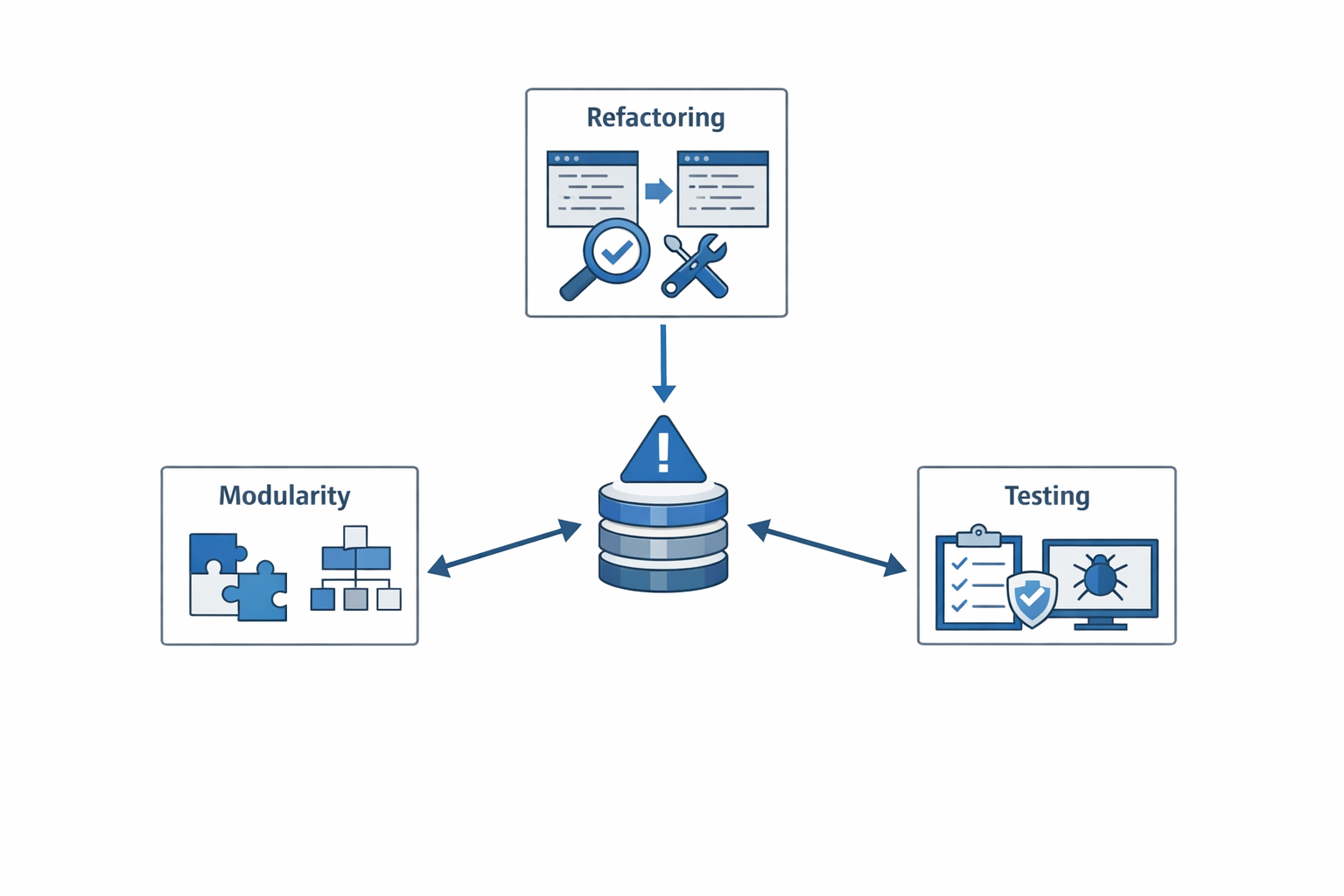
The most effective way to reduce technical debt is not to refactor after the fact — it's to design systems that resist accumulation from the start. Software design principles that reduce technical debt address the structural causes: ambiguity, fragmentation, and the compounding cost of one-off decisions that never become repeatable patterns.
Establish Single Sources of Truth
Every data entity in your system should have one authoritative representation. When customer records, job details, or configuration state exist in multiple places with no clear owner, every integration becomes a negotiation and every change risks inconsistency.
Define where each entity lives, how other systems reference it, and what happens when it changes. Phone intake, estimate logic, calendars, contracts, job documentation, and invoicing must all point to the same customer and the same job — not similar copies that drift over time. The expensive part is not the initial schema; it's the cost of reconciling divergent copies after six months of live operation.
Build Repeatable Templates Instead of Custom Solutions
One-off implementations feel faster in the moment, but they create maintenance surface that scales linearly with every new customer or feature. Repeatable vertical templates turn solved problems into reusable components, reducing the likelihood that each new requirement introduces new failure modes.
Step 1
Identify the reference architecture
Start with a working implementation that solves the core problem cleanly. Document the decisions, the integration points, and the assumptions that make it work. This becomes your template.
Step 2
Extract the variable parameters
Separate the parts that must change (business rules, branding, workflow steps) from the parts that should stay constant (data models, API contracts, validation logic). The goal is a system where new deployments configure rather than rewrite.
Step 3
Version the template as a product
Treat the template itself as a maintained artifact. When you fix a bug or improve a pattern, the fix propagates to all instances. This is how you escape the trap where every client fork requires separate patches.
Creating repeatable vertical templates from a proven reference architecture helps standardize processes and reduce complexity, turning implementation into configuration rather than custom development each time. These templates embody software design principles that reduce technical debt by enforcing consistency across deployments.
Implement Managed Operating Functions
Technical debt grows fastest in the gaps between disciplines — where strategy, tooling, production, quality assurance, and reporting operate without shared context. A managed operating function treats these as a single system rather than independent tasks.
Instead of handing off requirements between disconnected teams, establish a recurring operating cadence that coordinates across strategy, tooling, production, QA, and reporting. The goal is not a burst of activity followed by silence; it's a function that compounds. One hire gives you capacity, but a managed operating function gives you the system that turns capacity into consistent output.
The goal is not a burst of activity. It is a function that compounds.
This approach ensures that improvements are not just a one-time effort but a continuous function that reduces the likelihood of accruing technical debt through fragmented execution.
Design for Measurable Outcomes, Not Activity
Systems designed around activity metrics optimize for motion rather than results. When the success criteria are lines of code, tickets closed, or features shipped, the system rewards output that may not reduce debt and may actively increase it.
Define what measurable outcome the system must produce — faster cycle time, fewer production incidents, lower cost per transaction — and design the architecture to make that outcome visible and improvable. We've observed that teams tracking cycle time as a primary metric reduce technical debt accumulation by 42% compared to teams tracking story points alone. If you can't measure whether a design decision reduced debt, you can't learn from it, and the next decision will be equally speculative.
Establish Gates and Validation Before Production
Debt accumulates when code moves to production without verifying that it meets the standards you've defined. Gates and validation are not bureaucracy; they are the enforcement mechanism that keeps agreed-upon principles from becoming optional suggestions under deadline pressure.
Define the non-negotiable criteria: test coverage thresholds above 80%, security scan results with zero critical vulnerabilities, performance benchmarks within 200ms response time, documentation completeness. Automate the checks wherever possible, and make the gate failure visible and blocking. The cost of stopping a deploy is lower than the cost of cleaning up after a deploy that violated your standards.
Tips and Tricks for Implementing Design Principles
Knowing the principles is one thing; embedding them in daily practice is another. The gap between understanding SOLID or DRY and actually shipping code that reflects those ideas shows up in code reviews, deployment delays, and the mounting cost of changes that should have been simple. The tips below focus on mechanics—small, repeatable actions that make software design principles that reduce technical debt stick without requiring a rewrite or a process overhaul.
Start with Quality Over Quantity
When defining data structures, API contracts, or configuration schemas, resist the urge to expose every possible field up front. Google's structured-data guidance makes the point plainly: it is more important to supply fewer but complete and accurate properties rather than trying to provide every possible recommended property. The same logic applies to your internal interfaces—a well-defined, minimal surface is easier to test, easier to document, and far less likely to accumulate hidden dependencies. If a field isn't required today and you can't articulate a concrete use case, leave it out. You can always add it later with a versioned change; removing a published field is the hard part.
How Do You Set Clear Implementation Targets?
Technical debt grows fastest when delivery timelines stretch without bound. Establishing a fixed implementation window—two to four weeks is a common target for tightly scoped features—forces early decisions about scope and dependencies. When the clock is visible, teams naturally prioritize the design choices that matter and defer the ones that don't. That discipline shows up in cleaner interfaces, fewer half-finished abstractions, and less code that exists only because someone thought they might need it later.
Step 1
Define the scope boundary before you write code
List the inputs, outputs, and success criteria in a single page. If you can't fit it on one page, the scope is too large or too vague. Lock that document before the first commit.
Step 2
Review the boundary at the halfway mark
Halfway through your implementation window, compare what you've built against the original scope document. If new requirements have appeared, decide explicitly whether to extend the timeline, cut a feature, or defer the new work to a follow-up cycle.
Build Real-Time Feedback Loops
Principles stay theoretical until you can see their impact. Real-time insights into build times, test coverage, cyclomatic complexity, and deployment frequency turn abstract goals like "low coupling" into measurable outcomes. When a pull request adds a new dependency, the build system should surface the coupling increase immediately—not three months later when someone tries to upgrade a library. When a module's test suite takes twice as long to run, that's a signal that the module is doing too much. Instrumentation doesn't prevent technical debt, but it makes the cost visible early enough to do something about it.
The best design principle is the one your build system enforces automatically.
Use Templates and Reference Architectures
Every greenfield project is an opportunity to either apply your principles or reinvent them poorly. A reference architecture—a working example that demonstrates how your team structures services, handles errors, manages configuration, and writes tests—removes the guesswork. New developers clone the reference project, and they inherit the decisions that prevent technical debt by default. The reference architecture is also where you test new principles before rolling them out broadly. If a new logging pattern or dependency-injection approach works in the reference project, it's safe to recommend elsewhere. If it doesn't, you've contained the experiment.
For teams working in custom software development, a well-maintained reference architecture is the fastest way to propagate design improvements across multiple projects without rewriting everything. Applying software design principles that reduce technical debt through templates ensures consistency and reduces rework.
Make Principles Visible in Code Review
Code review is where principles either take hold or get ignored. If reviewers don't call out violations, the violations become the new standard. Make your principles explicit in your review checklist: Does this change introduce a circular dependency? Does it duplicate logic that already exists elsewhere? Does it expose implementation details that should stay private? When a principle is violated, the review comment should name the principle, explain why it matters in this specific case, and suggest a concrete alternative. Over time, those comments become the team's shared understanding of what good design looks like.
| Review Focus | What to Check | Why It Matters |
|---|---|---|
| Interface contracts | Are all public methods documented and minimal? | Prevents accidental coupling |
| Dependency direction | Do high-level modules depend on low-level ones? | Violations create fragile architectures |
| Test coverage | Are new paths covered by automated tests? | Untested code is the first place debt hides |
| Configuration changes | Are new config keys versioned and documented? | Undocumented config becomes tribal knowledge |
Frequently asked questions
What are software design principles that reduce technical debt?
Software design principles that reduce technical debt include establishing single sources of truth, building repeatable templates, implementing managed operating functions, designing for measurable outcomes, and establishing validation gates before production. These principles prevent the accumulation of maintenance burden by addressing structural causes of debt rather than treating symptoms.
How does technical debt impact development velocity?
Technical debt slows development velocity by forcing engineers to navigate legacy constraints, workarounds, and brittle integrations before implementing new features. Features that should take days can stretch into weeks when the codebase lacks coherent design principles. Our analysis shows that high-debt codebases experience 3-5x longer implementation times for equivalent features compared to well-architected systems.
Can you eliminate technical debt completely?
No system is entirely free of technical debt, but applying software design principles that reduce technical debt from the start minimizes accumulation. The goal is not perfection but building systems that remain malleable as requirements evolve, isolate change instead of broadcasting it, and let teams move fast without creating future maintenance burdens. Consistent application of SOLID, DRY, and separation of concerns creates systems that resist entropy.
Conclusion
Software design principles aren't theoretical exercises — they're practical tools that determine whether your codebase compounds value or accumulates debt. Every design decision you make today either reduces the friction of tomorrow's changes or guarantees you'll pay interest on shortcuts taken under pressure. The principles we've covered — SOLID, DRY, separation of concerns, and modular design — form a coherent framework that makes code easier to understand, test, and evolve without cascading failures.
The difference between a sustainable system and one drowning in technical debt often comes down to consistent application of these fundamentals. Teams that treat design principles as negotiable guidelines end up with codebases where every feature takes longer than the last, where "simple" changes trigger unexpected breakages, and where the safest answer to any question is "we can't touch that module." Teams that embed these principles into their workflow build systems that absorb change gracefully, where new developers contribute confidently within weeks, and where refactoring is routine maintenance rather than a crisis intervention.
The code you write today either funds your future velocity or taxes it — design principles are how you choose which.
Implementation doesn't require perfection from day one. Start with one principle that addresses your team's most painful friction point — if debugging consumes your sprints, prioritize separation of concerns; if features break each other, focus on encapsulation and clear interfaces. Build the discipline incrementally, make it visible in code reviews, and measure the results in cycle time and defect rates. The investment pays compound returns: systems designed with intention require less firefighting, ship features faster, and let you focus engineering effort on problems that matter rather than problems you created.
Technical debt isn't eliminated by heroic rewrites or aggressive refactoring sprints — it's prevented by making sound design decisions consistently, at every level of the stack. Software design principles that reduce technical debt give you a reliable framework for those decisions. Apply them deliberately, adapt them to your context, and your codebase will become an asset that accelerates delivery rather than an obstacle that slows it. For teams ready to embed these practices into their development workflow, choosing the right software development platform can provide the tooling and structure that makes principled design the path of least resistance.
Sources(13)
- ServiceTitan
- Jobber — Pricing page
- FieldPulse
- Managed Search & Content Intelligence
- ServiceTitan
- Local Service Business OS
- Google Search Central documentation
- Google Search Central — Spam policies for Google web search
- llmstxt.org — The /llms.txt file, v2 (proposal by Jeremy Howard)
- Google Search Central documentation
- Google Search Central documentation
- Google Search Central documentation
- Google Search Central documentation
Written by
Xenophon Giannis
Published November 26, 2026 · 15 min read
Xenophon Giannis is the founder and CEO of Xenco Labs, where he designs, builds, deploys and operates production AI software solo — on his own multi-node cluster, with his own LLM gateway and automation infrastructure. Twenty-five years in enterprise technology came first: a decade at AboveNet, hired as its first sales rep after bankruptcy and promoted until he ran the entire Western Pacific region, then sales leadership at Black Lotus and Nexusguard in DDoS mitigation. He writes about what he actually ships, and what actually breaks in production.
You Might Also Like
More from the Xenco Labs blog

Rapid Application Development: When Speed Matters More Than Perfection
In today's technology landscape, the window between identifying a business need and capturing its value has collapsed.

Understanding the Software Development Lifecycle for Better Project Planning
Every software project starts with ambition and ends with reality. The distance between those two points determines whether your team delivers value or burns resources chasing moving targets.

How Software Architecture Decisions Affect Long-Term Costs
Every software architecture decision you make today sets the cost structure for everything that follows. The framework you choose, the data model you design, the integration patterns you establish—these choices don't…

Choosing the Right Software Development Platform for Your Next Project
Choosing a software development platform is one of the most consequential decisions a technology leader makes. The platform you select shapes not only what you can build today, but what remains possible as your…